
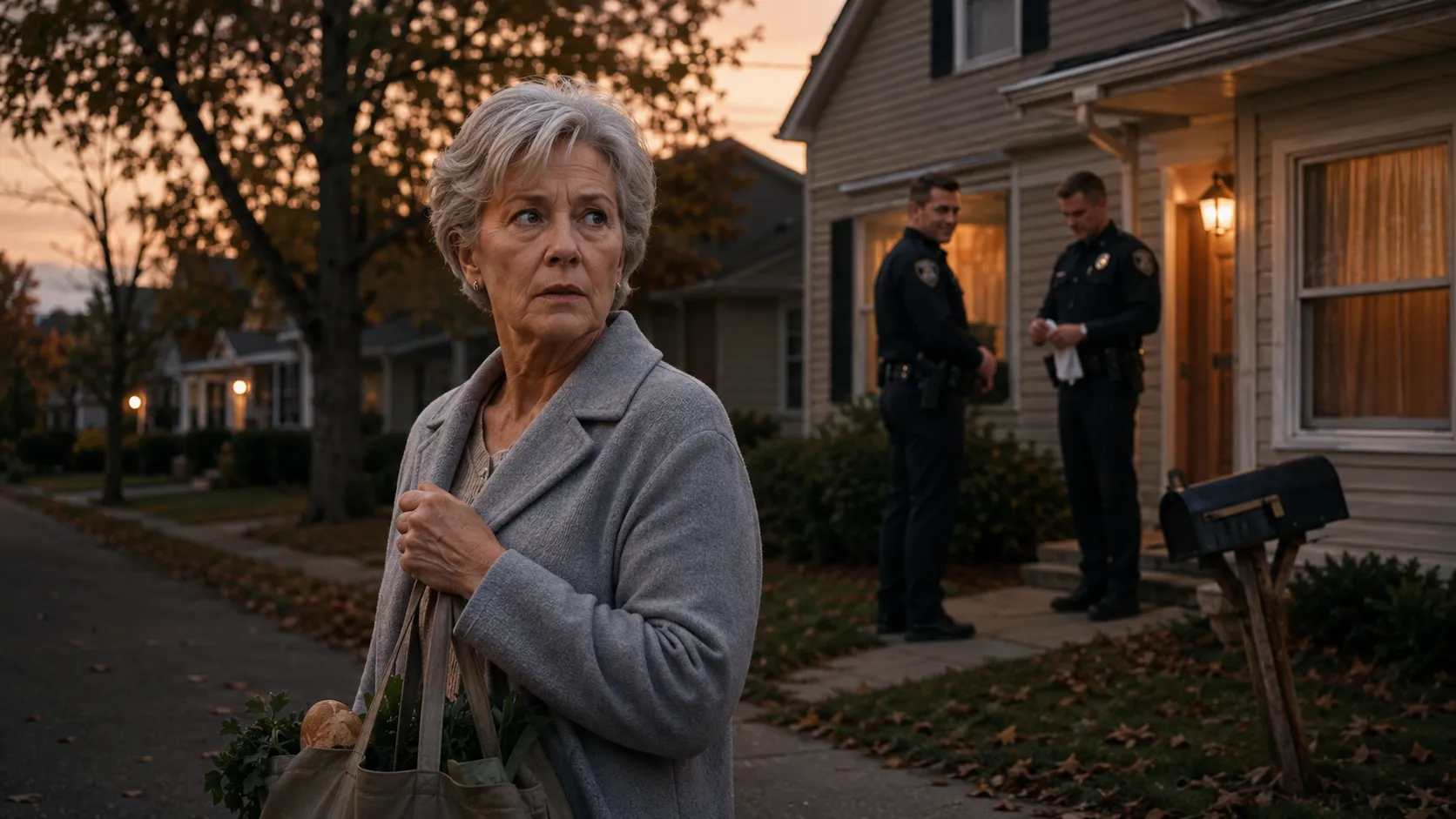
Margaret Ellis was only walking home with groceries when a terrified scream came from a quiet suburban house. Two officers stepped out and told her everything was under control — but one missing patrol car made her realize they were not officers at all.
Margaret Ellis had always trusted quiet streets.
At sixty-eight, after losing her husband, her evening walk to the grocery store was one of the few routines that still made life feel steady. The neighborhood was clean, ordinary, and safe-looking — white fences, trimmed lawns, porch lights turning on one by one.
Then a scream tore through the evening.
“Help!”
Margaret froze beside the beige corner house with the crooked mailbox. Her grocery bag swung from her wrist. Her heart hammered so hard she could hear it in her ears.
Before she could reach for her phone, the front door opened.
Two men stepped out wearing police uniforms.
For one second, relief nearly reached her.
Then she noticed they were not rushing. They were not speaking into radios. They did not look concerned.
One of them was wiping his hands with a white cloth.
The other smiled.
Not kindly.
“Don’t worry, ma’am,” he said. “Everything is under control.”
Margaret nodded because fear made her polite.
Then she walked away.
Not slowly.
Not calmly.
She hurried home, locked the door, and stood in her hallway with trembling hands.
Everything is under control.
The sentence would not leave her.
She sat in her living room, staring at the phone. Should she call the police? But they were the police.
Weren’t they?
Then the realization struck her.
No patrol car.
No flashing lights.
No radio call.
No neighbors outside.
Just two men in uniforms walking out of a house where someone had screamed.
Margaret went cold.
She called 911 from her kitchen and asked for the dispatcher’s name before she spoke. Then she said exactly what she had seen. The dispatcher checked the address and paused.
“No officers were sent to that location tonight.”
Margaret gripped the counter.
“There are two men there dressed as police.”
The voice on the line changed.
“Ma’am, stay inside. Do not approach the house.”
But Margaret could not stop looking through her window.
The beige house sat in darkness, curtains drawn as always. Then, just before midnight, a faint light flickered behind one curtain.
And a shadow moved.
Someone was still inside.
Margaret did not go back alone. She was frightened, but she was not foolish. She turned off every light in her house, took her late husband’s old binoculars from the hall closet, and watched from behind the curtains until real police arrived without sirens.
This time, there were patrol cars.
Real ones.
Officers surrounded the house quietly. Margaret stood on her porch with a blanket around her shoulders while a detective asked her to point out exactly what she had seen.
Then the front door of the beige house opened again.
One of the fake officers stepped out.
He smiled the same cold smile.
“Everything is under control,” he began.
Then he saw the real police.
The smile vanished.
The second man tried to run through the back door, but officers were waiting there too.
Inside the house, police found a woman locked in the basement. Her name was Helen Morris. She had been missing for three days after answering what she thought was a welfare check from two officers.
They were not officers.
They were men using stolen uniforms to enter homes, target older residents, and make neighbors believe nothing was wrong.
Helen was weak, frightened, and alive.
When the paramedics brought her out, she saw Margaret standing across the street and began to cry.
“You heard me,” Helen whispered.
Margaret took her hand.
“Yes,” she said. “And this time, I didn’t let them explain you away.”
The story spread through the neighborhood by morning. People came out of their houses, embarrassed by how many times they had passed the beige house without wondering why the curtains were always closed.
Margaret did not feel brave.
She felt shaken.
She kept thinking about how close she had come to accepting one calm sentence from the wrong men.
A week later, the town held a safety meeting at the community center. The detective explained how criminals use trust, uniforms, and confidence to make people doubt their own instincts.
Then he asked Margaret to speak.
She stood slowly, leaning on the podium.
“I am not a hero,” she said. “I was scared. I almost walked away. But something felt wrong, and I finally listened to that feeling.”
The room was silent.
She looked at the older women in the front row, the young parents near the back, the neighbors who had always believed danger looked obvious.
“If someone tells you everything is under control,” Margaret said, “you are still allowed to ask questions.”
After that night, the neighborhood changed.
People checked on one another. They learned the names behind the curtains. They stopped treating quiet houses as none of their business.
And Margaret still took her evening walks.
But now, when she passed the beige corner house, she remembered the scream, the fake smiles, and the lesson she had learned too late to forget:
sometimes fear is not weakness.
Sometimes it is the part of you that recognizes the truth before your mind is ready to say it.


