
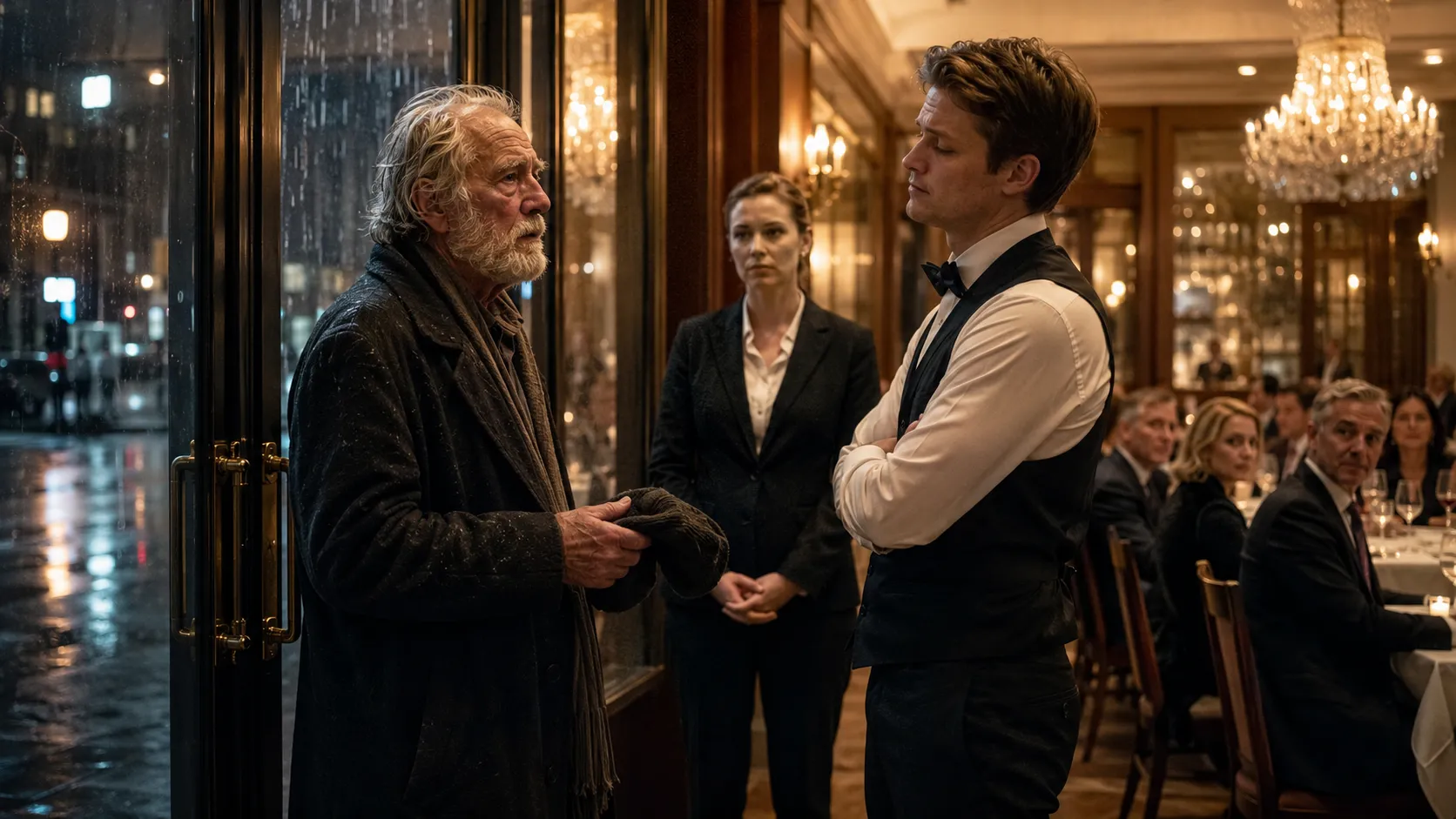
The guests at Harper & Lane laughed when an old man asked for leftovers in the rain. Then people inside the restaurant began collapsing one by one — and the man they had humiliated walked back in as the only person who understood what was happening.
The old man entered Harper & Lane smelling of rain, cold pavement, and hunger.
That was all the guests noticed.
Not the blood on his sleeve.
Not the tremor in his hands.
Not the exhaustion in his eyes.
Only the smell.
Inside the famous Chicago restaurant, crystal glasses shone beneath golden chandeliers. Wealthy couples laughed over wine. Executives discussed investments. Everyone looked polished, important, and too comfortable to be interrupted by suffering.
The old man removed his soaked beanie.
“Please,” he said softly. “Could anyone spare something to eat? Even leftovers.”
Silence fell.
Then someone laughed.
A young waiter named Kyle smirked loud enough for the whole room to hear.
“Leftovers? This isn’t a shelter.”
A few customers laughed with him. Someone lifted a phone to record.
The old man lowered his eyes.
“I’m hungry,” he said. “That’s all.”
The manager, Melissa Carter, hurried over with a frozen smile.
“Sir, you need to leave immediately.”
“I’ll go,” he whispered.
But Kyle was not finished.
“You people always beg,” he said. “Food, money, blessings. If God cared, you wouldn’t be standing here.”
The old man looked at him with a sadness that made Kyle uncomfortable for one brief second.
Then the security guard grabbed the old man by the shoulder.
“He heard you,” Melissa said. “Get him out.”
The guard pushed him toward the door.
The old man stumbled once.
Then again.
Outside, he fell hard onto the wet sidewalk. His cap rolled into the street. Coins scattered into the gutter. Rain soaked through his coat while the restaurant door locked behind him.
Inside, people laughed.
One woman raised her glass.
“To keeping standards high.”
The old man slowly stood in the rain and looked through the window.
Then he smiled.
Not with anger.
With terrible calm.
Inside, business returned to normal.
For six minutes.
Then the woman at Table 9 stopped breathing.
Her husband screamed. A glass shattered. Chairs scraped backward. A man near the bar collapsed, clutching his chest. Another customer began shaking. Then another.
Panic tore through the restaurant.
“Call 911!”
“Is it the food?”
“I can’t breathe!”
Melissa’s face went white. This was not one allergic reaction. This was not ordinary food poisoning. Something was moving through the room faster than anyone could understand.
Ambulances arrived within minutes. Paramedics rushed in. Guests who had laughed at a starving man were now sobbing on the floor, reaching for help from strangers.
Then the restaurant doors opened again.
The old man stepped inside.
Rainwater dripped from his sleeves as he crossed the ruined dining room. Nobody laughed now.
A paramedic tried to stop him.
“Sir, you can’t be here.”
The old man ignored him and knelt beside the woman from Table 9. He checked her pulse, looked at her lips, then turned sharply toward the kitchen.
“Who served the almond foam?”
Melissa blinked. “What?”
“Answer me.”
Kyle’s face drained.
The old man stood. “You have cross-contamination in the dessert station. Possibly nut protein in a shared siphon. People with allergies are reacting, and you’re wasting time treating it like panic.”
A paramedic stared at him. “Who are you?”
“Dr. Samuel Reed,” he said. “Retired emergency physician. Former federal public health consultant.”
The room froze.
The old man they had thrown into the rain began giving instructions with calm authority. EpiPens. Oxygen. Ingredient labels. Batch numbers. Separate the dessert plates. Check everyone who ordered the tasting menu.
The paramedics listened.
Because he was right.
Within minutes, the worst patients stabilized. The woman at Table 9 began breathing again. The man near the bar opened his eyes. The dining room, once full of arrogance, became silent with shame.
Kyle stood trembling near the counter.
“You’re a doctor?”
Samuel looked at him.
“No,” he said quietly. “Tonight I was a hungry man you refused to feed.”
The words hit harder than shouting.
Then another man entered the restaurant in a charcoal suit, followed by two officials and a legal investigator.
“My name is Daniel Carter,” he announced. “Federal Oversight Division.”
Melissa nearly collapsed.
Carter placed a folder on the hostess stand.
“This establishment is now under investigation for discriminatory conduct, unsafe food handling, and negligence. The video of what happened to Dr. Reed has already reached millions.”
Every face went pale.
Kyle whispered, “Over him?”
Carter turned slowly.
“No. Over what all of you revealed yourselves to be.”
The restaurant never recovered from that night.
Sponsors withdrew. Lawsuits followed. The kitchen failures were exposed. Melissa lost her license to manage. Kyle lost more than a job — he lost the illusion that cruelty had no witnesses.
But Samuel Reed refused every interview.
When reporters found him days later at a small church kitchen, he was serving soup to people standing in the rain.
One journalist asked why he had helped the same people who laughed at him.
Samuel looked across the room at the tired faces waiting for food.
“Because hunger teaches you something pride never will,” he said. “When someone needs help, you do not ask if they deserve it. You ask if you can give it.”
Years later, people still spoke about the night Harper & Lane fell.
Not because a rich restaurant made a mistake.
But because one room full of comfortable people looked at a hungry old man and saw nothing.
And by the end of the night, everyone understood:
the person you refuse to see may be the one who knows how to save you.


