
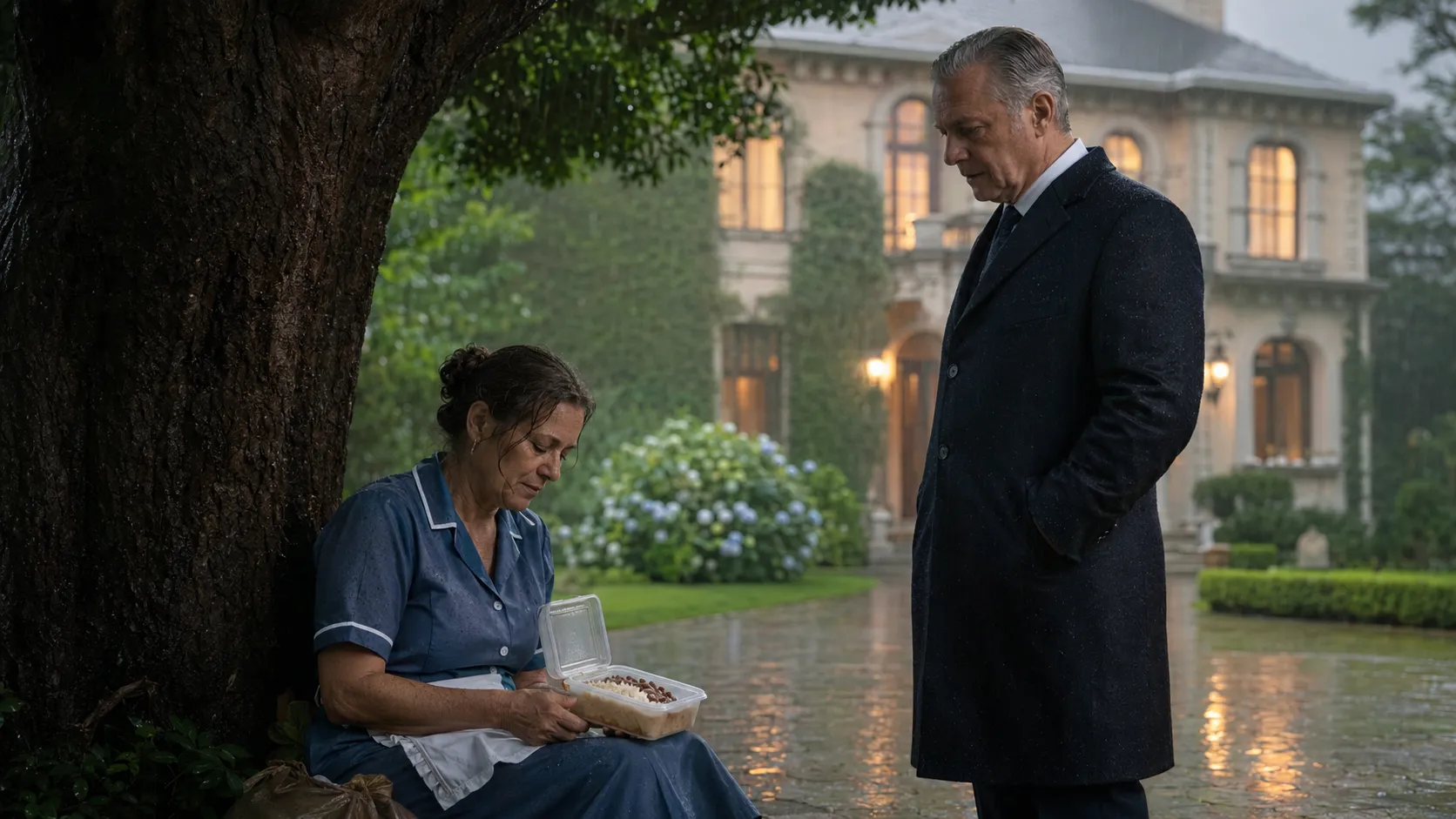
Ricardo thought Maria was eating outside by choice until he saw her lunchbox soaked with rain. What he uncovered inside his own mansion revealed a quiet humiliation he had been too blind to notice.
Ricardo Reio saw her from the back seat of his car.
The rain was falling hard over the gardens of his mansion, turning the grass dark and heavy. Beneath an old tree near the servants’ entrance sat Maria, one of his maids, hunched over a small plastic lunchbox.
Her blue uniform was soaked. Rain ran down her face, mixing with tears she tried to wipe away before anyone noticed.
Ricardo frowned.
Inside the mansion, there was a warm kitchen, a staff room, hot coffee, dry chairs. Why would anyone choose to eat outside in weather like this?
He almost ignored it.
He had meetings. Calls. Guests arriving that evening. Problems worth millions.
But the image stayed with him.
A woman eating cold rice in the rain while living inside a house with twelve dining rooms.
He stepped out of the car.
“Maria?”
She jumped to her feet so quickly the lunchbox nearly slipped from her hands.
“Sir. I’m sorry.”
“For what?”
She lowered her eyes. “I’ll go back to work.”
Ricardo looked at the food in her hands. A little rice. A few beans. Nothing more.
“You’re on your break.”
Maria said nothing.
That bothered him more than any answer could have.
At dinner that night, Ricardo asked his house manager, Paula, why Maria had been eating outside.
Paula gave a careful smile.
“She prefers it.”
“Does she?”
“Well,” Paula said, lowering her voice, “some guests once complained. They said they didn’t like seeing staff eating indoors while they were visiting. Maria took it personally.”
Ricardo stared at her.
“And no one corrected them?”
Paula looked uncomfortable.
“We didn’t want trouble.”
The next day, just before lunch, Ricardo watched from the hallway.
Maria carried her lunchbox through the back door and walked to the same tree. There was no rain this time, but the ground was still wet. She sat anyway, alone, as if the mansion had no place for her.
Ricardo followed.
“Maria,” he said gently, “tell me the truth.”
Her hands tightened around the lunchbox.
“Sir, please. I need this job.”
“I’m not firing you.”
She looked up, and for the first time he saw how tired she was.
“Your guests said I smelled like detergent,” she whispered. “They said people like me should not eat near them. Paula told me it would be better if I stayed out of sight during lunch.”
Ricardo felt the words land like stones.
People like me.
He had built his fortune from nothing. His mother had cleaned offices. His father had driven buses. Yet somewhere along the way, wealth had made him forget what humiliation sounded like when spoken quietly.
“How long has this been happening?”
Maria swallowed.
“Almost a year.”
A year.
In his house.
Under his roof.
He looked at her lunchbox again. “Is that all you eat?”
“It is enough.”
It was not enough.
Over the next week, Ricardo began paying attention.
Maria arrived two hours early because she walked from the bus stop to save money. She worked in silence, never complained, and sent most of her wages to her teenage son, Daniel, who dreamed of becoming a doctor.
One evening, Ricardo drove to the neighborhood where Maria lived.
Her house was small, with cracked walls and one dim light in the kitchen. Through the open window, he saw Daniel studying beside a stack of old textbooks. On the wall hung a drawing of a hospital, a nurse in a blue uniform, and the words:
For my mother, who never stopped working.
Ricardo sat in his car for a long time.
The next morning, he called a staff meeting in the main dining room.
Everyone came: cooks, cleaners, gardeners, drivers, Paula, and even the guests staying that weekend.
Maria stood near the back, frightened.
Ricardo walked to the head of the table.
“For years,” he said, “I believed this mansion showed my success. Today I understand it also showed my blindness.”
No one spoke.
He turned to Maria.
“You were made to eat outside because someone decided your dignity mattered less than their comfort.”
Paula’s face went pale.
Ricardo continued.
“That ends now. From this day forward, every person who works in this house eats indoors, seated, respected, and without shame.”
Then he faced the guests.
“And anyone who cannot share a room with the people who make this house run is free to leave it.”
One couple stood and left.
Ricardo did not stop them.
Then he handed Maria an envelope.
Her hands shook as she opened it.
Inside was a promotion to staff supervisor, a higher salary, and a scholarship agreement for Daniel’s medical studies.
Maria covered her mouth.
“Sir… I don’t know how to thank you.”
Ricardo shook his head.
“Don’t thank me for returning what should never have been taken.”
Years later, Daniel graduated from medical school.
Maria sat in the front row, crying into a folded handkerchief. Ricardo sat beside her, applauding louder than anyone.
After the ceremony, Daniel hugged his mother first.
Then he turned to Ricardo.
“You changed our lives.”
Ricardo looked at Maria, the woman he had once passed by without truly seeing.
“No,” he said quietly. “Your mother changed mine.”
Because that rainy afternoon taught him the truth no fortune had ever taught him:
a mansion is not rich because of marble, chandeliers, or gold.
It is rich only when every person inside it is treated like they belong.


