
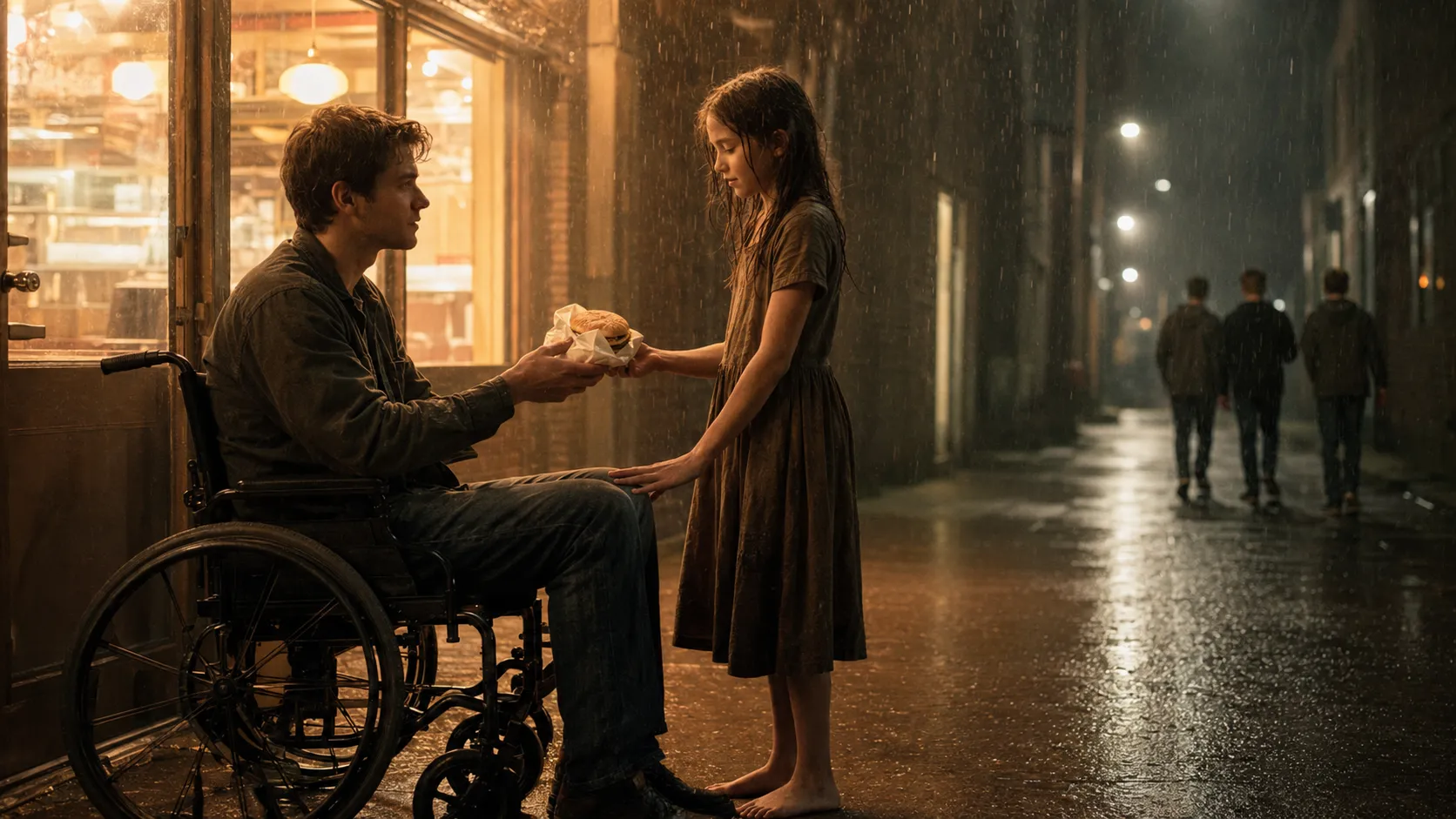
Daniel gave his last meal to a barefoot thirteen-year-old girl in a Chicago alley. In return, she touched his paralyzed legs, told him to stand, and left behind a miracle that led him to a grave no one had visited in years.
The scream came from the alley behind Miller’s Diner.
Most people on Chicago’s South Side kept walking when they heard trouble. Daniel Carter almost did too.
He was twenty-nine, sitting alone in his wheelchair under the diner’s back awning, holding a cold paper cup of coffee and trying not to think about the life he had lost. Six years earlier, a freeway accident crushed his spine, took his construction job, ended his engagement, and left him in a one-room apartment where hope felt like something that belonged to other people.
Then he heard the scream again.
“Please… stop.”
Daniel turned his chair toward the alley.
Three teenage boys were laughing around a skinny girl in a torn brown dress. She looked thirteen at most, barefoot in the rain, with tangled hair and a small piece of bread clutched in her hand.
One boy snatched it from her.
“That’s mine,” she whispered.
Daniel rolled forward.
“Leave her alone.”
The boys turned. One smirked when he saw the wheelchair.
“Or what?”
Daniel’s hands tightened on the rims.
“Or you’ll prove you’re only brave when someone can’t fight back.”
For a second, nobody moved. Then the boy threw the bread into a puddle and walked away with the others, laughing.
The girl picked it up.
“You shouldn’t eat that,” Daniel said.
She looked at him with strange, calm eyes.
“Are you hungry too?”
Daniel almost laughed. He reached into the paper bag beside his chair and pulled out the last food he had — a wrapped burger from the diner.
“It was supposed to be my dinner,” he said. “Take it.”
The girl accepted it with both hands.
“Thank you.”
Then she stepped closer and placed one small hand on Daniel’s knee.
Pain shot through his legs like electricity.
Daniel shouted and grabbed the wheels of his chair.
Then the pain vanished.
He froze.
For the first time in six years, he felt warmth in his feet.
Real warmth.
“What did you do?” he whispered.
The girl only said, “I’ll come tonight.”
“Wait. Who are you?”
But she was already walking into the rain.
And somehow, the puddles beneath her bare feet did not splash.
That night, Daniel sat awake in his apartment, telling himself hunger and loneliness had made him imagine everything.
Then came three soft knocks.
The girl stood outside his door.
Still barefoot.
Still dry, though the storm was pouring behind her.
“How did you find me?” Daniel asked.
“You wanted to walk.”
She entered the small apartment and looked around with quiet sadness.
“You live alone.”
“Yes.”
“You weren’t always alone.”
Daniel’s throat tightened.
“How do you know that?”
She knelt beside his wheelchair.
“Stand up.”
He laughed bitterly. “I can’t.”
“You can.”
“My spine was crushed.”
“You still dream about the crash,” she said. “And the woman screaming beside you.”
Daniel went cold.
He had never told anyone that. Not doctors. Not therapists. Not even the woman who left when his recovery became too heavy for her life.
The girl took his hands.
“Stand.”
The pain returned, fierce and burning. His dead muscles tightened beneath him. His toes curled. Daniel cried out, terrified and desperate at the same time.
“Stand,” she said again.
He pushed against the arms of the wheelchair.
His legs shook like glass.
Then, impossibly, he rose.
One second.
Two.
Three.
Daniel Carter stood on his own feet.
He took one broken step, then collapsed to the floor sobbing. Years of grief poured out of him at once.
When he looked up, the girl was at the door.
“Please,” he begged. “Who are you?”
She paused.
“Someone who was hungry once.”
Then she disappeared into the storm.
By morning, Daniel could walk across the apartment.
Not well. Not strongly. But enough.
Doctors had no explanation. Reporters called it a miracle after footage leaked from his physical therapy session. But Daniel refused every interview.
He searched for the girl instead.
Alleys.
Shelters.
Church steps.
Train stations.
No one knew her.
Then an old man near the tracks saw Daniel’s sketch and went pale.
“Ask Father Michaels,” he said. “But you won’t like the answer.”
At the tiny church on West 18th Street, Father Michaels stared at the drawing for a long time. Then he opened a wooden cabinet and pulled out an old newspaper clipping.
Daniel’s stomach dropped.
It was her.
Same face.
Same dress.
Same calm eyes.
The headline read:
HOMELESS 13-YEAR-OLD GIRL KILLED SAVING CHILD FROM HIT-AND-RUN
Her name was Anna.
She had lived on the streets, shared food with children smaller than herself, and died pushing a boy out of the path of a speeding car two years earlier.
Daniel could not speak.
Father Michaels touched the clipping gently.
“Before she died, the paramedics said she kept repeating one sentence.”
“What sentence?”
“Tell them not to stop helping each other.”
Daniel walked out of the church in silence.
That afternoon, he returned to Miller’s Diner. He bought twenty burgers with money he did not have to spare and handed them out beneath the train bridge.
The next week, he did it again.
Months later, Daniel opened a small food program for homeless children and called it Anna’s Table.
People asked why.
He never told the full story.
He only said a hungry girl once reminded him that kindness is not small. It can cross streets, years, pain, and even death.
And every time Daniel stood behind that table, handing warm food to children the city had forgotten, he felt the same warmth in his legs.
As if somewhere nearby, barefoot in the rain, Anna was still walking.


