
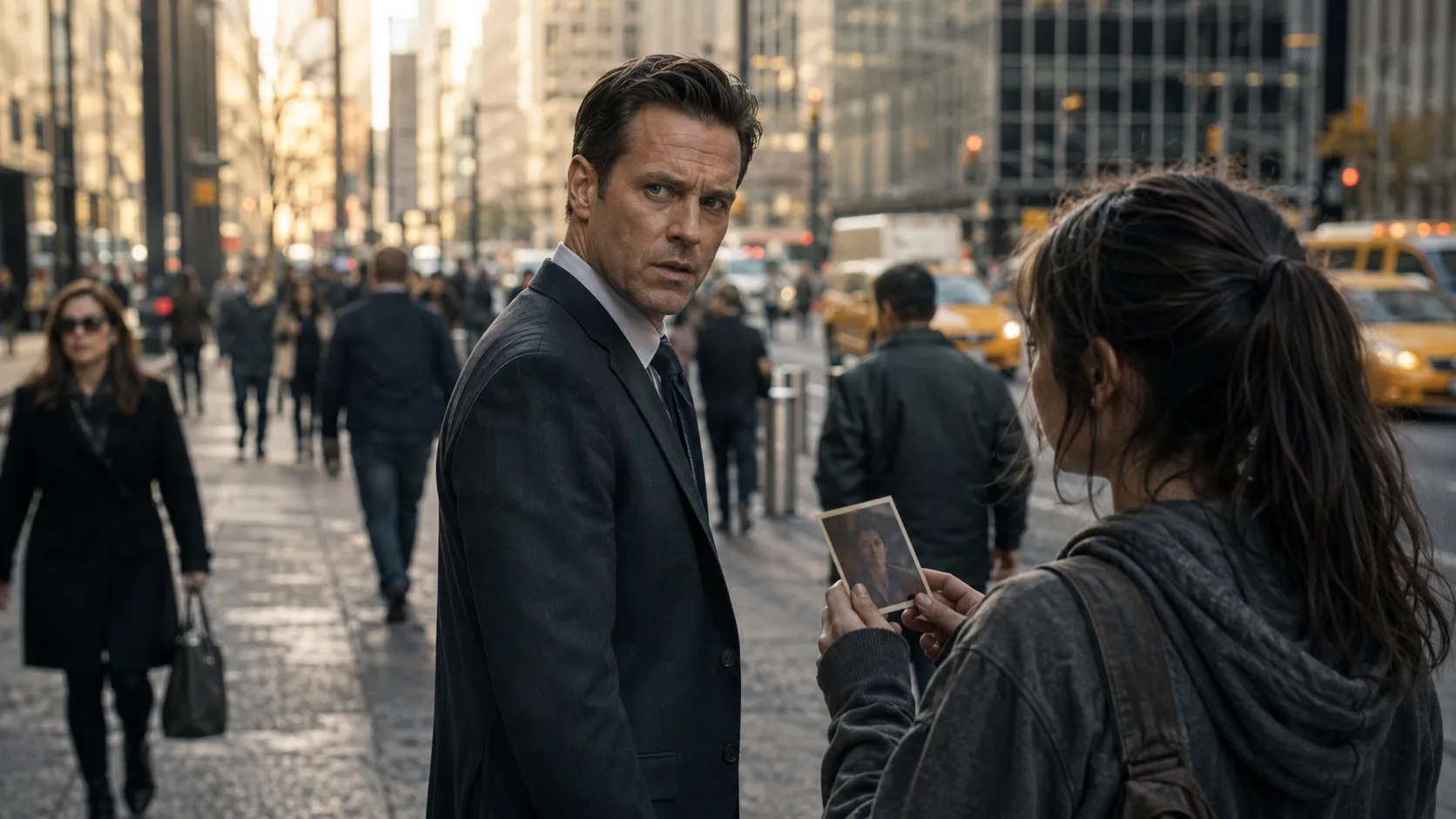
Ethan Cole thought the photograph in his pocket was only a painful memory from seven years ago. Then a homeless girl found it on a New York sidewalk, recognized the woman in the picture, and revealed the daughter Amelia had begged him to find.
New York never slowed down for grief.
Yellow taxis rushed past. Shoes clicked against the pavement. People hurried with coffee, phones, and problems too urgent to notice a girl sitting near the curb.
Ethan Cole was one of them.
He walked through Manhattan in a charcoal suit, his face calm, his schedule full, his heart trained not to feel more than necessary. To strangers, he looked like a man who had everything under control.
Then something slipped from his pocket.
A small photograph.
Ethan did not notice.
The photo fluttered behind him and landed beside a teenage girl sitting at the edge of the sidewalk. She looked sixteen at most, with torn sleeves, tangled dark hair, and the tired stillness of someone the city had ignored for too long.
At first, she only stared at the picture.
Then she picked it up.
The moment she saw the woman’s face, her breath caught.
“No,” she whispered.
She stood so quickly that people turned.
“Hey! Stop!”
Ethan paused, irritated at first, then looked back.
The girl was holding the photo in both hands like it might vanish.
“Where did you get this?” she demanded.
Ethan frowned. “What?”
She stepped closer, shaking.
“This woman. Where did you get her photo?”
Ethan glanced down.
And the world went silent.
The woman in the picture was Amelia.
Soft eyes. Warm smile. A face Ethan had carried in his wallet for seven years because he had never been able to forget the night he found her on the highway.
“She’s my mom,” the girl said.
Ethan’s throat tightened.
“That’s impossible.”
The girl’s eyes filled with anger and fear. “Don’t lie to me.”
“I’m not lying,” Ethan said quietly. “Her name was Amelia. She died seven years ago.”
The girl staggered back as if the words had struck her.
“No. She didn’t die. She left me. We got separated during a fire, and she never came back.”
Ethan shook his head.
“No. She didn’t leave you.”
He pulled out his wallet with trembling hands and took out another photo — older, folded, worn at the edges. Amelia was holding a little girl in her arms, both of them smiling at a camera in some happier life.
The girl stared at it.
“That’s me,” she whispered.
Ethan crouched in front of her.
“What’s your name?”
“Lena.”
The name struck him. He had heard it once, seven years earlier, through blood, rain, and broken glass.
Find Lena.
That was what Amelia had kept saying.
He had not understood then. Police had found no ID, no phone, no child nearby. Ethan had stayed with Amelia until the ambulance came, but by morning, she was gone, and the girl she begged for had remained only a name in his nightmares.
Lena covered her mouth.
“She looked for me?”
Ethan’s voice broke.
“With everything she had left.”
For years, Lena had believed her mother abandoned her. That belief had followed her through shelters, foster homes, streets, hunger, and every adult who promised help before disappearing.
Now one lost photograph had changed the shape of her whole life.
Ethan stood and looked at the girl properly.
Not a stranger.
Not a problem on the sidewalk.
The daughter of the woman whose final words had never let him sleep in peace.
“Come with me,” he said gently.
Lena stepped back.
“I don’t need pity.”
“This isn’t pity,” Ethan said. “It’s a promise I should have kept years ago.”
She looked at the photo again, then at his hand.
Slowly, she took it.
That afternoon, Ethan brought Lena to a quiet office, called a lawyer, and reopened every file connected to Amelia’s accident and the fire that separated mother and daughter. By evening, they found records no one had connected before: a shelter transfer, a mistaken identity, a child moved through systems too crowded to notice one missing mother.
Lena listened without speaking.
When Ethan told her Amelia’s final words, she finally cried.
Not from abandonment.
From truth.
“She didn’t forget me,” Lena whispered.
“No,” Ethan said. “She loved you until her last breath.”
Months later, Lena had a safe room, clean clothes, school again, and a framed copy of the photograph beside her bed. Ethan did not try to replace the family she had lost. He only did what Amelia had asked him to do.
He found her daughter.
And every morning, before the city began its rush again, Lena would look at the photo and remember the one thing the streets had almost stolen from her:
she had not been left behind.
She had been loved.


