
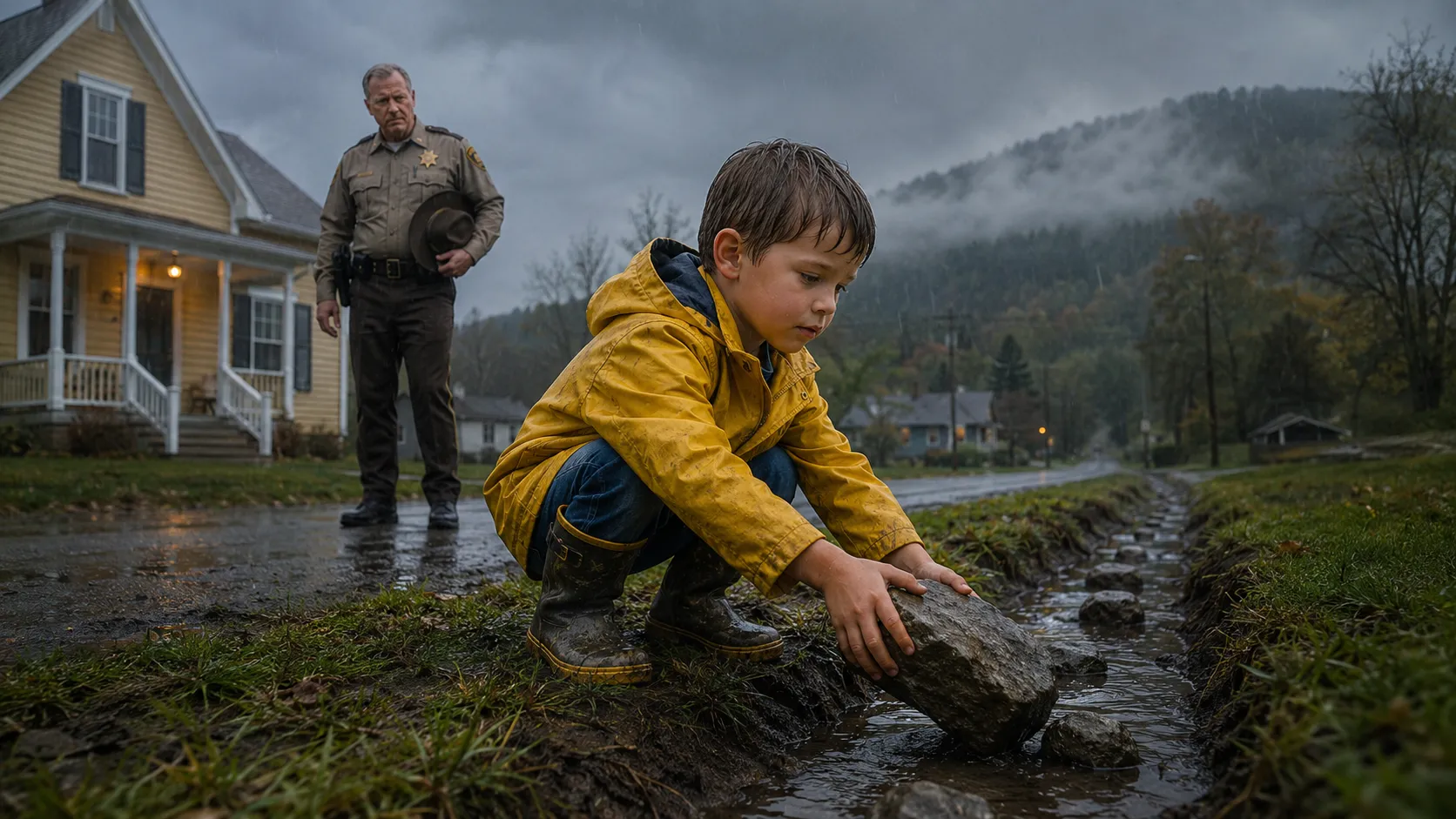
Sheriff Cole thought five-year-old Leo was causing trouble when he tried to break into the town’s warning siren during the storm. Twenty minutes later, the dam gave way — and the whole town learned that the boy who never spoke had been screaming the truth without words.
I had been sheriff of Blackwood Creek for twenty years, and I thought I knew the difference between danger and panic.
Then a five-year-old boy proved me wrong.
His name was Leo. He lived with his mother, Sarah, in the yellow house near the culvert. Leo did not speak, but he watched everything — the creek, the telephone wires, the cracks in the sidewalk, the way rainwater moved through the ditches.
Most people called him difficult.
His mother called him misunderstood.
That week, the rain would not stop. For seven days, it turned the roads black, filled basements, and pushed the creek higher under Miller Bridge. The county engineers kept telling us the Shadow Ridge dam was holding.
“Within safety limits,” they said.
I believed them.
Leo didn’t.
Two days before the flood, Mrs. Higgins called 911 because Leo was dragging heavy landscaping stones from her yard. When I arrived, he was soaked, muddy, and fighting with a rock almost too big for his arms.
“Leo,” I said, “put it back.”
He looked at me with fierce, impatient eyes and pointed toward the drainage ditch. Then toward the mountain.
I didn’t follow his finger.
I looked at Sarah, who came running out of the house, exhausted and ashamed.
“I’m sorry, Sheriff,” she said. “He’s been digging holes all week. I don’t know what’s gotten into him.”
I told her to keep him inside.
That was my first mistake.
The next night, the storm became violent. Wind slammed against the station windows. Trees came down. Power flickered across town.
At 2:00 a.m., Deputy Miller burst through the door dragging Leo by the collar of his pajamas.
“I found him at the siren tower,” Miller shouted. “He smashed the lock on the manual override box.”
Leo was shivering, barefoot, covered in mud. He reached for my radio, then pointed at the floor. His hands moved in a crumbling motion.
I thought he was panicking.
“The dam is fine,” I said. “Go to sleep.”
I put him in the holding cell until Sarah could come through the storm.
Leo grabbed the bars and opened his mouth in a silent scream.
I turned away.
Twenty minutes later, the radio died.
Then the ground shook.
It was not thunder.
It was Shadow Ridge giving way.
The whole station trembled. The lights went black. Somewhere in the distance, something huge tore open with a sound I will hear until the day I die.
Leo slammed both hands against the bars.
This time, I listened.
He pointed to my belt. My keys.
I opened the cell.
He ran.
Not toward the front door.
Toward the map wall.
With muddy fingers, Leo dragged a line from the dam to the old culvert behind his house, then to the drainage ditch he had been filling with stones. He pointed again and again, his breath coming fast, his whole body begging us to understand.
Sarah arrived soaked and crying.
“He’s been trying to build a channel,” she said. “He kept pointing to the water.”
That was when I saw it.
Leo had not been stealing stones.
He had been trying to redirect runoff away from the low streets. He had heard something in the mountain, felt something in the ground, seen a pattern none of us respected enough to notice.
I ran to the manual siren switch.
This time, I broke the lock myself.
The siren screamed across Blackwood Creek.
People woke. Lights came on. Doors opened. Families ran uphill with children in blankets and dogs under their arms. Deputy Miller drove through the lower streets shouting through the cruiser speaker. Volunteers banged on doors.
Eight minutes later, the first wall of water hit town.
It swallowed the park.
It tore through the old feed store.
It lifted cars like toys and smashed them against trees.
But most people were already moving.
By sunrise, Blackwood Creek looked broken. Mud filled the streets. Porches were gone. The bridge had folded in the middle. The church basement was full of brown water.
But the school gym was crowded with survivors.
Almost the whole town was alive because the siren had sounded in time.
And the siren sounded because the boy we called a menace would not stop trying.
That morning, I found Leo sitting on the gym floor beside his mother, wrapped in a blanket. He had not slept. His eyes were fixed on the muddy shoes of people walking past.
For the first time, they were not looking at him like a problem.
Mrs. Higgins came first.
She knelt in front of him, crying.
“You were taking my stones to save us.”
Leo did not answer.
But he reached into his pocket and placed a small muddy pebble in her hand.
That broke her.
Soon after, the county engineers arrived. They spoke carefully about pressure shifts, ground vibration, drainage failure, and sensory pattern recognition. They said Leo may have noticed warning signs the rest of us missed.
I did not need their careful words.
I had seen his silent scream.
A month later, Blackwood Creek held a town meeting in the school gym. I stood in front of everyone with my hat in my hands and said what should have been said sooner.
“I was wrong. We were wrong. Silence does not mean a child has nothing to say.”
Sarah cried quietly in the front row.
Leo sat beside her, tracing circles on his knee with one finger.
The town rebuilt slowly. Stronger culverts. Better warning systems. Real emergency drills. And at the new siren tower, we placed a small brass plaque:
FOR LEO
WHO WARNED US WITHOUT WORDS
Years have passed, but I still carry the broken lock from that siren box in my desk drawer.
Not as evidence.
As a reminder.
The loudest warning I ever ignored came from a child who could not speak.
And the greatest lesson Blackwood Creek ever learned was buried in the mud:
sometimes the person everyone dismisses is the one already trying to save us.


