
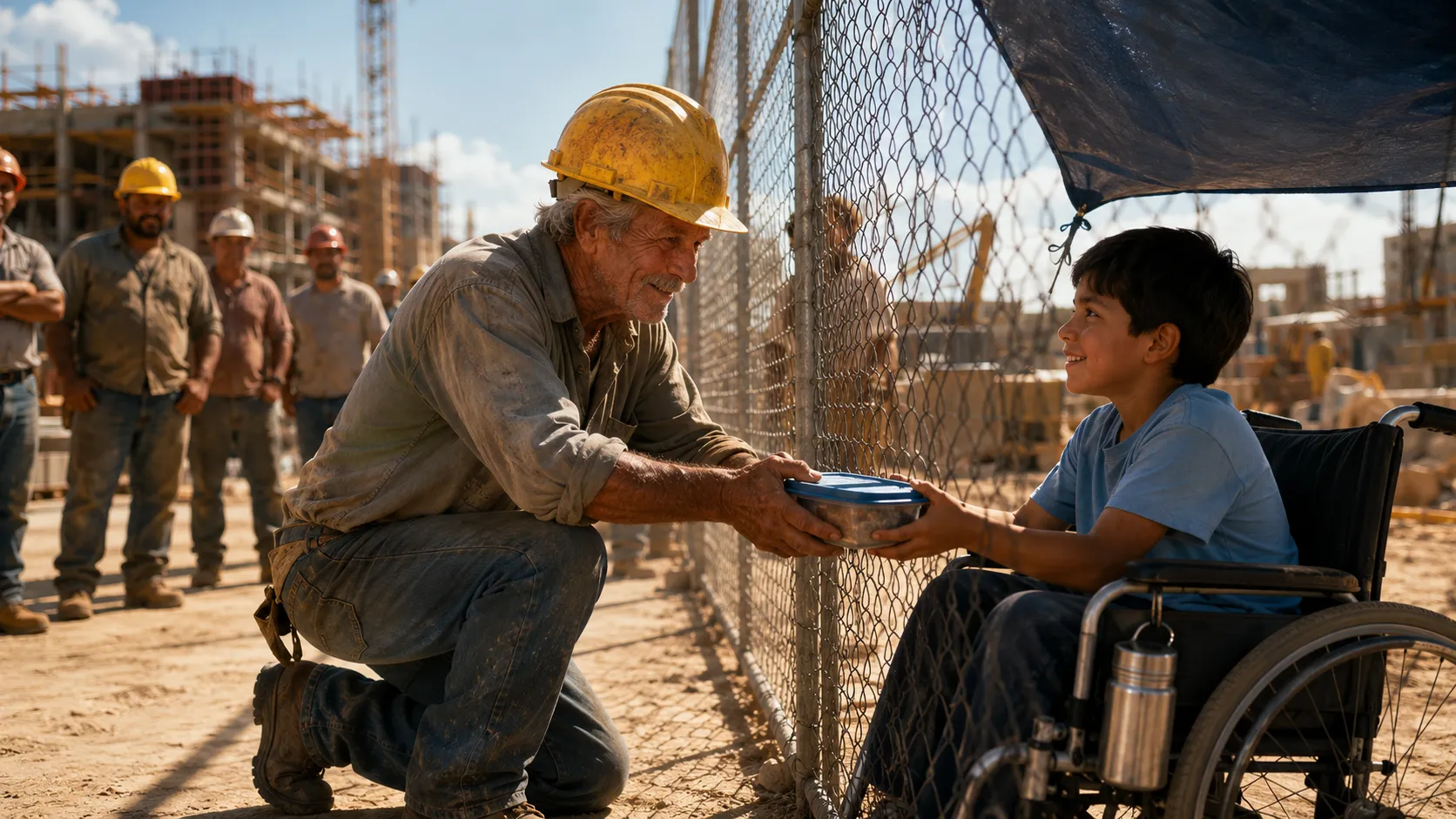
Cicero only saw a hungry child sitting alone in the heat, so he shared his lunch through the fence. But when a millionaire arrived shouting the boy’s name, every worker who had mocked him went silent.
Cicero had spent forty years building walls for men richer than he would ever be.
Every morning, he arrived at the construction site before sunrise, carrying his old aluminum lunchbox and the same quiet dignity he brought to every brick he laid. The younger workers mocked his age, his worn boots, and the way he still treated tools like sacred things.
Cicero never answered.
He believed a man’s work should speak louder than his pride.
At noon, while the others went to the corner bar, Cicero sat near the fence and opened the lunch Maria, his wife, had packed before dawn: rice, beans, and sometimes a small piece of chicken if the week had been kind.
That was where he first saw the boy.
Across the fence, beneath the brutal sun, sat a child in a wheelchair. He looked about ten, thin and silent, wearing a loose blue shirt and watching the cranes move above the site as if they were miracles.
No parent nearby.
No nurse.
No shade.
Just a boy alone in the heat.
Cicero walked to the fence slowly.
“Are you thirsty, son?”
The boy did not speak. He only looked up and nodded.
Cicero passed his water bottle through the metal bars. The child drank with both hands and returned it carefully.
The next day, the boy was there again.
So Cicero asked Maria to pack extra food.
“New friend?” she asked.
He smiled. “A quiet one.”
By the end of the week, Cicero had made a small table from a plank and two bricks. He shared rice and beans through the fence, talked about walls and beams, and showed the boy how each brick mattered because one weak piece could make everything fall.
The boy never said a word.
But he listened.
And every day, his small smile grew a little less afraid.
The workers noticed.
Roberto, the loudest of them, laughed first.
“Look at old Cicero feeding beggars now. What’s next, building him a house too?”
Others joined in.
They called the boy useless. They called him dead weight. They told Cicero he was wasting food on someone who could never repay him.
Cicero looked at them calmly.
“A man’s worth is shown by how he treats someone who has nothing to offer.”
They laughed again.
But he kept bringing food.
One Friday, the heat became dangerous. The boy’s face was pale, and sweat gathered on his forehead. Cicero dropped his tools, found a tarp, and tied it to the fence, making a small patch of shade. Then he brought an old pillow from his locker and placed it behind the boy’s back.
“There,” he said. “The sun won’t fight you alone anymore.”
The boy squeezed Cicero’s hand.
Weakly.
Gratefully.
Then the sound of brakes cut through the construction site.
A black luxury sedan stopped at the gate. A man in an expensive suit jumped out before the driver could open the door.
“Miguel!”
The boy in the wheelchair turned.
For the first time, he made a sound.
A small cry.
“Son!” the man shouted, running toward him.
Workers froze.
The man was Daniel Valadares, the millionaire owner of the company funding the entire project.
He fell to his knees beside the boy and held him like something returned from the edge of the world.
“We searched everywhere,” Daniel whispered. “Why did you leave again?”
Then he saw the lunchbox. The water bottle. The pillow. The shade tied carefully above his son’s head.
His eyes moved to Cicero.
“Was it you?”
Cicero removed his cap, embarrassed.
“He was hungry and hot, sir. I didn’t know who he was. I only saw a child who needed a friend.”
Daniel stared at him.
“My son has severe autism and partial paralysis,” he said. “Most people see a diagnosis before they see him. You didn’t. You saw Miguel.”
The workers who had mocked Cicero lowered their eyes.
Daniel took out a thick envelope.
“Please. Let me repay you.”
Cicero stepped back.
“No, sir. Kindness has no price. My wife packed that food with love. I would shame it if I sold it.”
For a moment, the millionaire could not speak.
Then Miguel lifted his trembling hand and waved at Cicero.
A whisper followed.
“Thank you.”
Cicero covered his mouth.
The men who had laughed looked away, ashamed.
Weeks later, the company announced a change to the building project. Half of the new structure would become a free care center for children with disabilities. On inauguration day, Cicero received a letter.
It was not a dismissal.
It was an appointment.
Daniel wanted him to become head of maintenance and community care.
“I need someone who understands that the strongest foundations are not made of concrete,” the letter said.
Cicero accepted.
Not for the salary.
Because every afternoon, in the garden of the new center, Miguel waited for him with two small plates, a piece of bread, and the same quiet smile.
There were no fences now.
No insults.
No burning sun without shade.
Just an old bricklayer and a boy everyone else had misunderstood.
And whenever Cicero watched children laughing under that roof, he remembered the lesson he had always known:
sometimes the greatest buildings begin with the smallest act of kindness.


