Ellie only came to the rooftop gala to carry glasses and help pay for her grandmother’s motel room. But when Wade Colton dared her to sing, he accidentally gave a dead songwriter’s daughter the microphone.
By the time Ellie Harper stepped out of the service elevator, the rooftop gala was already glowing above Nashville.
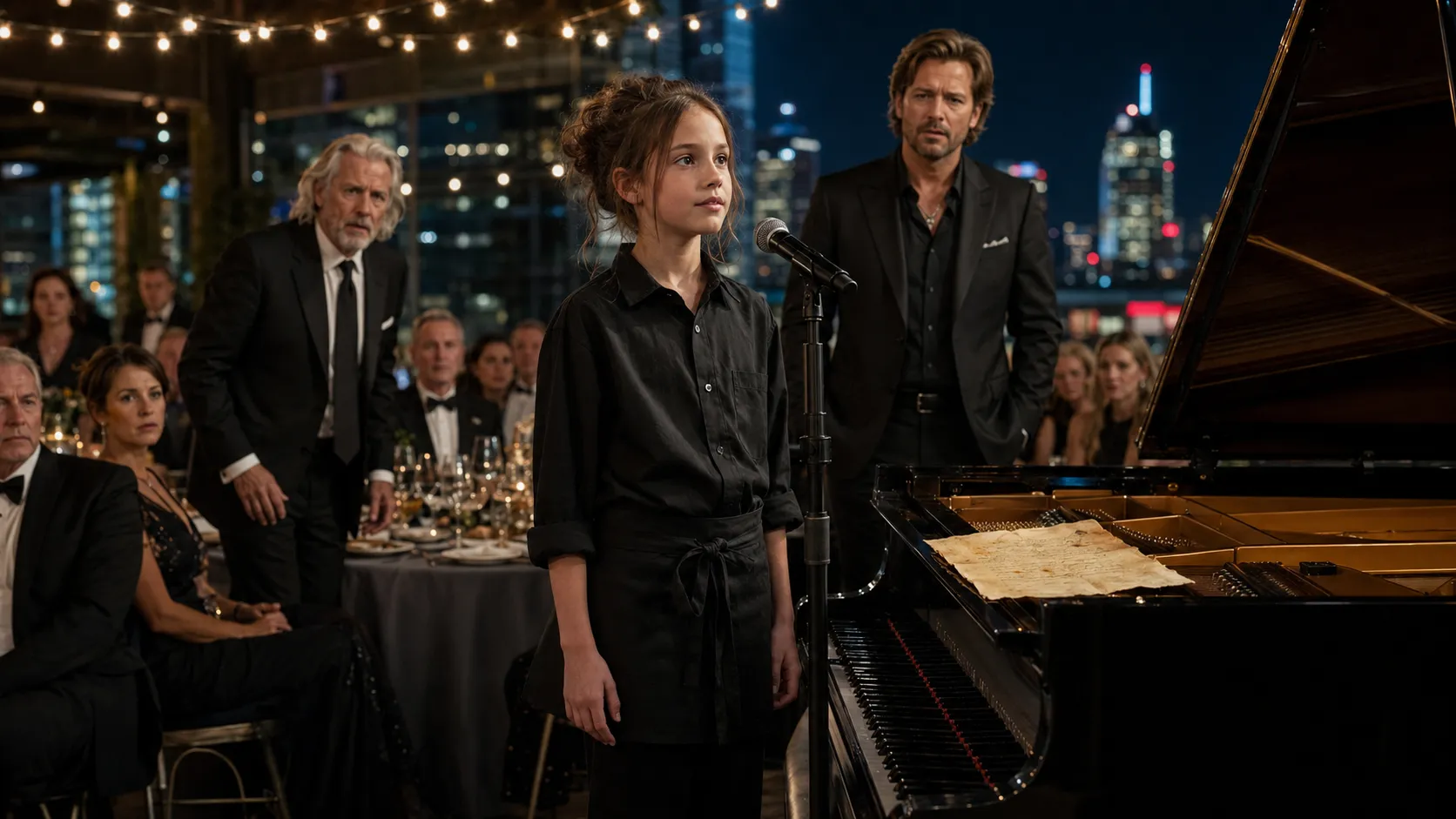
She was twelve years old, wearing a black banquet shirt with sleeves rolled twice because it belonged to someone older. In one hand, she carried a tray of empty champagne glasses. Hidden inside her apron was a folded yellow lyric page, worn thin at the creases.
It had belonged to her mother.
Across the rooftop, rich donors laughed under warm lights. A black piano waited near the stage. Behind it, a giant screen read:
THE HOLLOW CREEK FOUNDATION
Raising Up the Next Generation of Songwriters
Ellie stared at those words and felt her throat tighten.
Hollow Creek had been her mother’s phrase.
June Harper used to write it in notebooks, on cassette labels, on scraps of paper tucked into cookbooks. She sang about hollow creeks, screen doors, kitchen lights, and women who loved men before those men learned how to profit from them.
Wade Colton had been nobody when June met him. She helped him with songs, gave him lines, trusted him with melodies.
Then he took one.
Hollow Creek Baby became his biggest hit. He told the world he wrote it alone in his truck under a Tennessee moon. June tried to fight, but sickness came, bills came, lawyers came, and poverty made justice feel like a luxury.
Now June was gone.
Ellie and her grandmother Mae lived in a cheap motel, never sure if they could keep the room past Friday.
Three weeks earlier, Ellie found the yellow lyric page in an old tote. At the top was the title Wade had made famous. At the bottom, in her mother’s handwriting, were the words:
June Harper — don’t let Wade take this one too.
That night, Grandma Mae told her the truth.
“People don’t believe broke women over famous men,” she said.
Ellie folded the page carefully.
“Then they’ll believe me when I sing it.”
Now Wade Colton stood onstage at his own foundation gala, smiling into the microphone.
“When I was a nobody,” he told the donors, “somebody believed in my songs.”
The crowd applauded.
Ellie looked down at her old shoes.
That part was true.
He just never said her mother’s name.
When Wade sat near the piano for a “surprise acoustic moment,” someone shouted, “Play the old one!”
Wade laughed. “You know I always do.”
The first familiar chords began.
That was when Ellie stepped out from behind the catering station.
At first, almost no one noticed. Then the pianist looked up. A waiter froze. A donor turned in his chair.
Ellie walked toward the stage.
Wade smiled down at her, amused.
“Well now,” he said into the microphone. “Did somebody lose a server?”
A few people laughed.
Ellie stopped at the stage steps.
“Can I sing one?”
The laughter grew softer, more uncomfortable.
“Sweetheart,” Wade said, “this isn’t open mic night.”
“I know.”
“What do you want to sing?”
Ellie touched the lyric page beneath her apron and looked him in the eye.
“Please, sir… my mama wrote this one.”
The laughter died.
For half a second, Wade’s smile cracked.
Then Ellie climbed the steps.
No one stopped her.
She stood at the microphone, a banquet girl in cheap shoes under expensive lights, and began to sing.
Not the chorus everyone knew.
Not the opening line that had sold millions.
She sang the missing bridge.
The bridge June Harper had written.
The one Wade never performed live because it had never made it into the official version.
The first line left Ellie’s mouth, and the pianist flinched.
By the second, the rooftop had gone still.
By the third, Wade’s bourbon glass trembled in his hand.
Ellie’s voice was not huge. It did not need to be. It was clear, Southern, and heartbreakingly honest, carrying porches, church pews, cheap kitchens, and every woman who had ever been erased by a man with better lawyers.
Halfway through the bridge, the yellow lyric page slipped from her apron and landed on the piano lid.
An old session guitarist in the front row stood so fast his chair scraped the floor.
Boots McCall.
He had played on Wade’s earliest demos before Nashville cleaned the story up.
He picked up the page and stared at it.
“This is June Harper’s handwriting,” he said.
The room stopped breathing.
Boots held it up for the cameras.
“Blue edits in the margin. Coffee stain in the corner. I watched her write this bridge at Sweetwater before Wade could even keep time without stomping his boot.”
Wade set down his glass too quickly. It fell and shattered.
Ellie finished the bridge anyway.
When the last note faded, nobody clapped for Wade.
Ellie looked at the crowd.
“My grandma said he promised to help her,” she said. “Instead he took my mama’s song, got rich, and let us end up in a motel.”
Wade swallowed.
“This is complicated.”
Boots laughed once, hard and bitter.
“No. It’s ugly. Complicated is for weather and pedal steel.”
Then Ellie said the line that broke the room.
“This foundation uses her title. But my grandma still worries every Thursday if Friday morning’s gonna throw us out.”
Phones were already filming.
A board member lowered her wine glass. A donor whispered, “I wrote a check tonight.” The foundation director quietly stepped away from Wade.
He tried one last time.
“She gave me ideas. We all traded lines back then.”
Boots snapped, “Not that bridge. She kept that page because she said you stole the last two.”
By midnight, the clip was everywhere.
Not the speeches. Not the donors. Not the skyline.
Just Ellie saying, “Please, sir… my mama wrote this one,” and then singing the verse the world had never heard.
By morning, old demos began surfacing. Former studio assistants came forward. Boots gave a statement. A retired pianist confirmed June’s voice on early recordings.
Six months later, the credits changed.
Hollow Creek Baby was amended to include June Harper as co-writer. Royalties followed. The foundation froze its activity under review. A music-rights attorney took Ellie and Mae’s case for free.
The first money did not buy anything glamorous.
It paid old bills. Then real groceries. Then a small white duplex with a pecan tree out front and a kitchen window where morning light came in without a checkout deadline.
A month after the credits were restored, Boots organized a songwriter’s night in June Harper’s name.
No gala.
No donor banners.
No tuxedos.
Just a small brick room, folding chairs, one microphone, and a handwritten sign above the stage:
JUNE HARPER SONG NIGHT
Ellie wore a denim dress and boots someone from church had bought her.
Grandma Mae sat in the front row with a tissue already in her hand.
Before Ellie stepped onstage, Boots bent beside her.
“No one’s laughing tonight,” he said.
Ellie nodded.
Then she placed the yellow lyric page on a stool and sang the whole song the way her mother had written it.
When she reached the missing bridge, the room did not gasp.
It already knew.
And that made it even better.
Because this time, the moment was not a scandal.
It was restoration.
When Ellie finished, the applause rose slowly, honestly, and warmly.
Not because people pitied her.
Because the song was good.
Because June Harper had been good.
And because sometimes the most powerful thing in the world is not revenge.
Sometimes it is a child standing under the lights and putting a stolen name back where it belongs.


