
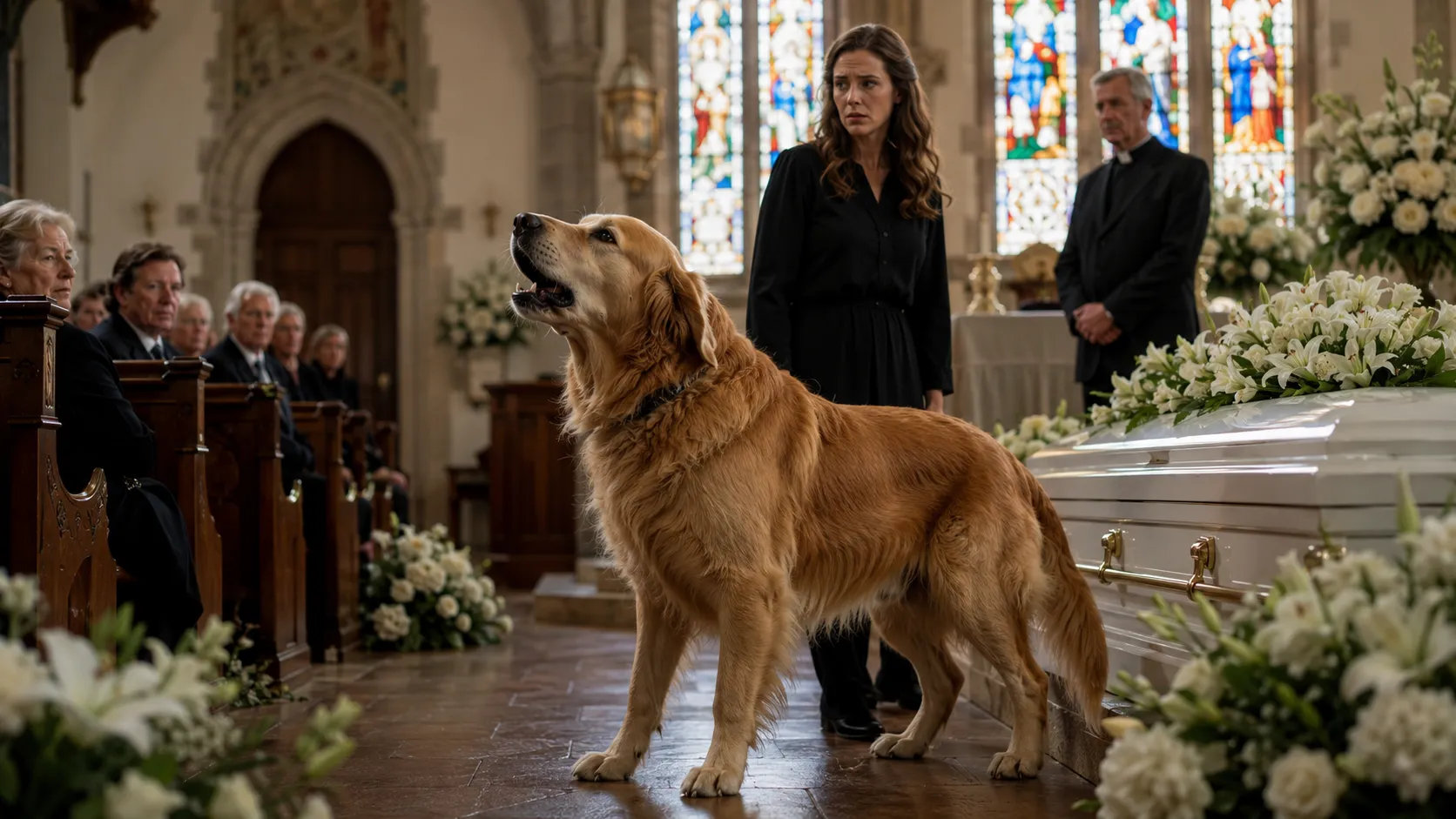
Duke would not stop barking at Hannah’s casket, even when the priest ordered him taken outside. But when the old dog dragged her sister toward the side chapel, the mourners discovered Hannah had not taken her secret to the grave after all.
Duke began barking before the first prayer was finished.
The church was full that cloudy morning. People stood shoulder to shoulder beneath the old wooden beams, holding handkerchiefs, lowering their eyes, whispering about how unfair it was that Hannah Bell had died so suddenly.
She had been only thirty-two.
A nurse.
A volunteer.
The kind of woman who brought soup to widows, sat with frightened children, and remembered every birthday in the village.
Now her casket rested beneath white lilies at the front of St. Michael’s Church.
And Duke, her old golden shepherd, stood beside it trembling.
At first, people thought he was grieving.
Then the barking changed.
Sharp.
Desperate.
Insistent.
“Duke,” Hannah’s sister, Clara, whispered. “Please.”
The dog ignored her. His eyes stayed fixed on the casket, then on Father Michael, who stood near the altar with a tight smile and sweat shining at his temple.
“Someone take the animal outside,” the priest said. “This is not appropriate.”
But Duke growled when a man reached for his collar.
The church went still.
Everyone in town knew Duke. He was gentle with children, patient with old people, and never aggressive. If he was growling, there was a reason.
Clara stepped forward.
“Father, let him stay.”
The priest’s face hardened.
“Your sister deserves dignity.”
“My sister loved that dog,” Clara said. “If he’s trying to tell us something, I want to know what.”
A murmur spread through the pews.
Duke barked again, then did something no one expected.
He left the casket.
He ran to the side chapel, scratched at the locked door, and whined so painfully that Clara felt the sound in her bones.
Father Michael moved quickly.
“There is nothing in there.”
Clara turned to him.
“Then open it.”
He did not.
That was when the first suspicion moved through the room.
Hannah’s death had already felt wrong. The accident had been too convenient, too quick, too neatly explained. She had supposedly lost control of her car on a quiet road after visiting a patient. Father Michael had insisted on arranging everything quickly, saying Hannah would not want delay.
But Hannah had called Clara the night before she died.
“I found something,” she had whispered. “Something people will hate me for knowing.”
Then the line went dead.
Clara had told herself grief was making her imagine things.
Now Duke was tearing at the chapel door.
The village constable, Martin Hayes, stepped out of the front pew.
“Father,” he said quietly, “open the door.”
The priest stared at him.
“This is a funeral.”
“No,” Martin said. “Now it’s an investigation.”
A church caretaker brought the spare key.
The moment the chapel door opened, Duke rushed inside and went straight to a storage cabinet beneath the stained-glass window. He scratched at the bottom drawer until Clara knelt and pulled it open.
Inside were Hannah’s red nursing bag, her phone, and a brown envelope sealed with tape.
Clara covered her mouth.
“That bag was not found at the accident.”
Father Michael backed away.
Martin took the envelope and opened it in front of everyone.
Inside were copies of bank transfers, medical records, and handwritten notes in Hannah’s careful script.
At the top of the first page was a name:
Father Michael Arlen.
Below it were records showing donations meant for the village clinic had been moved into private accounts for years. Medicine that families had paid for had never reached them. Elderly patients had gone without treatment while the church charity fund paid for repairs, travel, and quiet debts.
Hannah had discovered it.
And she had planned to report it.
Clara’s hands began to shake.
“You knew,” she whispered.
Father Michael’s face lost all warmth.
“Hannah misunderstood what she saw.”
Duke barked so violently that the priest flinched.
Martin found one more thing in the bag: a voice recording on Hannah’s phone. He pressed play.
Hannah’s voice filled the church.
“If anything happens to me, check the chapel. I left copies where Duke would know my scent. Clara, I’m sorry. I should have told you sooner.”
Then another voice spoke.
Father Michael.
“You should have stayed out of things that did not concern you.”
The recording ended with Hannah saying one sentence:
“People trusted you.”
No one moved.
The priest looked around the church and realized there was no sermon left that could save him.
By evening, the police had taken Father Michael away for questioning. The clinic files were seized. The charity accounts were frozen. More documents were found hidden in the rectory office, exactly where Hannah’s notes said they would be.
The next week, investigators confirmed what the village had feared: Hannah had discovered years of stolen donations and falsified medical purchases. Her death was reopened as suspicious.
But the funeral did not continue that day.
Clara could not bury her sister while the truth was still breathing.
Instead, the village carried the flowers from the casket to the clinic steps. People stood in the rain with candles, not as mourners only, but as witnesses.
Duke sat beside Clara the whole time.
He no longer barked.
He only rested his head against her knee, exhausted from doing what no person in that church had managed to do.
He refused to let Hannah’s truth be buried.
Months later, the clinic reopened under new leadership. A small plaque was placed by the entrance:
IN MEMORY OF HANNAH BELL
WHO CARED ENOUGH TO NOTICE
Below it, someone had added a smaller line:
AND DUKE, WHO WOULD NOT LET US LOOK AWAY
Clara visited every Sunday.
Duke always came with her.
He would sit beneath the plaque, quiet and dignified, as villagers passed by and touched his head with gentle hands.
People still spoke about the day he barked at the casket.
Some called it instinct.
Some called it loyalty.
Some called it a miracle.
Clara never argued.
She only knew one thing.
On the day everyone came prepared to say goodbye, the one creature who loved Hannah most refused to accept silence.
And because of him, the truth came home before the grave could close.


