
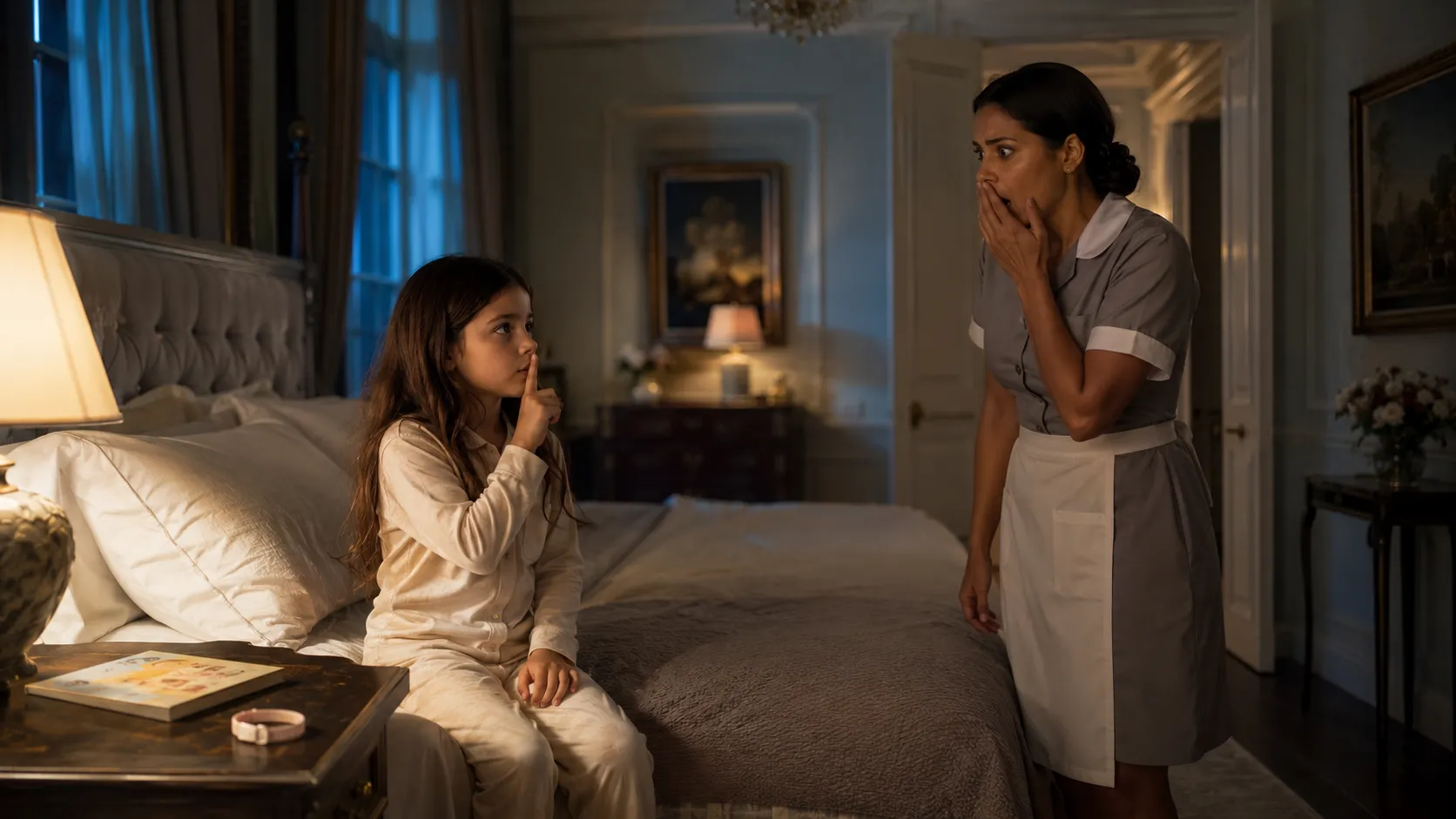
Sofia came to the Vargas mansion to care for a mute little girl named Isabella. But on the tenth night, she heard the child singing a lullaby only one person in the world should have known — Sofia’s missing daughter, Luna.
Sofia Marquez straightened her nanny uniform and stepped into the Vargas mansion with a heart full of fear.
The house was beautiful, but cold. Marble floors. High ceilings. Long corridors where every sound disappeared too quickly.
Mrs. Elena Vargas introduced the child without warmth.
“This is Isabella,” she said. “She is six. She does not speak.”
Sofia looked at the little girl sitting by the window.
Isabella had large dark eyes, delicate hands, and the quiet stillness of a child who had learned to hide inside herself. Everyone called her mute, but Sofia felt something different.
The girl did not seem unable to speak.
She seemed afraid to.
Sofia knew that kind of silence.
Years earlier, her own daughter, Luna, had vanished from a hospital nursery after a fire alarm caused chaos in the building. Sofia had searched until grief hollowed her out. Police said Luna was probably gone forever.
Sofia never believed them.
But life continued cruelly. Bills came. Rent came. Hunger came. So Sofia took work where she could, and the Vargas mansion became her newest place to survive.
Days passed.
Sofia read to Isabella. Drew pictures with her. Brushed her hair gently. The little girl never spoke, but sometimes she smiled — and when she did, Sofia felt a pain so sharp she had to look away.
The tilt of the head.
The small dimple near the cheek.
The way Isabella touched her left ear when nervous.
Just like Luna.
Sofia told herself not to imagine things.
Then came the tenth night.
The mansion was silent. Sofia was washing cups in the kitchen when she heard a tiny voice drifting down the staircase.
A song.
Her hands froze in the sink.
Not just any song.
A lullaby.
“Sleep, my little moon, my shooting star…”
Sofia stopped breathing.
Her grandmother had written that song. Sofia had sung it to Luna every night before bed. No one outside her family knew the words.
No one.
She followed the melody upstairs with trembling legs.
The sound came from Isabella’s room.
Sofia pushed the door open.
Isabella sat on the bed with her eyes closed, rocking gently, singing every word perfectly.
Sofia whispered, “Luna?”
The song stopped.
Isabella opened her eyes.
For one second, the child looked terrified.
Then she lifted one finger to her lips.
Don’t tell.
Sofia’s knees nearly failed.
The next morning, she searched carefully. Not drawers. Not jewelry. Not money. She searched for truth.
In Isabella’s old medical folder, she found a copied birth certificate.
The date was wrong.
The hospital name was wrong.
But tucked between two pages was something Elena Vargas had missed: a tiny bracelet from a maternity ward.
Baby Marquez.
Sofia covered her mouth to stop herself from crying out.
That afternoon, Ricardo Vargas came home early. He found Sofia in the library, holding the bracelet with shaking hands.
“What is that?” he asked.
Sofia turned to him.
“Where did Isabella come from?”
Ricardo frowned. “My wife arranged the adoption. I was told the mother had died.”
Sofia stepped closer.
“My daughter was stolen from a hospital six years ago.”
The color left his face.
Before he could answer, Elena appeared in the doorway.
Her expression told them everything.
Ricardo’s voice dropped. “Elena. Tell me this is not true.”
Elena’s face cracked.
“I wanted a child,” she whispered. “You were always gone. The doctors said I couldn’t have one. A woman at the hospital said there was a baby no one would claim. She gave me papers.”
Sofia stared at her in horror.
“No one would claim her? I was screaming her name in the street.”
Elena began to cry, but Sofia felt no pity.
“You heard my daughter sing because I taught her that song before she was taken.”
Ricardo called the police himself.
The truth came out in pieces. A nurse had sold false adoption papers. Elena had paid, then hidden every doubt because returning Isabella would have destroyed the life she had built around a lie.
DNA confirmed what Sofia already knew.
Isabella was Luna.
For days, the little girl said nothing.
Then one evening, Sofia sat beside her bed and sang the lullaby softly.
Halfway through, Isabella reached for her hand.
“Mommy?” she whispered.
Sofia broke.
She held her daughter carefully, as if too much love at once might frighten her.
“Yes,” she cried. “I’m here.”
Ricardo ended his marriage and opened every document to investigators. He also did something Sofia did not expect: he gave her time, space, protection, and the right to decide what Luna needed.
Not the mansion.
Not money.
Truth.
Months later, Luna began speaking again. Small words at first. Then questions. Then laughter.
Sofia never rushed her.
Some nights, Luna still woke afraid that someone would take her away. Sofia would sit beside her, stroke her hair, and sing the old song until her breathing softened.
The Vargas mansion never felt the same after that.
Its silence had been built on a secret.
But in a small apartment filled with sunlight, drawings, soup, and a mother’s voice, Luna learned a new truth:
love can be stolen for a while…
but the heart remembers its song.


