
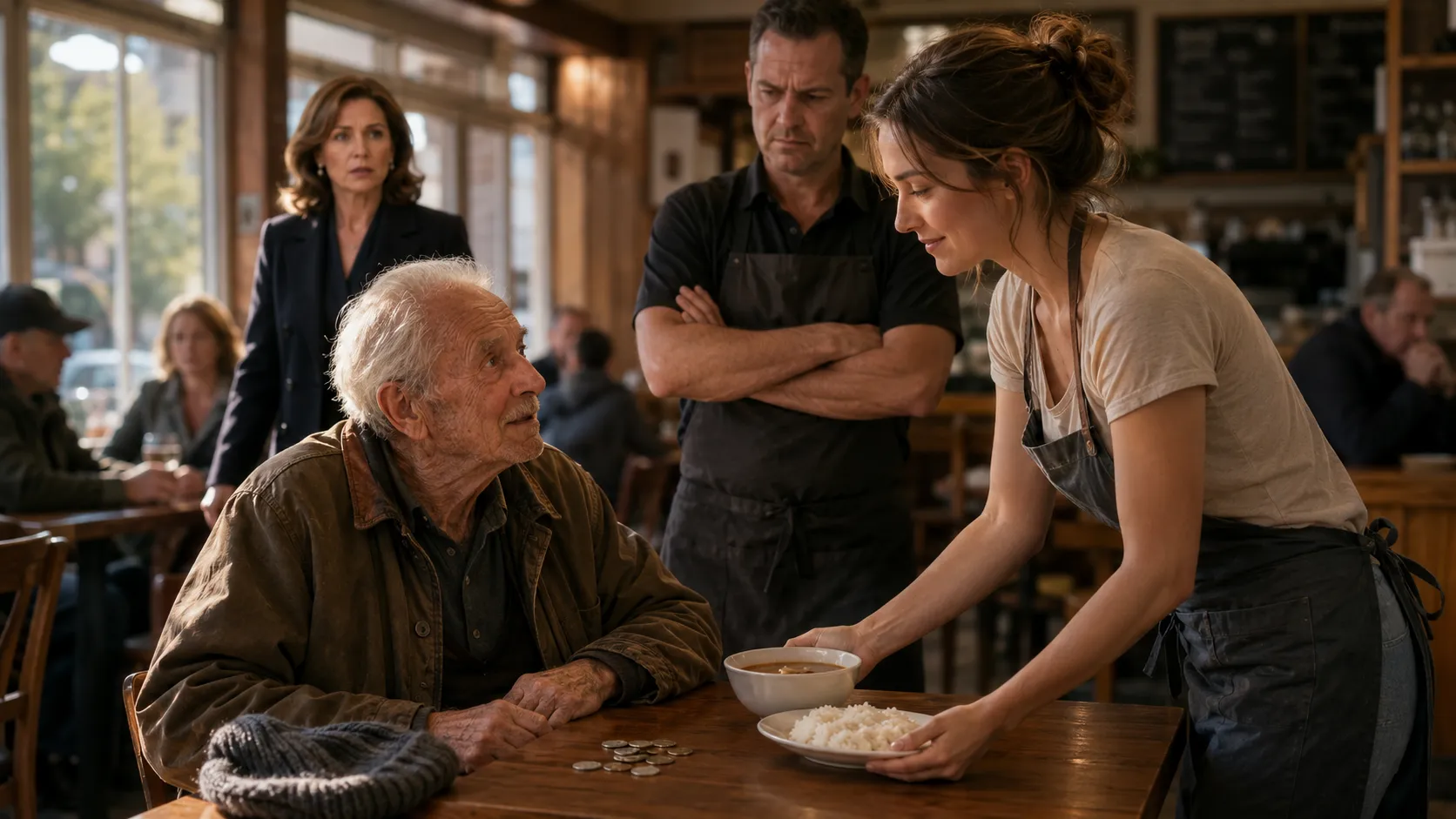
Mia only wanted to help an old man who was counting coins for a bowl of soup. But when his daughter walked through the door, the cruel manager learned exactly who he had humiliated.
The old man counted the coins twice before he dared to look up.
They lay scattered across the counter of a busy lunch café — nickels, dimes, pennies, and two trembling hands trying to make them enough.
“How much is the soup and rice again?” he asked softly.
“Twelve dollars,” the cashier said, barely hiding her impatience.
The old man swallowed and counted again. Behind the counter, two workers whispered loud enough for him to hear.
“He pays with coins every time.”
“Someone should tell him this isn’t a charity.”
His face lowered, but he did not argue. He only pushed a few coins forward.
“Maybe just the soup, then.”
Before the cashier could answer, a young waitress stepped beside him.
“No,” Mia said gently. “Give him the soup and rice.”
The cashier frowned. “He’s short.”
“I’ll cover it.”
The manager, Greg, came out of the kitchen just as Mia placed the tray in front of the old man.
“Who added rice?” he snapped.
“I did,” Mia said. “I paid for it.”
Greg’s eyes hardened. “This is a business, not your personal charity project.”
The old man immediately stood.
“I can leave,” he whispered. “I’m sorry.”
Mia touched the edge of the table, not him, as if even kindness needed permission.
“Please sit, sir. Eat while it’s hot.”
Greg looked at the old man with open disgust.
“If you can’t afford lunch, don’t come in.”
The café went quiet for one uncomfortable second.
Then forks started moving again. People looked down at their plates. They had seen cruelty and decided silence was easier.
Mia sat across from the old man while he ate slowly, almost carefully, as if someone might still take the meal away.
“My daughter is busy,” he said after a while. “I don’t like bothering her.”
“You’re not a bother,” Mia replied.
He smiled sadly. “People start treating you like furniture when you get old.”
Mia shook her head.
“Not to me.”
The old man looked at her for a long moment, and something in his tired face softened.
At that moment, the café door opened.
A well-dressed woman stepped inside, scanning the room with worried eyes. She wore a dark coat, pearl earrings, and the kind of calm that made people move aside before she asked.
“Excuse me,” she said to the counter. “I’m looking for my father.”
Then she saw the old man in the corner.
“Dad?”
He looked up.
“Claire?”
She rushed to him and knelt beside his chair.
“Why are you here alone? I called you three times.”
“I didn’t want to bother you,” he said. “I was hungry. This young lady helped me.”
Claire looked at Mia.
“You paid for his meal?”
Mia nodded, embarrassed.
“He was just a little short.”
Claire stood slowly and turned toward Greg.
“And you?”
Greg forced a smile. “Ma’am, we treat all customers equally.”
The old man’s voice was quiet but clear.
“He told me not to come in if I couldn’t afford it.”
Claire’s expression changed.
Not loud.
Worse.
Calm.
“Your name,” she said.
Greg blinked. “Why?”
“Because I own this building.”
The café went silent.
Greg laughed once, but it died quickly when Claire lifted her phone.
“Send the attorney in,” she said. “And terminate the lease today.”
Color drained from Greg’s face.
“You can’t do that.”
Claire looked around the café — at the customers, the staff, the old man’s empty bowl, and the young waitress who had done what everyone else had avoided.
“I can,” she said. “And I should have done it sooner.”
Minutes later, a man in a suit entered with a folder. Greg read the papers and went pale.
“You’re serious.”
“Very,” Claire said.
Then she turned to Mia.
“What’s your name?”
“Mia.”
“Mia, pack your things.”
Mia’s heart dropped.
“Am I fired?”
Claire smiled gently.
“No. You’re the new manager.”
Gasps moved through the café.
Mia stared at her. “I’ve only worked here three months.”
“That was long enough to show who you are.”
Greg slammed his hand on the counter.
“You can’t run a restaurant with charity.”
Claire looked at him.
“No. But you can ruin one with cruelty.”
The words hung in the air.
The old man stood slowly and reached into his coat pocket. He pulled out a folded twenty-dollar bill and placed it in front of Mia.
“For the soup,” he said.
Mia shook her head. “No, sir. It’s okay.”
He smiled.
“My wife used to say kindness should always be returned.”
Claire’s eyes filled when he said it.
“She fed people too?” Mia asked.
“Always,” he whispered. “Even when we had very little.”
For a moment, the café was no longer a place of orders and receipts. It was a room full of people remembering how easily dignity can be taken from someone — and how little it costs to give it back.
Claire helped her father toward the door, then turned to Mia one last time.
“I’ll be here tomorrow morning. We’ll go over everything.”
“I don’t know how to run a restaurant,” Mia admitted.
Claire glanced at her father.
“You already know the most important part.”
“What part?”
“Seeing the person before the bill.”
After they left, the café remained still.
Then one customer raised a hand.
“So… are we still getting lunch?”
Mia looked at the tables, the kitchen, the counter, and the empty chair where the old man had been sitting.
Then she picked up the order pad.
“Yes,” she said. “We are.”
And for the first time since she had started working there, the café did not feel like a job.
It felt like a place where kindness had finally been put in charge.


