
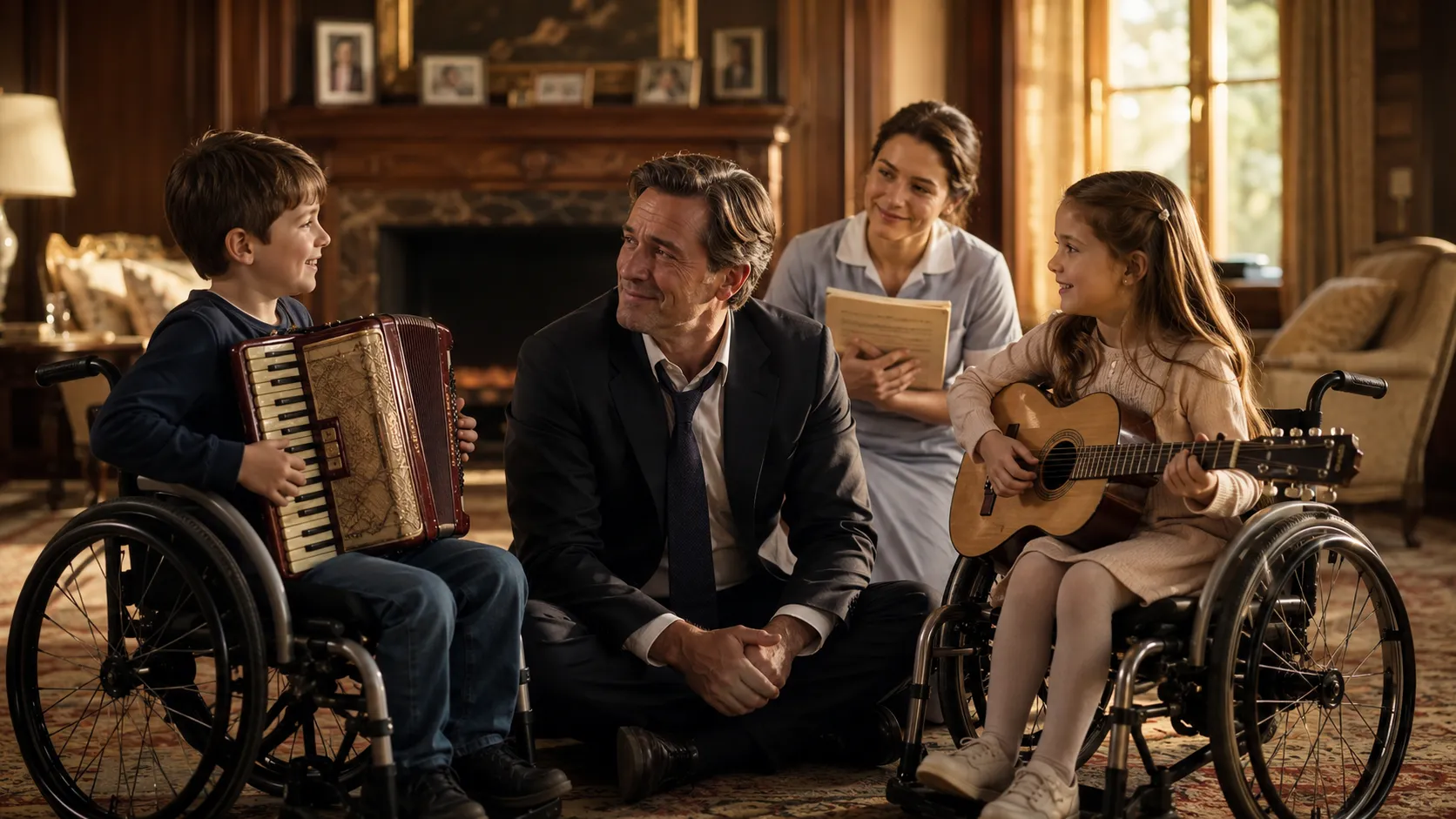
Daniel thought grief had stolen every sound from his mansion after his wife died and his twins came home in wheelchairs. Then he returned early one evening and found the quiet maid teaching his children the song their mother used to sing.
Daniel Harrington unlocked the front door just before dusk, expecting the same silence that had haunted his mansion for months.
Instead, he heard music.
Not perfect music.
A few uneven notes.
A hesitant rhythm.
A soft voice saying, “Try again. Slowly this time.”
Daniel froze in the hallway.
For one impossible second, the sound felt so close to his late wife that his chest tightened. Sarah used to fill the house with music. She sang while cooking, hummed while folding laundry, and played gentle melodies for their twins before bedtime.
Then came the accident.
Sarah was gone.
And Ethan and Mia, his eight-year-old twins, came home from the hospital in wheelchairs.
After that, the mansion changed. The rooms stayed clean, expensive, and beautiful, but they no longer felt alive. Daniel buried himself in work because every corner of the house reminded him of what had been taken.
He had hired Laura Bennett three months earlier.
She was quiet, efficient, and almost invisible. A housekeeper who arrived on time, cleaned every room, and never asked personal questions. Daniel knew very little about her, except that the house stayed spotless.
But what he saw in the living room had nothing to do with cleaning.
Ethan sat in his wheelchair with a small accordion across his lap. His fingers moved awkwardly, fighting stiffness and frustration. Mia held a little guitar against her knees, tapping the strings with careful concentration.
And Laura knelt between them, patient and calm.
“It’s not about being strong,” she told Ethan. “It’s about listening. Let your hands follow the sound.”
Ethan tried again.
A broken note came out.
Mia giggled.
Then Ethan laughed too.
Daniel grabbed the doorframe.
His son had not laughed like that since the hospital.
Laura clapped softly. “There it is. That’s music.”
Daniel stepped back before they saw him.
The next few days, he began coming home early on purpose. He told himself it was coincidence, but it was not. He lingered in the hallway, listening as Laura turned therapy exercises into songs. She helped Mia stretch her fingers by practicing chords. She helped Ethan build strength by opening and closing the accordion.
Every mistake became a lesson.
Every small success became a celebration.
Then one afternoon, Daniel saw an old notebook on the kitchen counter.
He recognized the handwriting before he touched it.
Sarah’s.
Inside were the lyrics his wife used to sing to the twins before the accident. Laura had copied the words carefully, added simple chords, and written a title at the top:
Your Mom’s Song.
Daniel sat down hard.
When Laura walked in and saw him holding the notebook, her face went pale.
“I’m sorry,” she said quickly. “I found it in the music cabinet. I didn’t mean to cross a line.”
Daniel looked up slowly.
“Why are you doing this?”
Laura lowered her eyes.
“My younger brother was in an accident when we were children. After he lost movement in part of his body, our house became silent. Everyone was so afraid of hurting him that they stopped treating him like a boy.”
Her voice trembled.
“One day, a nurse brought him a harmonica. He could barely hold it, but when he made a sound, my mother cried for the first time in months. I never forgot that.”
Daniel stared at the notebook.
“So you thought music could help them.”
Laura nodded. “Not fix everything. Just remind them they’re still children.”
Those words broke something in him.
He had spent months trying to provide the best doctors, the best equipment, the safest home. But somewhere inside his grief, he had stopped sitting on the floor with them. He had stopped laughing. He had stopped letting the house be messy, noisy, and human.
That evening, Daniel walked into the living room instead of hiding in the hall.
Ethan looked startled. Mia went quiet.
Laura stood, unsure whether she had done something wrong.
Daniel loosened his tie and sat on the floor.
“Can I listen?”
The twins stared at him.
Then Mia whispered, “We’re not very good yet.”
Daniel’s eyes filled.
“I don’t care.”
Ethan squeezed the accordion. A rough note filled the room. Mia followed with a tiny chord. Laura counted softly.
And Daniel listened.
Not as a broken man.
Not as a widower hiding from memory.
As a father who had finally come back into the room.
Weeks passed, and the house changed.
Daniel bought a second-hand keyboard. He canceled late meetings. He learned to clap after wrong notes and laugh when the rhythm fell apart. Ethan grew stronger. Mia grew braver. Laura stayed longer than she needed to, never asking for praise.
One evening, the twins played Sarah’s song from beginning to end.
It was slow.
Uneven.
Beautiful.
When the final note faded, Daniel closed his eyes.
For the first time since Sarah died, he did not feel only loss.
He felt her presence in the room — not as pain, but as love still moving through their children.
Laura stood quietly near the doorway.
Daniel turned to her.
“You brought sound back into this house.”
She shook her head.
“No. They did.”
Then Mia smiled and said, “Dad, can we play it again?”
Daniel wiped his eyes and nodded.
“Yes,” he said. “As many times as you want.”
The mansion would never be what it had been before.
Sarah would not walk through the door.
The twins still had hard days ahead.
But music had returned to the halls. Laughter had returned to the living room. And Daniel finally understood that healing does not always arrive like a miracle.
Sometimes it comes quietly…
carrying a song.


