
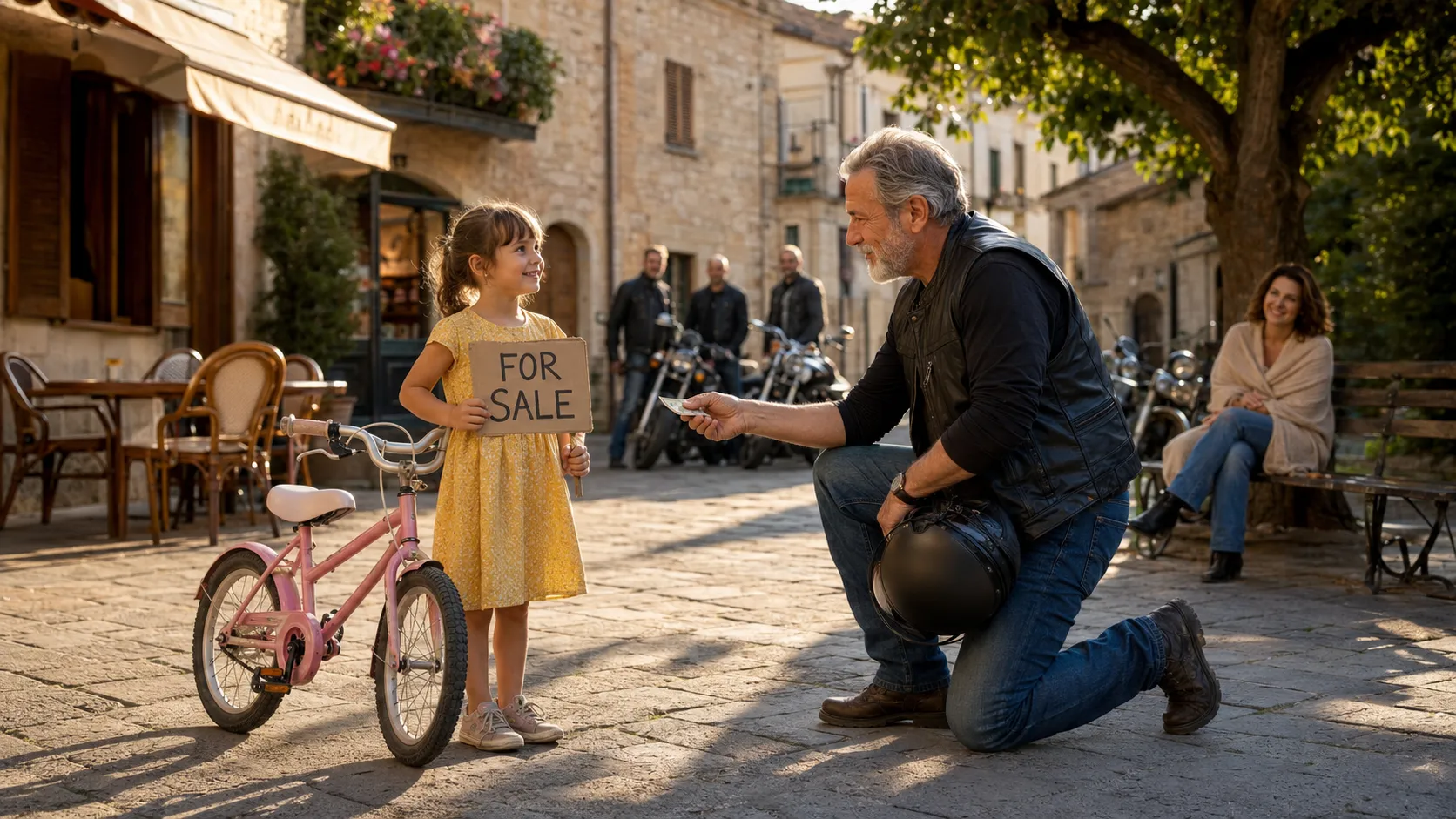
Rocco thought he had seen every kind of pain on the road. Then a six-year-old girl offered him her pink bicycle for twenty euros because her mother had not eaten in two days.
“Would you buy my bicycle, sir? My mother hasn’t eaten in two days.”
The words were so small they almost disappeared beneath the low rumble of the motorcycles.
Rocco Balestri heard them anyway.
He was riding through Borgoforte with three men from the Iron Falcons — Toro, Michele, and Vipera. They wore black leather vests, heavy boots, and the red falcon patch on their backs. People usually stepped aside when they saw them coming.
But that afternoon, a little girl stopped all four motorcycles as if she had placed a rope across the road.
She stood on the sidewalk beside a small pink bicycle. The basket was cracked and held together with tape. A piece of cardboard hung from the handlebars.
FOR SALE
The girl’s yellow dress was faded. Her shoes were worn thin. She could not have been more than six.
Rocco turned off his engine.
One by one, the others did the same, until the whole street went quiet.
He removed his helmet and crouched to her height.
“What’s your name, little one?”
The girl twisted the cardboard sign in her fingers.
“Mia.”
“Mia,” he repeated gently. “You’re selling your bicycle?”
She nodded quickly. “It still works. I can clean it. I just… I need money for food.”
Her voice broke.
“My mother hasn’t eaten in two days.”
Rocco felt something tighten in his chest.
He had heard grown men beg with pride still stuck between their teeth. He had seen liars ask for money with clean hands and false eyes. But a child selling the one thing that still looked like childhood?
That was different.
Mia glanced toward a tree near the edge of the sidewalk.
A woman sat beneath it, wrapped in a thin blanket. Her face was pale, her body too still, as if even pretending to be strong had become too heavy.
“Is that your mother?” Rocco asked.
Mia nodded. “She says we’ll be okay. But she says that so I won’t be scared.”
That sentence hit Rocco harder than he expected.
The child had already learned how adults lie when love is the only thing they have left.
He walked slowly toward the woman.
“Signora,” he said. “Are you all right?”
The woman lifted her head. Her eyes were tired, but there was still pride in them.
“I’m fine,” she said automatically, then looked ashamed of the lie. “I’m Clara Ferri. I’m sorry if my daughter bothered you.”
Mia rushed forward. “Please, sir. The bicycle is twenty euros. I can even—”
Rocco turned back to her and swallowed.
He had been a father once.
Not long enough to learn everything, but long enough to know what it meant to lose the sound of a child’s voice.
His son had died in a car accident eight years earlier. Since then, Rocco had filled the silence with engines, roads, and charity rides — anything that let him feel useful without saying the word grief.
Now this little girl was offering her bicycle like payment for her mother’s survival.
Rocco took out his wallet.
He placed several folded bills into Mia’s hands — far more than twenty euros.
“The bicycle stays with you,” he said. “You already earned this.”
Mia stared at the money as if it might disappear.
“It’s too much.”
“No,” Rocco said softly. “It is exactly what it should be.”
Toro stepped forward and added money. Then Michele. Then Vipera, silent as ever, placed bills in the girl’s trembling hands.
Clara tried to stop them.
“No. We can’t accept this.”
Rocco raised one hand.
“Let your daughter breathe,” he said. “This is not charity. This is community.”
Clara looked at the four men in leather as if she still did not know whether to be afraid.
“Why?” she whispered. “You don’t even know us.”
Rocco looked at Mia.
“We know enough.”
Then his voice changed.
“Who did this to you?”
Clara lowered her eyes.
“My boss.”
“Name.”
“Riccardo Gherardi. Gherardi Industries. I worked in administration. I got sick for a week and missed two days. I asked for more time, but he said I was replaceable.”
Replaceable.
The word hung in the air like poison.
Rocco’s jaw tightened.
“Where is his office?”
Clara became frightened. “Please, no. I don’t want trouble.”
“He already made trouble,” Rocco said. “You do not owe him your silence.”
He crouched once more in front of Mia.
“You stay with your mother. And you do not sell that bicycle. Do you hear me?”
Mia nodded.
Rocco turned to Toro. “Stay with them. Food first. Then somewhere safe.”
Toro was already on the phone.
Then three motorcycles started again.
They were not going to start a fight.
Rocco had buried enough fights in his life.
They were going to deliver a reminder: cruelty does not become invisible just because it wears a suit.
Gherardi Industries occupied the most elegant building in town — glass, steel, and arrogance. The lobby smelled of expensive perfume and polished stone.
The receptionist stiffened when she saw the leather vests.
“We’re here to see Riccardo Gherardi,” Rocco said calmly.
“Do you have an appointment?”
“Five minutes will be enough.”
Minutes later, they were taken into a bright office lined with awards, framed photographs, and a polished desk large enough to make any visitor feel small.
Riccardo Gherardi stood behind it with the smooth smile of a man used to being obeyed.
“Gentlemen,” he said. “How may I help you?”
Rocco placed something on the desk.
Mia’s cardboard sign.
FOR SALE
Gherardi frowned. “What is that?”
Rocco leaned forward, not threatening him, only refusing to let him look away.
“That,” he said, “is the price of your greed.”
Michele spoke next, controlled and precise.
“Three blocks from here, a woman named Clara Ferri is sitting under a tree with no food. Her six-year-old daughter was trying to sell her bicycle because you fired her for being sick.”
Gherardi’s smile weakened.
“We had budget cuts. Difficult decisions.”
Vipera finally spoke, his voice low and rough.
“Payroll is not a budget cut.”
Gherardi straightened. “My company is my business.”
Rocco placed his palm flat on the desk.
“No. People are not pieces you throw away.”
The office went silent.
“What do you want?” Gherardi asked.
“You will pay Clara for the week she was sick. You will give her severance. And you will sign a reference letter so she can find work somewhere that remembers employees are human.”
Gherardi gave a dry laugh.
“And if I refuse?”
“Then Clara files a complaint with the labor inspectorate,” Rocco said. “And your name becomes part of a story about a child selling her bicycle so her mother doesn’t starve.”
He tapped the cardboard sign.
“Your charity posters will start looking like what they are — a lie.”
For the first time, color left Gherardi’s face.
He stared at the sign as if it weighed more than his whole desk.
Finally, he swallowed.
“Send me her information.”
Michele slid a folded note across the desk.
Rocco turned to leave, then stopped at the door.
“Forgiveness cannot be bought,” he said. “But you can begin to deserve it. Start today.”
That evening, strange things began happening in Borgoforte.
Anonymous donations paid overdue bills. Boxes of groceries appeared at shelters and parish centers. Two employees dismissed “for budget reasons” were quietly called back.
Clara received an email.
Attached was a signed reference letter from Riccardo Gherardi himself.
No one knew why.
But some people guessed.
When the sun began to set, three motorcycles returned to the same street.
Mia saw them first.
“Mama! They came back!”
Clara stood slowly. She was still weak, but her back seemed straighter now, as if hope had put bones back where exhaustion had taken them.
Rocco carried a paper bag. Toro carried two boxes of groceries.
“You didn’t have to come back,” Clara whispered.
“We wanted to make sure you were all right,” Rocco said.
Mia hugged her pink bicycle. “I cleaned it. Look.”
Rocco smiled. Not the hard smile people expected from men like him. A tired, true one.
“It looks new,” he said. “Keep it that way.”
Clara tried to hand some of the money back.
Rocco gently closed her fingers around it.
“You owe us nothing,” he said. “Only one thing.”
“What?”
“Don’t give up. Not on her. Not on yourself.”
Clara’s tears finally fell.
“I promise.”
They sat under the tree as the sky turned gold. Mia rode her bicycle in small circles on the sidewalk, her laughter cutting through the silence like sunlight after a storm.
Later, when the motorcycles disappeared down the road, Mia fell asleep holding the handlebars of her bicycle, as if it were proof she did not have to sell her childhood to keep her mother alive.
And miles away, Rocco looked up at the stars and thought of the son he had lost.
For the first time in a long while, he felt he had done something right.
Because real strength is not in fists or fear.
Sometimes it is simply in stopping for a child no one else was willing to hear.


