
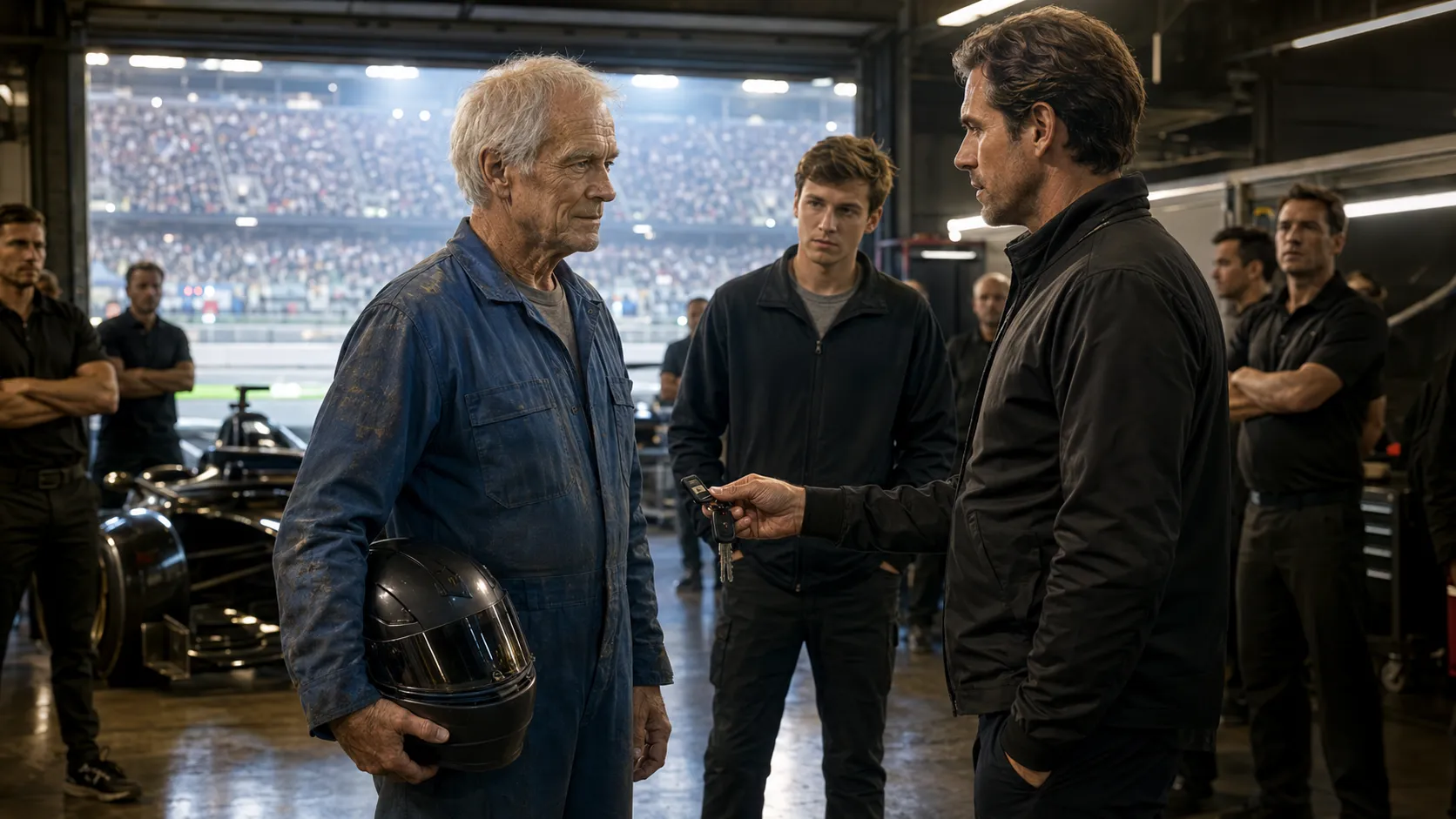
Falcon Racing had lost every driver minutes before the championship, and everyone thought the team was finished. Then Frank, the quiet janitor they mocked every day, picked up the keys and reminded the whole stadium why legends are never truly gone.
The stadium was already roaring when Falcon Racing fell apart.
Thousands of fans filled the grandstands. Cameras flashed over the track. Engines growled beneath the lights like thunder waiting to break loose.
Inside Pit Garage 7, Marcus Reed slammed his fist against a tool cabinet.
“Our driver is gone?” he shouted.
His assistant Ethan nodded, pale. “The Black Titans bought him out this morning.”
For a moment, no one spoke.
The team’s best driver had abandoned them less than an hour before the championship. Sponsors were watching. Reporters were waiting. Mechanics stared at the floor because they all understood what this meant.
Falcon Racing was finished.
Then a calm voice came from the garage entrance.
“I can drive.”
Everyone turned.
Frank, the old janitor, stood there in faded blue overalls with a mop in one hand and a bucket in the other. His beard was gray, his sleeves were stained with oil, and most people in the stadium walked past him every day without learning his last name.
Marcus stared at him.
“You?”
Frank nodded. “I know this track.”
The garage exploded with laughter.
One mechanic nearly choked on his coffee. Another covered his face. Marcus stepped forward, furious.
“This isn’t a game. Go clean the hallway.”
Frank did not argue.
He only looked toward the track with quiet disappointment, picked up his bucket, and walked away.
Twenty minutes later, disaster returned.
Falcon’s backup driver crashed during warm-up and was taken out with a broken shoulder. The car survived. The driver could not race.
An official entered the garage with a clipboard.
“You have ten minutes to name a driver, or you’re disqualified.”
Marcus felt the world closing in around him.
Debt.
Sponsors.
Employees.
Years of work.
Everything would collapse in one night.
Then Ethan said carefully, “There is one option.”
Marcus turned.
“No.”
“The janitor sounded confident.”
“He’s old.”
“He may also be all we have.”
Five minutes later, Marcus found Frank mopping near the service hall.
“You really think you can handle that car?”
Frank looked up calmly.
“Yes.”
“You have experience?”
Frank was quiet for a moment.
“A little.”
Marcus threw him the keys.
“If you wreck my car, I’ll spend the rest of my life regretting this.”
Frank caught the keys with one hand.
The motion was clean.
Too clean.
When the stadium screen showed Frank walking toward the Falcon racing suit, the crowd laughed. Social media mocked the team instantly. Rival crews pointed and smiled.
Then an elderly commentator in the media booth stood so fast his chair rolled backward.
“No way,” he whispered.
The younger commentator frowned. “You know him?”
The old man stared at the screen.
“That’s Frank Dalton.”
The name moved through the booth like electricity.
Twenty-five years earlier, Frank Dalton had been the most feared driver in America. People called him The Ghost because he could move through impossible gaps as if the car had no weight. Sponsors begged him to race professionally.
Then his younger brother died during a championship night while working as his mechanic.
After that, Frank vanished.
No interviews.
No races.
No goodbye.
Most people thought he was dead.
Now he was standing on the starting grid in a janitor’s uniform beneath a borrowed racing suit.
Marcus heard the commentators and turned toward him in shock.
“You’re Frank Dalton?”
Frank tightened his gloves.
“I used to be.”
“Why are you cleaning floors?”
Frank looked at the track.
“Because after my brother died, winning stopped feeling worth anything.”
The countdown began before Marcus could answer.
Three.
Two.
One.
The cars launched forward.
Falcon dropped to last almost immediately, and the crowd laughed again. Marcus buried his face in his hands.
Then Turn 4 came.
Frank changed.
His car slipped through the corner with impossible control, smooth as a blade. One car disappeared behind him. Then another. Then another.
The laughter died.
By Lap 8, he was fourth.
By Lap 11, second.
The whole stadium was standing now.
Then rain began falling across the track.
Drivers slowed. Tires slipped. Warnings flashed. Marcus screamed into the radio.
“Frank, slow down!”
Frank’s voice came back calm.
“No.”
He accelerated.
The car sliced through the rain as if the storm belonged to him. Every corner was measured. Every move was quiet, patient, exact.
On the final lap, Frank was behind the Black Titans driver — the same team that had stolen Falcon’s champion that morning.
The rival blocked him hard.
The finish line was close.
Then Frank drifted through the final corner inches from the wall, using the rainwater like a guide instead of a threat. The rival hesitated for half a second.
That was enough.
Frank passed him.
Falcon Racing crossed the line first.
The stadium exploded.
When Frank removed his helmet, the crowd chanted his name. Reporters surrounded him. Marcus stood frozen, tears in his eyes.
One reporter asked, “Why come back after twenty-five years?”
Frank looked toward the track.
“My brother loved racing,” he said softly. “Tonight, I wanted to remember why I loved it too.”
Marcus stepped forward with a contract in his hand.
“You’re not cleaning floors anymore,” he said. “Drive for us.”
Frank looked at the paper for a long time.
Then he shook his head.
“I’ll drive one more season. But only if the team starts a training program for young mechanics who can’t afford racing school.”
Marcus stared at him.
Frank smiled faintly.
“My brother was a mechanic. People like him deserve a way in.”
One year later, Falcon Racing was no longer known only for the miracle race.
It was known for the Dalton Garage — a program where janitors, mechanics, and overlooked workers could prove what they knew before the world decided who they were.
Frank still arrived early.
Sometimes in a racing suit.
Sometimes in blue overalls.
But no one laughed when he walked through the garage anymore.
Because that night had taught them something the track never forgot:
a man’s uniform may tell you his job…
but it does not tell you his story.


