
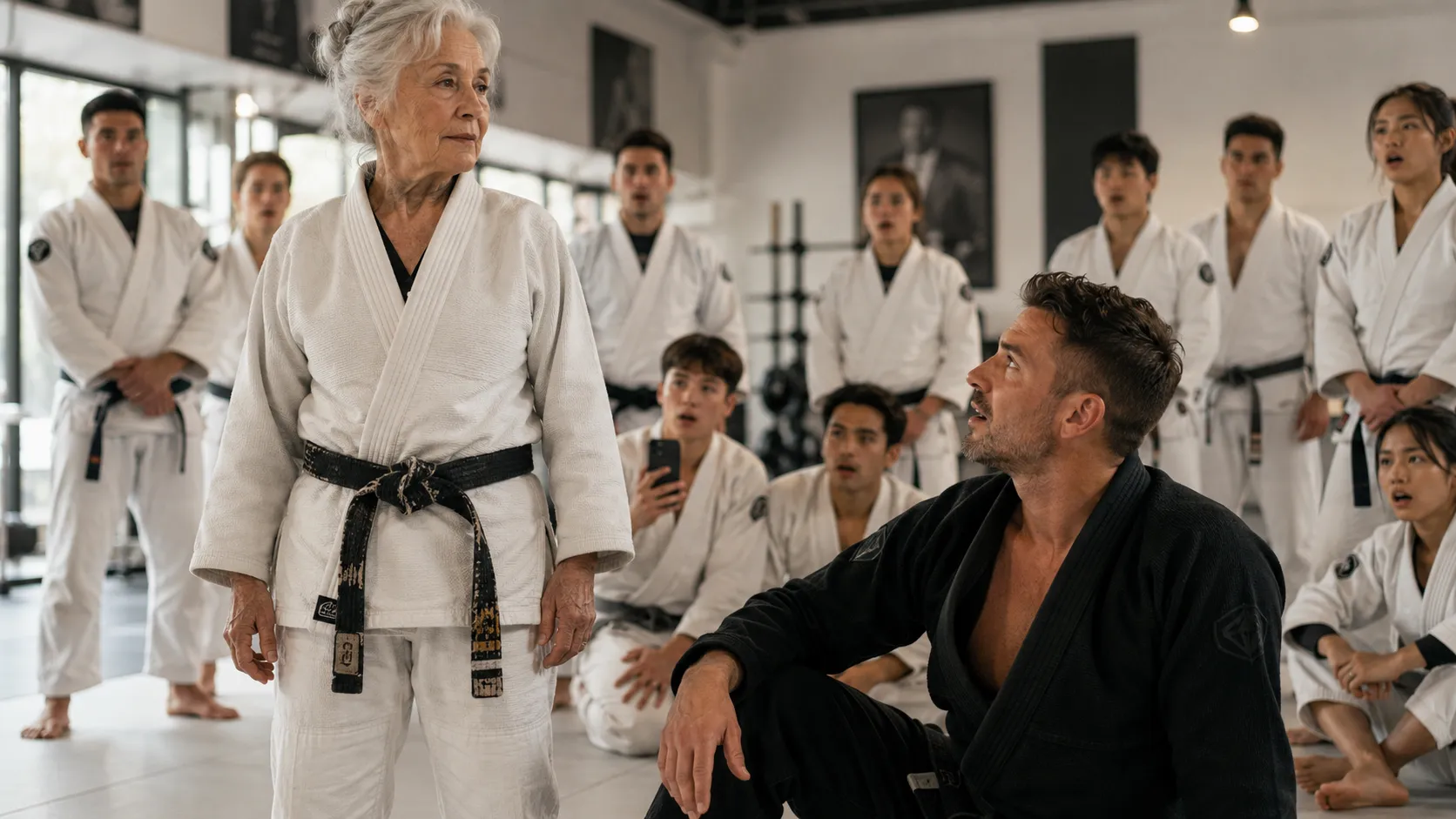
Edith Simmons walked into the academy with silver hair, careful steps, and a faded black belt hidden in her bag. The coach called her “Grandma” in front of everyone — until she stepped onto the mat and showed them what forty years of discipline looked like.
Edith Simmons tied her silver hair into a neat bun and placed her old black belt inside her gym bag.
She was seventy-two years old, widowed, and new in town. Most people her age were told to slow down, sit still, protect their joints, and accept the quiet shrinking of life.
Edith had never been good at accepting things.
For more than forty years, jiu-jitsu had been her anchor. She had trained when women were rare on the mat. She had raised children, cared for her husband, worked through pain, and still returned to practice again and again.
The belt in her bag was faded at the edges, but she had earned every thread.
That morning, she walked into Elite Martial Arts Academy hoping only to find a place to train.
The receptionist looked up and smiled politely, but her eyes gave her away.
“Can I help you?”
“I’d like to join the jiu-jitsu class,” Edith said.
The young woman hesitated. “We also have senior yoga on Tuesdays.”
Edith smiled.
“I’ve been practicing jiu-jitsu since 1980.”
The receptionist blinked.
A few minutes later, Edith stepped onto the training floor. The room was bright, modern, and full of young athletes in crisp uniforms. Some were warming up. Some were laughing. Then they noticed her.
The laughter softened into whispers.
Coach Adam Jackson crossed the mat with the confidence of a man used to being admired. He was strong, athletic, and young enough to believe age was a weakness.
“I think you may be in the wrong room,” he said. “Tai Chi is down the hall.”
The students laughed.
Edith bowed respectfully.
“I’m here for jiu-jitsu.”
Jackson looked her up and down.
“At your age? This is a competition-level class.”
“I understand.”
He smirked. “Can you even get up from the ground without help?”
More laughter.
Edith did not answer the insult. She had learned long ago that people who underestimate you often give you their balance before they realize it.
“What belt are you claiming?” Jackson asked.
“I don’t claim it,” she said calmly. “I earned my second-degree black belt under Master Hiroshi Takahashi.”
For one second, Jackson’s expression changed.
He knew the name.
Then pride returned.
“Standards were different back then,” he said. “Why don’t you observe today?”
Edith’s eyes stayed steady.
“I didn’t come to watch. I came to train.”
The room went quiet.
Jackson folded his arms. “Fine. I’ll assess you.”
He gestured to a younger student, but Edith raised one hand.
“If you’re evaluating me, Coach Jackson, it should be with you.”
A low murmur moved across the mat.
Jackson’s smile tightened.
“You want to roll with me?”
“You are the head instructor, aren’t you?”
Now he could not refuse.
The students formed a circle. Some looked excited. Some looked embarrassed for her. One pulled out a phone, ready to record what he thought would be a funny moment.
Jackson stepped forward.
“I’ll go light,” he announced. “No submissions. Just basic movement.”
Edith nodded.
“Begin.”
Jackson reached for her sleeve.
That was his mistake.
Edith moved so slightly that most students barely saw it. Her hand caught his wrist, her foot adjusted, and his balance vanished before his strength could help him.
He stepped forward to recover.
She was already waiting.
In one smooth motion, Edith redirected his weight, dropped under his center, and sent him to the mat. Before his knees fully landed, she had mounted him with perfect control.
The room gasped.
Jackson pushed.
Another mistake.
Edith shifted her hips, isolated his arm, and locked the submission so cleanly that the whole academy seemed to freeze.
Jackson slapped the mat.
“Tap!”
Less than ten seconds.
Silence.
Edith released immediately, stood, straightened her kimono, and bowed.
“Thank you for the assessment, Coach.”
No one laughed now.
Jackson sat up slowly, red-faced and stunned.
“Who are you really?”
“I already told you,” Edith said. “Edith Simmons.”
A student near the back whispered, “Edith Simmons? She was Takahashi’s top female competitor. Three-time regional champion.”
The coach lowered his eyes.
“I owe you an apology.”
Edith looked around the room.
“Not only to me. To everyone you’ve ever judged before they had a chance to show you who they were.”
That hurt more than the armbar.
Then one student stepped forward.
“Can you show us how you did it?”
Edith glanced at Jackson.
This time, he bowed first.
“Please,” he said. “Teach us.”
For the next hour, the class became silent in a different way. Not awkward. Not ashamed.
Focused.
Edith explained leverage, timing, patience, and humility. She showed them that technique was not about youth overpowering age. It was about understanding the moment before force arrived.
Three months later, the academy had changed.
Older students joined. Beginners felt welcome. Jackson became a better coach because he had finally learned how dangerous arrogance can be on a mat.
And every Tuesday morning, Edith Simmons stepped onto the floor, bowed, and trained.
Not to prove she was young.
Not to prove anyone wrong.
But because discipline does not retire when the body grows older.
Sometimes it simply waits for someone foolish enough to laugh.


