
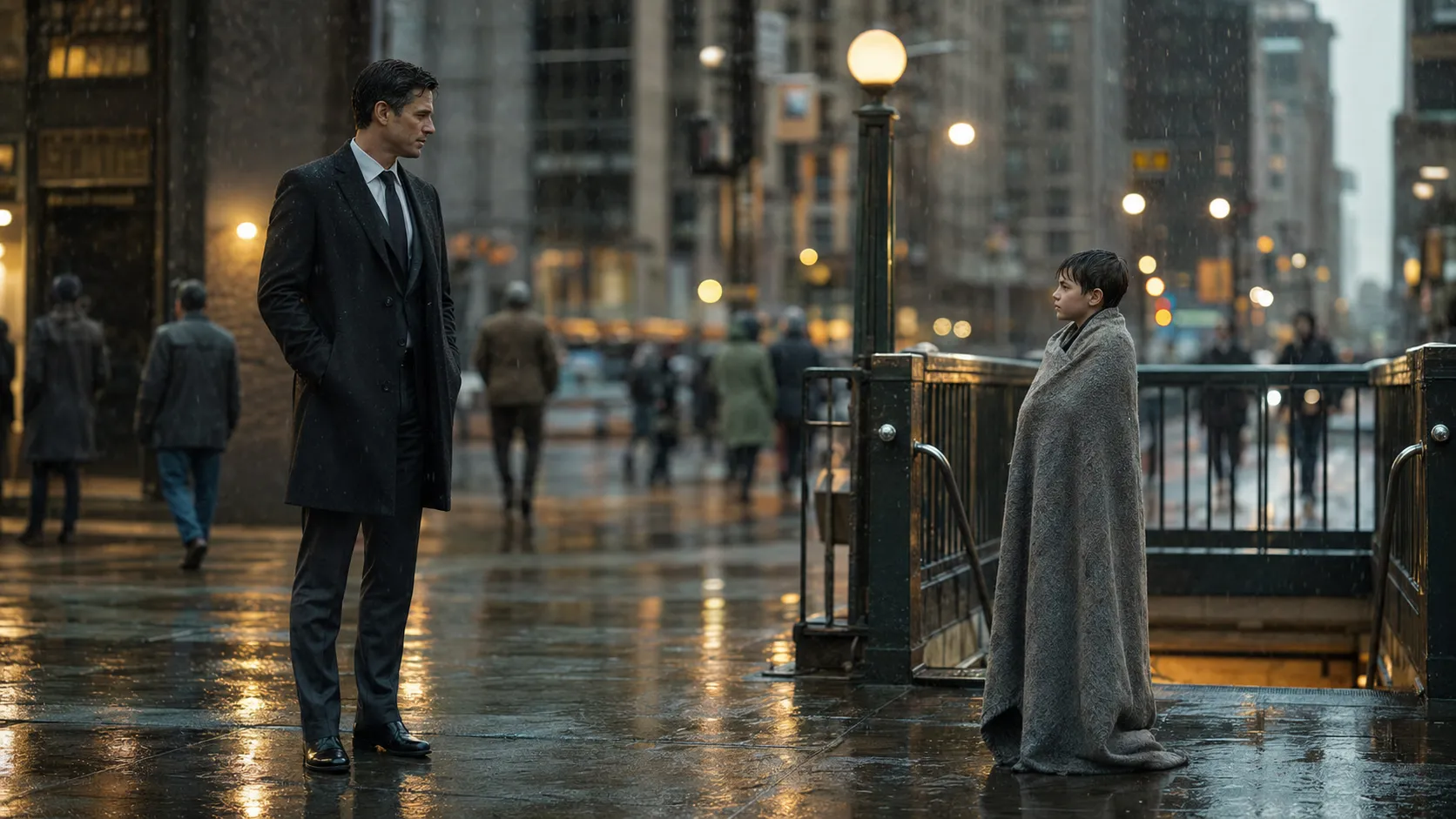
Daniel Harper thought a few hundred dollars could buy him ten seconds of kindness. But the hungry boy on the sidewalk refused the money and spoke one sentence that dragged Daniel back to the night he had spent twelve years trying to forget.
The boy sat near the subway entrance with a cardboard sign across his knees.
HUNGRY.
Most people in downtown Chicago passed without slowing. A few tossed coins. Others looked away before guilt could catch them.
Daniel Harper noticed him only because the boy did not look up.
Daniel was thirty-seven, rich, feared, and dressed in a black suit that made strangers step aside before he asked. His investment company owned buildings, ruined competitors, and turned struggling families into numbers on spreadsheets.
He had learned long ago that money made people listen.
So he pulled several hundred-dollar bills from his wallet and held them out.
“Here,” he said. “Buy yourself food.”
The boy looked at the money.
Then he looked at Daniel.
“Keep it.”
Daniel frowned. “Excuse me?”
The boy’s voice stayed calm.
“You’re going to need it soon.”
People nearby slowed down.
Daniel’s face hardened. “You think this is funny?”
The boy said nothing.
Daniel shoved the cash closer. “Take it.”
The child shook his head.
“You’re about to lose everything.”
Before Daniel could answer, his phone rang.
He almost ignored it. Then he saw his assistant’s name.
“What?” he snapped.
The voice on the other end was shaking.
“Sir, federal investigators froze the company accounts.”
Daniel went still.
“What?”
“The board is resigning. Investors are pulling out. Internal documents leaked online. Every news channel has it.”
Daniel’s grip tightened around the phone.
“That’s impossible.”
“There’s more,” the assistant whispered. “Mr. Lawson is gone.”
Daniel lowered the phone slowly.
The city around him blurred — traffic, sirens, footsteps, rainwater running along the curb.
The boy was still watching him.
Daniel knelt in the wet pavement, not caring that his expensive pants were ruined.
“How did you know?”
The boy looked toward the subway stairs.
“Do you remember Ashbury Shelter?”
Daniel stopped breathing.
Ashbury Shelter.
South Side. Winter. Broken windows. Thin blankets. Children sleeping close together for warmth.
Daniel had lived there before the suits, before the cars, before he became the kind of man who believed poor people were interruptions.
“How do you know that place?” he whispered.
The boy’s eyes softened with a sadness too old for his face.
“You used to sleep by the back window. You hated the cold.”
Daniel stepped back.
Nobody knew that.
Nobody alive.
The memory returned in pieces.
A smaller boy at the shelter. Quiet. Sick most nights. Always hungry. Daniel had shared bread with him when he could. His name had been Noah.
Then came the fire.
The owner had locked the rear exit to hide overcrowding from inspectors. A heater sparked. Smoke filled the hallways. Children screamed. Daniel, fifteen and terrified, escaped through a broken side window.
Noah had been trapped behind fallen wood.
Daniel had shouted, “I’m coming back!”
But outside, the smoke, the sirens, and fear swallowed him.
He ran.
By morning, the shelter was gone.
So was Noah.
Daniel stared at the boy on the sidewalk.
“No,” he whispered. “You died.”
The boy gave a faint, unreadable smile.
“Maybe.”
Daniel’s hands began to shake.
The life he had built suddenly looked like a monument to cowardice. He had become rich by crushing the weak because he had once been weak himself. He had stepped over people in the street because looking at them reminded him of who he used to be.
The boy glanced at the money still in Daniel’s hand.
“You became the kind of person who ignored us.”
Daniel sat down beside him on the wet sidewalk.
For the first time in years, he did not care who saw him cry.
“I should have come back for you,” he said.
The boy was quiet.
“I was scared,” Daniel whispered. “I was just a kid.”
“Yes,” the boy said. “But you stopped being a kid a long time ago.”
Those words hurt worse than accusation.
Daniel looked across the street at the news screens in the bank window. His company’s name flashed in red. Fraud investigation. Frozen assets. Partner missing. Empire collapsing in public.
Everything he had worshipped was falling.
And somehow, in the ruin, he felt the first honest breath he had taken in years.
“What do you want from me?” Daniel asked.
“Nothing.”
“Then why are you here?”
The boy stood and pulled the torn blanket around his shoulders.
“To tell you that you still have time.”
“To save the company?”
The boy shook his head.
“To become human again.”
A bus roared past between them.
For two seconds, Daniel lost sight of him.
When the bus moved on, the sidewalk was empty.
The boy was gone.
Only the cardboard sign remained near the subway entrance.
Daniel picked it up with trembling hands.
The word HUNGRY had vanished.
In its place, written in dark, uneven letters, were four words:
NOT HUNGRY ANYMORE.
The next morning, Daniel resigned before the board could remove him. He turned over evidence against Lawson, admitted what he had known, and used what money remained outside the frozen accounts to reopen the Ashbury Shelter case.
A memorial was built where the shelter once stood.
Then Daniel did something no one expected.
He created the Noah House Foundation — not with speeches, not with cameras, but with beds, hot meals, legal help, and winter coats for children the city had learned not to see.
People called it redemption.
Daniel never did.
Redemption sounded too clean.
He knew the truth.
A boy had died waiting for him to come back.
And years later, whether as memory, ghost, or mercy, that same boy had returned to save what was left of his soul.


