
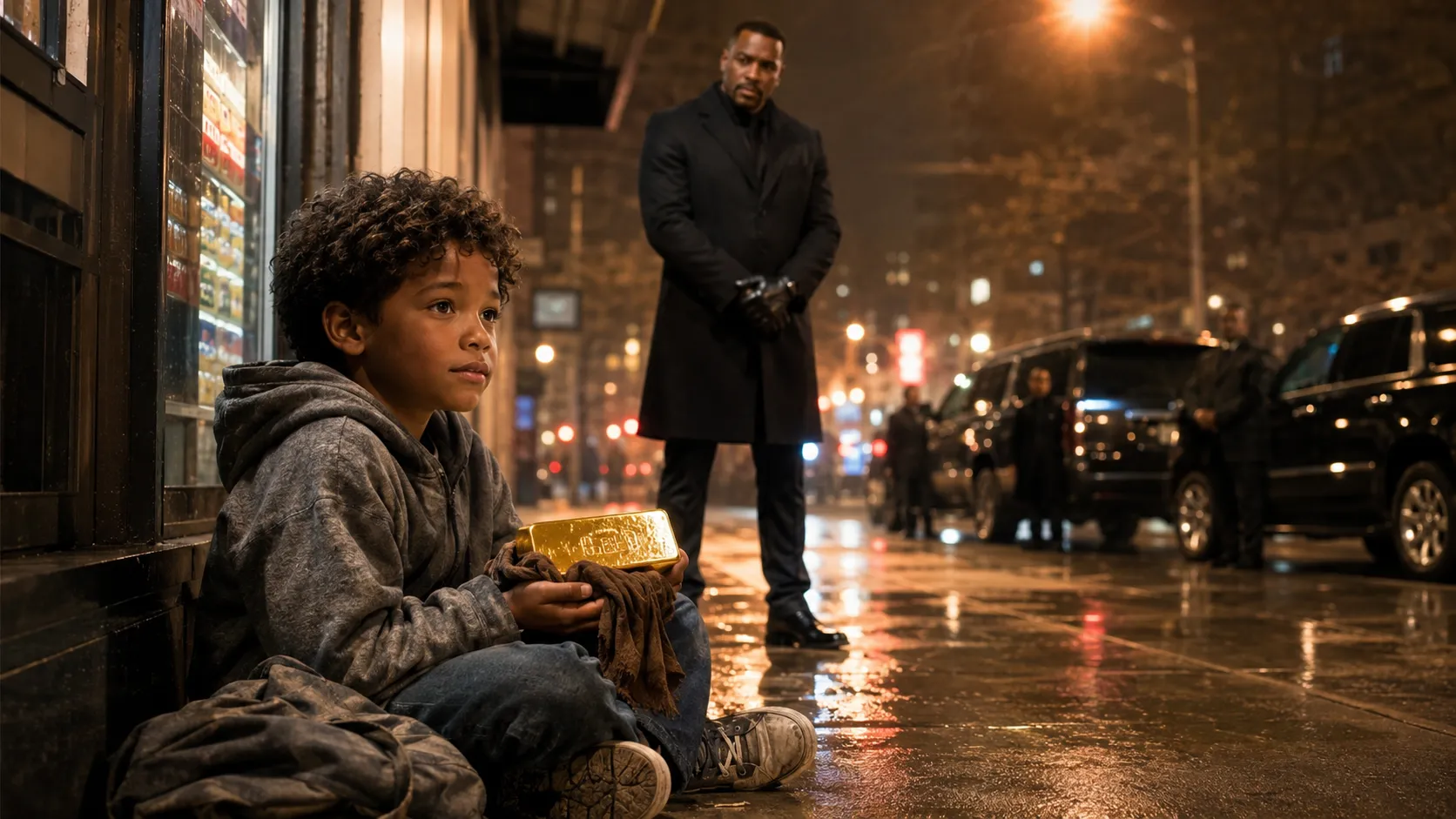
Marcus thought the gold brick in his hands was the first miracle life had ever given him. But when a greedy man tried to steal it, three black SUVs arrived — and the truth behind the old stranger changed everything.
The rain had been falling over downtown Chicago for hours.
People rushed past the closed convenience store without looking down, without slowing, without noticing the small boy curled beside the wall.
His name was Marcus.
He was seven years old.
His hoodie was soaked, his fingers trembled from the cold, and the torn backpack beside him held everything he owned: one dirty blanket, two candy bars, and an old photograph of his mother.
But that night, Marcus held something impossible in his lap.
A gold brick.
Real gold.
Three hours earlier, an old man with a silver cane had stopped near the subway entrance and knelt in front of him.
“Protect this,” the stranger had said. “One day, it will change your life.”
Then he disappeared into the crowd.
At first, Marcus thought it was a toy. But when he scraped one corner against the sidewalk, the metal underneath shone bright yellow beneath the dirt.
He did not know how much it was worth.
He only knew it felt like hope.
Maybe food.
Maybe a warm bed.
Maybe a way to find his mother again.
Marcus hugged the brick tightly against his chest.
That was when a man in a brown leather jacket stopped in front of him.
“What are you holding there, kid?”
Marcus pulled the brick closer.
The man crouched, staring not at Marcus, but at the gold.
“That thing is dangerous,” he said with a fake smile. “You shouldn’t carry junk like that. Give it to me.”
“No,” Marcus whispered. “Someone gave it to me.”
The kindness vanished from the man’s face.
He looked around the empty, rain-soaked street.
No police.
No witnesses.
No one willing to stop.
Then he lunged.
Marcus screamed as the man grabbed the gold and tried to tear it from his arms.
“Give it to me!” the man shouted.
People across the street glanced over, then kept walking.
Nobody wanted trouble.
Marcus slipped on the wet pavement, crying, still holding on with all the strength his small hands had left.
Then a large hand clamped down on the man’s shoulder.
The man froze.
Behind him stood a tall man in a dark coat and black gloves. Rain rolled down his shaved head, but his face stayed calm.
Too calm.
“I think,” the stranger said quietly, “the boy told you no.”
The man released the gold at once.
Marcus fell back against the wall, shaking.
The tall stranger crouched beside him.
“You okay, little man?”
Marcus nodded, still crying.
The thief tried to laugh. “I was only helping him.”
The stranger looked at him.
“You call stealing from children helping?”
The man’s face turned pale.
Before he could answer, headlights appeared through the rain.
One black SUV stopped at the curb.
Then another.
Then a third.
Four men in suits stepped out and approached the tall stranger with respect.
“Sir,” one said, “we found you.”
Marcus stared, confused.
The stranger sighed and looked back at him.
“Do you remember the old man who gave you the gold?”
Marcus nodded. “The man with the cane.”
“That was my father.”
Marcus blinked.
“My name is David King,” the man said. “My father owns one of the largest gold companies in America.”
The thief stepped back in panic.
David did not look away from Marcus.
“My father spent years walking through cities in disguise. He believed kindness still existed, even when the world looked away. Sometimes he gave valuable things to strangers to see what they would do.”
Marcus looked down at the brick.
“You mean… he wanted me to keep it?”
“Yes.”
David’s voice softened.
“He chose you because he watched you for three days. Yesterday, you shared one of your candy bars with another homeless child, even though you barely had anything yourself.”
Marcus remembered the little girl near the train station.
He had thought no one saw.
David smiled faintly.
“My father said most adults passed hungry people without seeing them. But you didn’t.”
Police sirens echoed down the street.
The thief tried to run, but the suited men stopped him before he reached the curb. David told the officers the man had been following his father for weeks, waiting to steal from whoever received the gold.
Marcus watched the man disappear into the rain in handcuffs.
Then the street became quiet again.
David sat beside Marcus under the store awning.
“You hungry?”
Marcus nodded shyly.
“Good,” David said. “I know a place with the best pancakes in Chicago.”
Marcus looked at the gold brick in his lap.
“How much is it worth?”
“Enough to change your future,” David said.
Marcus was silent for a long moment.
Then he asked, “Can it help other kids too?”
David stared at him.
After everything — the cold, the hunger, the fear — the boy was still thinking about someone else.
Slowly, David smiled.
“Yes,” he said. “I think it can.”
That night, Marcus did not sleep beside the closed store.
He ate warm pancakes. He wore dry clothes. He sat in a safe room while David’s people searched for his mother and arranged care that did not disappear by morning.
Weeks later, the gold brick became the beginning of a fund for homeless children in Chicago.
David named it The Marcus Promise.
But Marcus always remembered the old man’s words differently.
Protect this.
He had thought the old man meant the gold.
Now he understood.
Some things are worth more than money.
A kind heart.
A shared meal.
A child who still thinks of others after the world forgets him.
That was what the old man had trusted Marcus to protect.


