
Emily was eight years old, freezing, hungry, and eating abandoned pancakes when a cruel employee tried to throw her out. But one tired waitress chose kindness over money — and twenty years later, Emily returned to repay the woman who had saved her dignity.
The little girl had learned early that hunger could make people invisible.
At eight years old, Emily Carter sat alone in the corner booth of a small Chicago restaurant, her frozen hands wrapped around a chipped spoon. Outside, snow covered the sidewalks. Inside, families ate burgers, fries, pancakes, and steaks beneath warm yellow lights.
Nobody looked at her.
Her hoodie was too big. Her shoes were ripped open at the toes. Her hair was tangled from sleeping under bridges and in bus stations. For days, she had survived on scraps, and now a half-eaten plate of pancakes sat in front of her.
Someone had left it behind.
Emily had taken it quietly when no one was watching.
Every bite felt like staying alive.
Then a voice shattered the room.
“Hey!”
Emily froze.
A tall employee named Rick stormed toward her, his face twisted with anger.
“What do you think you’re doing?”
Emily held the spoon in both hands. “I was just hungry.”
Rick grabbed the plate and shoved it away so hard pancakes scattered across the table.
“You didn’t pay for that.”
Customers stared. Some looked uncomfortable. Others lowered their eyes and returned to eating, as if a hungry child was easier to ignore than a cold meal.
Emily’s eyes filled with tears.
She had been yelled at before. In shelters. In stores. On buses. On streets where adults looked through her like she was not a child at all.
Then a woman stepped between them.
Her name tag read Sarah.
She was a waitress, maybe twenty-seven, with tired eyes and shoes worn down from long shifts. But her voice was calm.
“Let her eat.”
Rick glared at her. “She’s stealing food.”
“She’s hungry.”
“That’s not our problem.”
Sarah looked down at Emily, and something in her face softened.
“You can finish eating, sweetheart.”
Emily stared up in disbelief.
Nobody had called her sweetheart in years.
Rick scoffed. “Fine. Then it’s coming out of your pay.”
Sarah hesitated only one second.
“Okay.”
The restaurant went quiet.
Rick walked away muttering, but Sarah did not let Emily eat the cold scraps. She picked up the fallen plate and returned a few minutes later with fresh pancakes, eggs, and hot chocolate.
Emily looked at the meal as if it were impossible.
“For me?”
Sarah smiled. “For you.”
Emily ate with trembling hands. She tried not to cry while chewing, but tears slipped down anyway. It was not only the food.
It was the feeling of someone choosing her over a few dollars.
When she finished, Sarah wrapped two cookies in a napkin and placed them in her hands.
“For later.”
At the door, snow blew around Emily’s thin legs.
She looked back at the waitress.
“I will remember you,” she whispered.
Sarah smiled gently, thinking it was just something a grateful child said.
But Emily meant every word.
That night became the turning point of her life.
Hours later, police found her unconscious behind a grocery store during the snowstorm. She was taken to a shelter, where an elderly volunteer named Margaret noticed something in her — not just fear, not just hunger, but manners, patience, and a quiet determination life had not managed to destroy.
Margaret became her foster mother.
The years that followed were not easy. Emily fought trauma, loneliness, bullying, and the shame of thrift-store clothes in classrooms full of children who had never slept outside.
But whenever life hurt, she remembered Sarah.
When students laughed at her shoes, she remembered the hot chocolate.
When college tuition seemed impossible, she remembered the waitress who lost pay so a homeless child could eat.
When she worked night shifts and studied business during the day, she remembered one sentence:
“You can finish eating, sweetheart.”
That memory became fuel.
By twenty-eight, Emily Carter had become one of the youngest female tech entrepreneurs in Chicago. Her logistics software company was worth millions. Magazines called her inspiring. Investors called her brilliant.
But Emily still remembered being a little girl in a corner booth with dirty shoes and frozen fingers.
And she never forgot the woman who saved her dignity.
One rainy evening, Emily sat in the back of a black car outside the old restaurant.
Her assistant looked at the flickering sign.
“Are you sure this is the place?”
Emily nodded.
“It hasn’t changed.”
Inside, the restaurant was nearly empty. The booths were worn. The lights were dimmer. The smell of coffee and pancakes was exactly the same.
Then Emily saw her.
Sarah.
She was nearly fifty now. Gray streaked her hair. Her uniform was faded. She walked with a slight limp, carrying plates carefully to a table near the window.
Emily’s chest tightened.
Twenty years vanished.
Sarah approached politely.
“Table for one?”
Emily looked at her face and realized Sarah did not recognize her.
Why would she?
To Sarah, that winter night had probably been one small act in thousands of exhausting workdays.
To Emily, it had changed everything.
“Yes,” Emily said softly.
Sarah seated her in the same corner booth.
“What can I get you?”
Emily swallowed the lump in her throat.
“Hot chocolate and pancakes.”
Sarah smiled. “Coming right up.”
While she waited, Emily quietly asked another waitress about Sarah.
The young woman sighed.
“She’s been here forever. This place would fall apart without her. Her husband died years ago, and medical bills wiped out her savings. She still works double shifts when she has to.”
Emily looked down.
The woman who had once given away money she barely had was still fighting to survive.
A few minutes later, Sarah returned with pancakes and hot chocolate.
Emily smiled through tears.
“Thank you.”
Sarah turned to leave, but Emily spoke again.
“You once helped a little girl here.”
Sarah paused.
“I’ve helped a lot of people.”
“This girl was homeless,” Emily said. “A man yelled at her because she couldn’t pay.”
Sarah’s expression changed slowly.
Emily continued, her voice trembling. “And you said, ‘Let her eat.’”
Sarah froze.
“You told him it could come out of your pay.”
The restaurant grew quiet as customers began to notice.
Sarah stared at Emily’s face.
“The little girl…” she whispered.
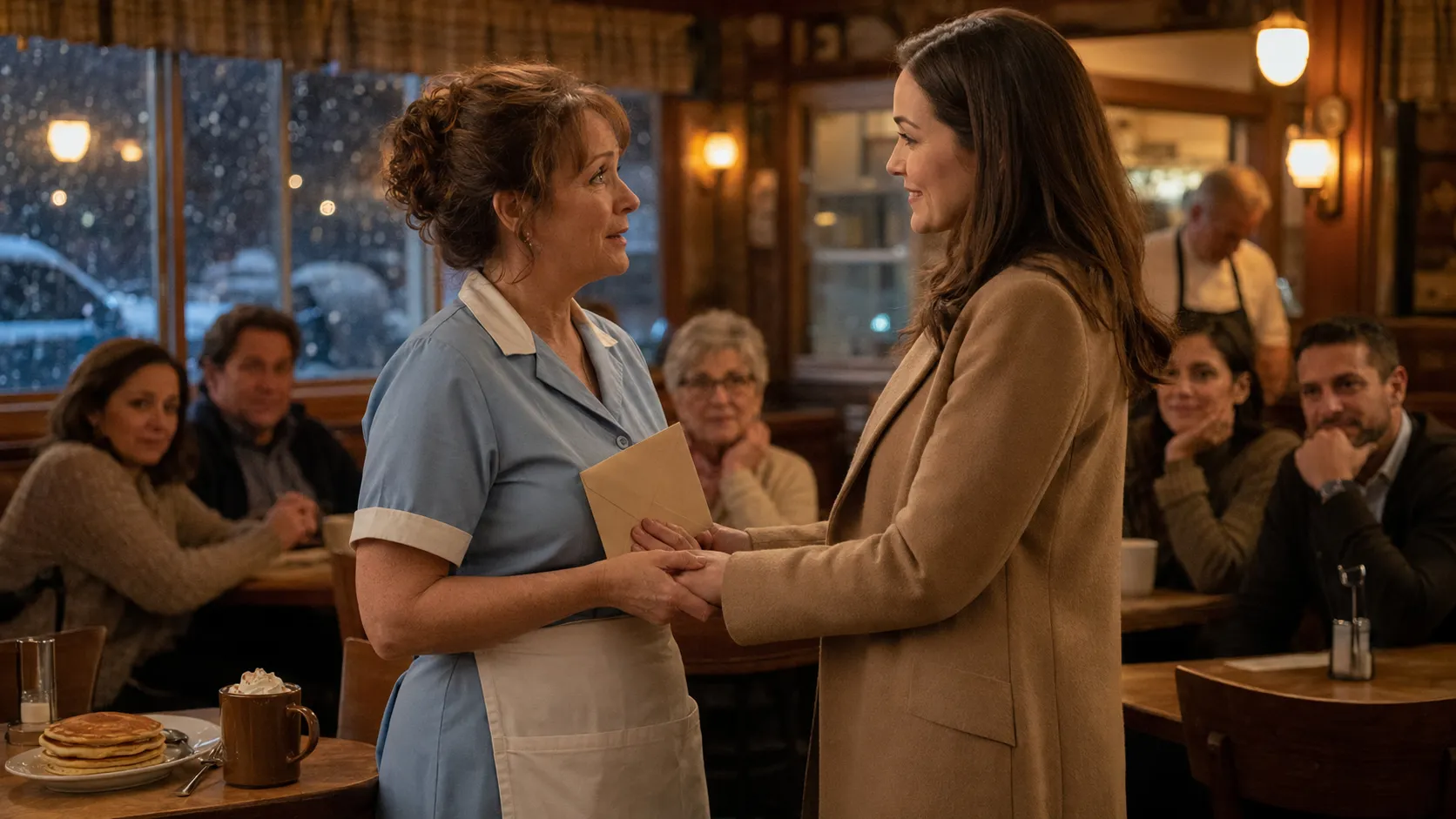
Emily stood and opened her purse.
“I remembered.”
She placed a thick envelope into Sarah’s trembling hands.
Inside was a check for two million dollars.
Sarah gasped. “I can’t take this.”
“Yes, you can,” Emily said softly. “You fed me when nobody cared if I lived or died.”
Sarah began to cry.
“It was just pancakes.”
Emily shook her head.
“No. It was hope.”
The whole restaurant fell silent. Even the kitchen staff had stopped working.
Emily held Sarah’s hands.
“That night, you treated me like I mattered. Do you know how rare that is for a homeless child?”
Sarah covered her mouth, sobbing.
For twenty years, she had worked, served, struggled, and wondered whether her life had meant anything beyond bills and tired feet.
Now the answer stood in front of her.
Emily looked around the restaurant.
“I bought this building yesterday.”
Sarah blinked. “What?”
“You’re retiring,” Emily said. “And everyone here is getting a raise.”
Gasps moved through the room.
Near the kitchen, Rick — older now, heavier, quieter — stood with his eyes lowered. He remembered. Emily saw it.
But she said nothing cruel.
She did not need revenge.
Life had already answered.
Sarah hugged her tightly.
And for the first time in twenty years, the little homeless girl who once sat alone in that corner booth finally felt full inside.
Not because she was rich.
Because the kindness that saved her had finally found its way home.


