
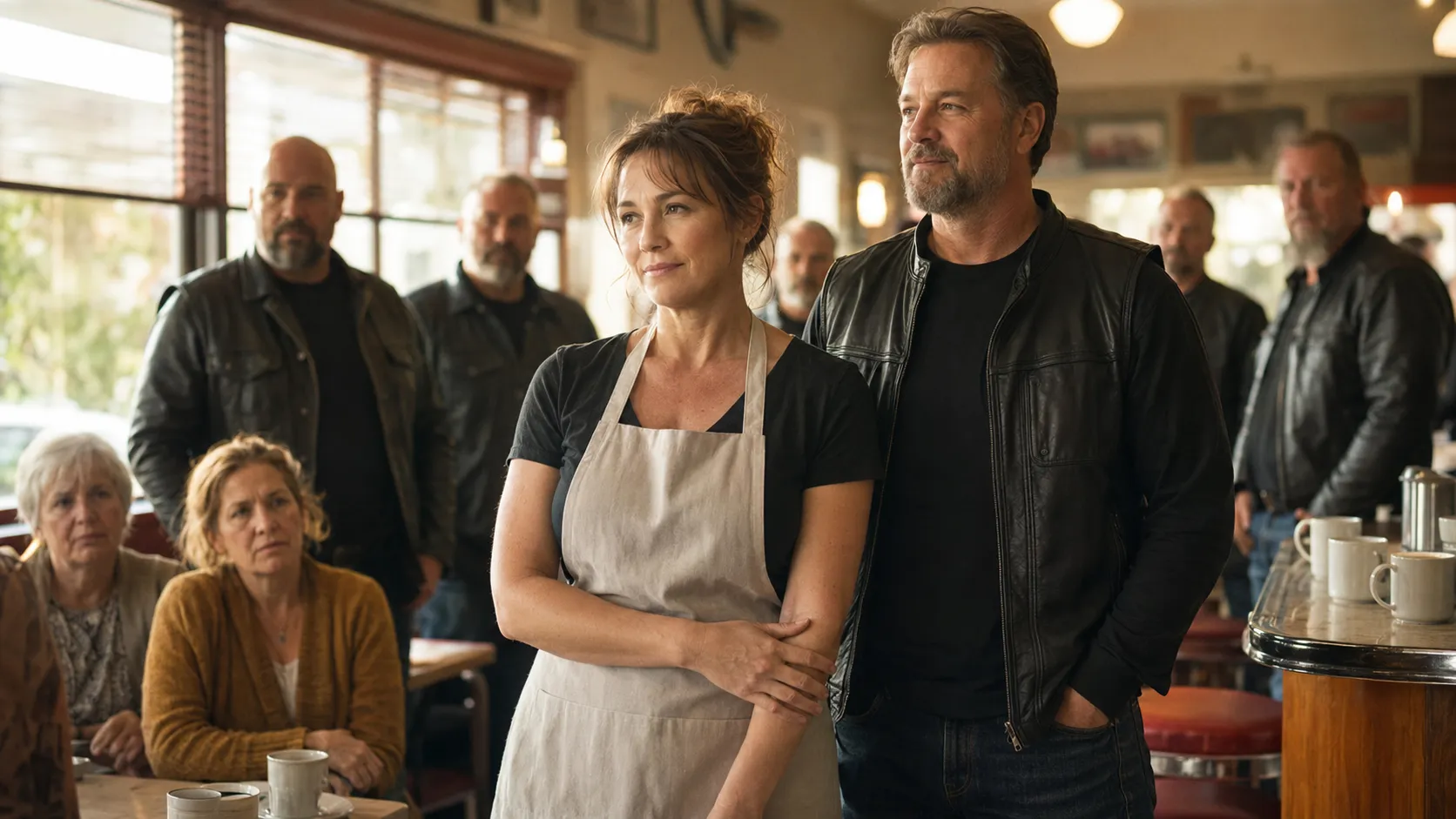
Brad thought he could shame a tired waitress because she needed the job too badly to fight back. But when he grabbed her arm and forced her against the table, he did not know her husband and an entire motorcycle club had just arrived outside.
Sunday brunch at The Maplewood always felt like a test of endurance.
The booths were full, the coffee never stopped pouring, and I had been on my feet since six that morning. My back ached, my apron was stained, and every tip mattered because my daughter’s asthma medication was waiting at the pharmacy with a price tag I still didn’t know how to cover.
Then Table 4 called me over again.
The man’s name was Brad. I learned it because his wife, Tiffany, kept saying it like a warning. He wore a sharp suit, a gold watch, and the kind of smile that made people feel small before he even opened his mouth.
“Are you deaf or just stupid?” he snapped. “I asked for ketchup three minutes ago.”
“I’m sorry, sir,” I said, forcing my voice to stay calm. “I was bringing it now.”
His wife barely looked up from her phone.
“Just comp the meal,” she said. “She ruined the whole vibe.”
Heat rose in my face, but I swallowed it. Pride did not pay rent. Anger did not buy inhalers.
“I can bring fresh eggs,” I offered.
Brad stood.
“I don’t want fresh eggs. I want competence.”
Then he shoved the plate off the table.
It hit the floor and shattered. Eggs and salsa splattered across my shoes. The diner went silent.
I took one step back.
“Sir, I’m going to ask you to leave.”
Brad laughed.
“You? You’re kicking me out?”
He moved closer until I was trapped against the counter. His cologne was sharp and expensive. His face was red with the pleasure of having an audience.
“I could buy this dump,” he said, “and fire you for fun.”
Then he grabbed my arm.
Hard.
Pain shot up to my shoulder.
“Let go of me,” I said.
He yanked me forward, forcing my hands against the edge of the table. My cheek nearly touched the cold surface.
“Apologize to my wife,” he hissed.
I looked around.
People stared.
Some held forks in midair. Some had phones half-raised. Nobody moved.
For one terrible second, I understood how cruelty survives.
Not because cruel people are strong.
Because everyone else freezes.
Then the floor began to tremble.
At first, it was low and distant. A heavy rumble rolling through the walls. Glasses shook. Silverware rattled. Outside the windows, the parking lot filled with chrome, leather, and headlights.
Motorcycles.
Dozens of them.
The bell above the door rang once.
Then again.
Heavy boots stepped onto the tile.
Brad still had my arm when the room went dark behind him.
A voice spoke from over his shoulder.
“Take your hand off my wife.”
Brad turned.
My husband, Cole, stood there in a black riding vest, his face calm in the way that meant something inside him had gone very cold. Behind him stood more riders than the diner could hold — older men, younger men, women in leather jackets, veterans, mechanics, fathers, mothers. People who had come to eat after a charity ride, not to witness a woman being pinned to a table.
Brad released me.
Fast.
Cole did not touch him.
He did not need to.
He stepped between us and looked at my arm, where red fingerprints were already rising on my skin.
“You did this?” he asked.
Brad tried to laugh. “It was a misunderstanding.”
“No,” Martha, the manager, said from behind the counter.
Her voice shook, but she kept going.
“We all saw it.”
One customer stood.
“So did I.”
Then another.
“He grabbed her.”
A woman at the next table lowered her phone and said, “I recorded the whole thing.”
Tiffany finally looked up, and for the first time that morning, she seemed embarrassed to be sitting beside him.
Cole turned to me.
“Are you hurt?”
I nodded once, because if I spoke, I knew I would cry.
His face softened.
Then he looked back at Brad.
“You thought she was alone because she was wearing an apron.”
The diner stayed silent.
Cole’s voice did not rise.
“That apron doesn’t make her less than you. It means she works harder in one morning than you probably have all month.”
Brad’s mouth opened, then closed.
Martha picked up the phone.
“The police are on their way,” she said.
Brad went pale.
Tiffany stood slowly, placed cash on the table, and stepped away from him.
“I told you to stop,” she whispered.
When the officers arrived, nobody protected Brad. Not his suit. Not his money. Not his watch. The video showed enough. The witnesses said enough.
He was escorted out under the eyes of the same people he had expected to impress.
Afterward, the diner remained quiet.
Then one of the riders picked up the broken plate pieces from the floor. Another brought me water. Martha wrapped an ice pack in a towel and pressed it gently to my arm.
A woman from the corner booth came over with tears in her eyes.
“I’m sorry,” she said. “I should have stood up sooner.”
I looked around the room.
So many people looked ashamed.
But shame, I learned that day, can become something useful if it turns into courage next time.
Cole sat beside me in the empty booth and took my shaking hands.
“You don’t have to stay here,” he said.
I looked at the counter, the tables, the old regulars, Martha crying quietly by the register, and the riders filling every corner of the diner like a wall nobody could push through.
“Yes,” I said. “I do. But not silently.”
The next week, The Maplewood put up a sign near the door:
ABUSE OF STAFF WILL NOT BE SERVED HERE.
Under it, someone taped a smaller note:
KINDNESS IS NOT OPTIONAL.
People still came for pancakes, coffee, and Sunday brunch.
But after that day, when a customer raised his voice, someone always looked up.
And that was the part I remembered most.
Not the fear.
Not the pain in my arm.
The moment a room full of strangers finally understood that watching cruelty is also a choice.


