
Eleanor Briggs had spent years believing the town was right about her: too large, too plain, too unwanted. Then a widowed cowboy asked if she could care for his five children — and one child’s answer changed the way everyone saw her.
Eleanor Briggs knew exactly what people said when she passed the general store.
Too large.
Too plain.
Too old to still be unmarried.
Too much of everything a woman was not supposed to be.
She heard the whispers even when people smiled.
So when Thomas Hale, the widowed rancher, asked to meet her outside the store, Eleanor already knew what the town expected. They expected embarrassment. Maybe pity. Maybe another quiet rejection she would have to carry home alone.
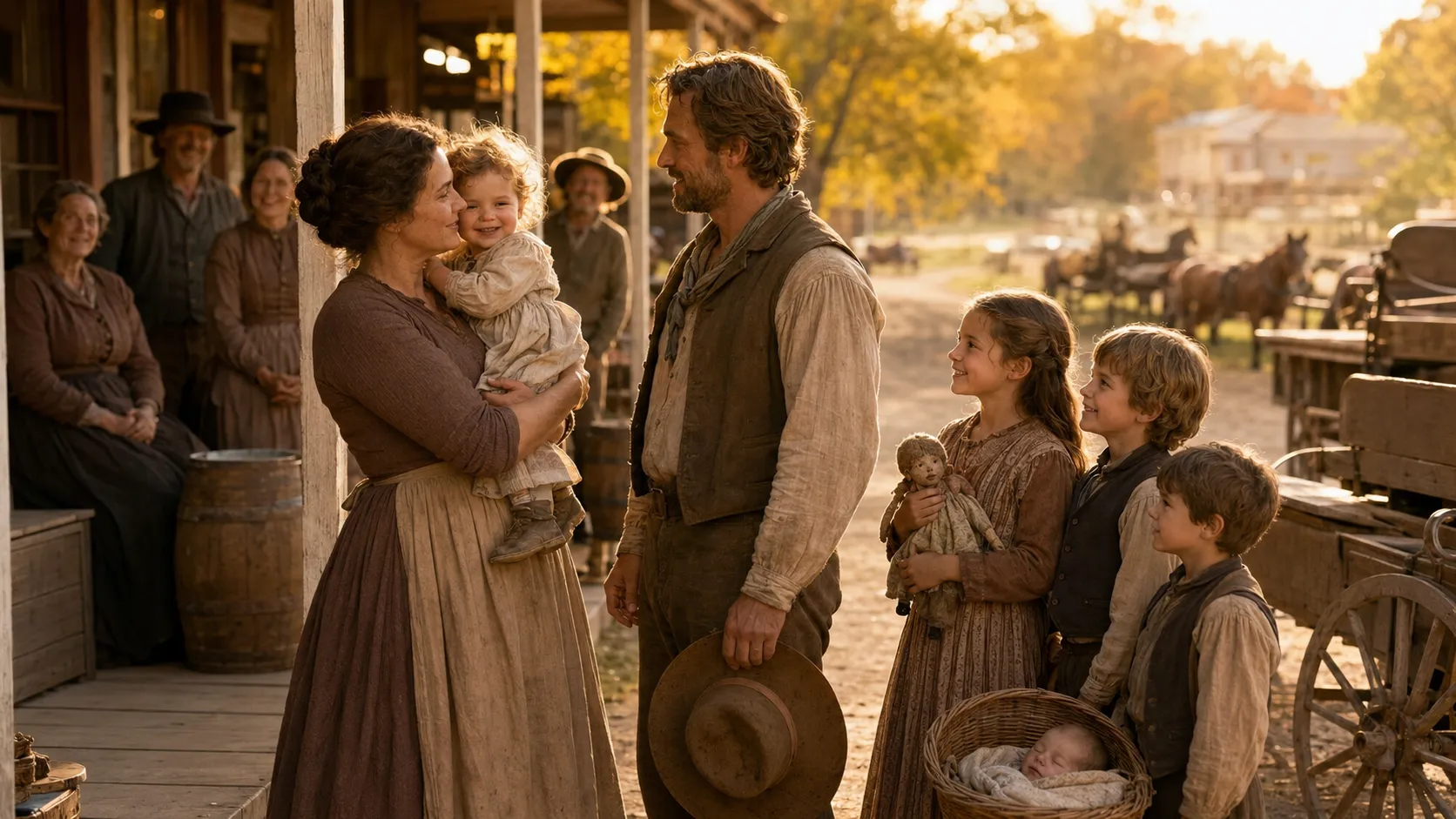
Thomas stood near his wagon with five children gathered around him. Clara, the eldest, held a cloth doll. Two boys stood with dusty boots and curious eyes. A toddler clung to Thomas’s shirt, and an infant slept in a basket beneath a faded blanket.
Since his wife died the previous winter, Thomas had been trying to be father, mother, cook, nurse, and comfort all at once.
The town had offered advice.
Marry again.
Hire someone young.
Find a woman who looked right beside him.
Then someone mentioned Eleanor Briggs, the seamstress who lived alone above the tailor shop.
Thomas cleared his throat. “Miss Briggs, I appreciate you coming.”
Eleanor folded her hands tightly.
“Before you say anything more,” she said, “there is something you should know.”
The porch went quiet. People nearby pretended not to listen.
Eleanor lifted her chin, though her voice trembled.
“I am not fit for any man.”
Thomas frowned.
She forced herself to continue.
“I know what people see when they look at me. A woman too heavy to be graceful. Too awkward to be pretty. Too used to being alone. I have never had a husband, Mr. Hale, and I do not expect I ever will.”
The children stared.
Eleanor looked at them, and her expression softened.
“But I can love your children.”
The words settled over the street like a prayer.
Thomas did not answer at once. He looked down at Clara.
“What do you think?”
The little girl studied Eleanor carefully.
“Do you know how to braid hair?”
Eleanor blinked. “Yes.”
One boy stepped forward. “Can you make pie?”
A small smile touched Eleanor’s mouth. “Yes.”
The youngest boy asked, “Can you read stories?”
Eleanor’s throat tightened.
“I love reading stories.”
Then the toddler on Thomas’s hip reached for her.
Eleanor froze.
Thomas looked surprised, but he did not pull the child back. Eleanor took him carefully, and the little boy rested his head on her shoulder as if he had known her all his life.
The street fell silent.
Thomas looked at the sleeping child in her arms, then at Eleanor.
“My late wife used to say a good heart matters more than a pretty face.”
Some of the townspeople lowered their eyes.
Thomas’s voice grew softer.
“I am not looking for a woman to impress the town, Miss Briggs. I am looking for someone who will not leave my children feeling alone.”
For the first time in years, Eleanor did not know what to say.
Thomas nodded toward the wagon.
“Would you like to see the ranch?”
The Hale ranch sat five miles outside town. The fields were beautiful, but the house was tired. Laundry sat unfinished. Boots were piled near the door. Dishes filled the sink. A broken chair leaned against the wall.
Eleanor saw the truth immediately.
This was not a house without money.
It was a house without a mother’s hands.
She set the toddler in his cradle, rolled up her sleeves, and asked, “Where do you keep the flour?”
Thomas blinked. “Flour?”
“If five children live here,” she said, “someone should be baking.”
Within an hour, the kitchen smelled of bread. Clara held the mixing bowl proudly. The boys stopped fighting long enough to help. The baby slept. Thomas stood in the doorway, watching the room come alive around a woman who believed she had nothing to offer.
That evening, Eleanor read to the children from a dusty book she found on the shelf.
Her voice was warm, steady, and gentle.
Even Thomas sat down to listen.
When the story ended, Clara leaned against Eleanor’s arm and whispered, “Will you stay tomorrow?”
Eleanor looked at Thomas.
He did not pressure her. He did not look embarrassed by her. He only said, “Only if you want to.”
Eleanor looked around the room — at the tired furniture, the hopeful children, the cradle, the warm bread on the table.
“I think I would like that,” she said.
Months passed.
The ranch changed slowly.
The garden grew. The children laughed more. Torn clothes were mended. Hair was braided. Stories were read by lamplight. The boys stopped calling her Miss Briggs and began calling her Mama Eleanor without asking permission.
The town noticed.
At first, people whispered.
Then they stopped.
Because every Sunday, the Hale children arrived clean, smiling, and proud. Clara told everyone Eleanor made the best pies in the county. The boys said she could fix any shirt, any scrape, any bad dream. Even little Samuel cried when anyone else tried to take him from her arms.
One afternoon, Clara found Eleanor in the yard hanging sheets in the sun.
“Are you really not fit for any man?” the girl asked.
Eleanor paused.
“Why do you ask?”
Clara pointed toward the barn.
“Because Papa doesn’t look like he agrees.”
Eleanor turned.
Thomas stood by the fence, watching her with quiet respect. Not pity. Not amusement. Not judgment.
Something warmer.
For the first time in her life, Eleanor wondered if the town had been wrong.
Maybe she was not meant for every man.
Maybe she was not made to be admired by strangers on a porch.
But when Samuel ran across the yard and wrapped his little arms around her skirt, when Clara smiled with her braids tied in ribbon, when Thomas looked at her as if her presence had saved more than his house…
Eleanor finally understood.
She had never been too much.
She had simply been waiting for a family large enough to receive all the love she had been carrying.


