
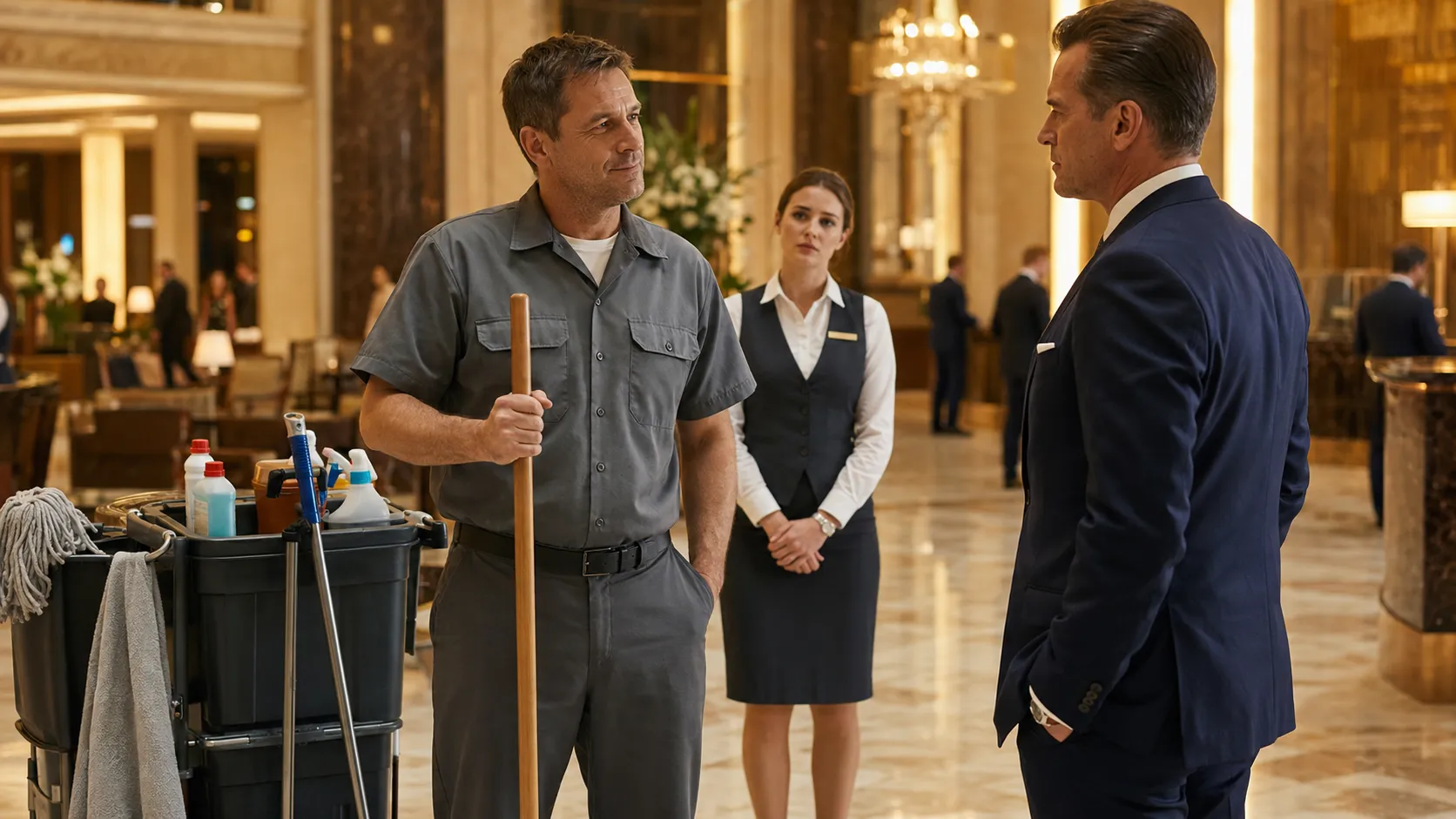
Victor Langston thought the quiet janitor at the Grand Meridian was invisible enough to insult. But hours later, powerful executives rushed into the lobby, bowed their heads, and called the man in the gray uniform “Mr. Reed.”
Daniel Reed pushed his mop across the marble floor of the Grand Meridian Hotel while chandeliers glittered above him.
To the wealthy guests passing through the lobby, he was barely a person. Some stepped around his cleaning cart without looking. Others frowned as if the sight of work ruined the beauty of the room.
Daniel noticed everything.
He simply kept mopping.
Then Victor Langston entered with a group of laughing investors. His suit was perfect, his shoes polished, his watch bright enough to catch every light in the lobby.
He was staring at his phone when he slammed his shoulder into Daniel.
The bucket rocked. Water splashed near Victor’s shoes.
Victor snapped his head up.
“Watch where you’re going, idiot.”
The lobby quieted.
Daniel looked at him calmly. Then, strangely, he smiled.
“Sorry about that, sir.”
Victor adjusted his jacket with disgust.
“People like you should stay invisible.”
Then he walked away.
A young receptionist named Emily saw the whole thing. She had worked at the hotel for only three months, but something about Daniel had always confused her. He was polite, quiet, and patient — but not weak.
He spoke like a man who had once given orders.
“Are you okay?” she asked.
Daniel wrung water from the mop.
“Perfectly.”
“He humiliated you.”
Daniel glanced toward Victor’s table near the café.
“People reveal their true character when they think someone is beneath them.”
Emily stared at him.
That was not how janitors usually spoke.
Two years earlier, Daniel Reed had been one of the youngest tech billionaires in America. He owned a cybersecurity company, appeared on magazine covers, traveled by private jet, and lived in houses so large they felt empty even when full.
But success had shown him something ugly.
People respected his money, not his heart. Executives praised him in public and mocked workers in private. One night, Daniel overheard his own senior staff laughing about janitors and warehouse employees.
“People at the bottom aren’t even human to companies like ours,” one of them said.
That sentence changed him.
Daniel disappeared from public life. While the business world wondered where he had gone, he began working ordinary jobs under another name.
Dishwasher.
Cleaner.
Warehouse worker.
Gas station clerk.
Hotel janitor.
He wanted to know how society treated people who had no title to hide behind.
The answer broke him.
Workers were ignored, insulted, underpaid, and expected to smile through humiliation. Yet those same people shared food, covered shifts, helped sick coworkers, and showed more loyalty than many executives he had known.
That evening, Daniel was sent to Room 2107.
An elderly woman opened the door, trembling.
“Please,” she whispered. “My husband collapsed.”
Daniel stepped inside and found an old man unconscious beside the bed.
He did not wait for permission.
He checked the pulse, called for emergency services, and began CPR with the calm focus of a man who had handled crises before. The woman sobbed behind him. Minutes stretched painfully.
Then the old man coughed.
His eyes opened.
When hotel staff and paramedics rushed in, Daniel quietly stepped back.
The woman grabbed his hand.
“You saved my husband.”
Daniel only nodded.
“Anyone would have done the same.”
But he knew that was not true.
Later that night, luxury cars began arriving at the hotel. Executives hurried into the lobby. Security teams gathered near the entrance. Guests whispered as several powerful businessmen walked straight toward the janitor in the faded gray uniform.
One of them bowed his head.
“Mr. Reed,” he said carefully, “the board has been trying to reach you.”
The lobby froze.
Emily’s mouth fell open.
Victor Langston turned pale.
“You’re Daniel Reed?” he whispered. “The billionaire?”
Daniel sighed.
“I was hoping for one quiet night.”
The executive continued, “Your approval is needed for the merger.”
Daniel looked around the lobby — at the janitors, the housekeepers, the bellmen, the receptionist, the manager, and finally Victor.
Victor tried to speak.
“I didn’t know—”
Daniel raised one hand.
“That is exactly the problem.”
Silence spread through the room.
“You respected me only after you learned I was rich,” Daniel said. “A few hours ago, you told me people like me should stay invisible.”
Victor lowered his eyes.
Daniel turned to the hotel manager.
“How much do your lowest-paid workers make?”
The manager swallowed and gave the number.
Daniel’s expression hardened.
“Raise it. Immediately.”
“Sir?”
“Use my account until the hotel adjusts its budget.”
Gasps moved through the lobby.
Then Daniel faced the staff.
“For two years, I worked beside people the world pretends not to see. I learned that character is not revealed by how someone treats the powerful. It is revealed by how they treat the person cleaning the floor.”
Emily wiped her eyes.
Victor looked at the janitors nearby.
“I’m sorry,” he said quietly.
Daniel shook his head.
“The apology is not mine to accept.”
The next morning, Daniel removed the janitor uniform for the last time. Before leaving, he placed a note on Emily’s desk.
Never judge a person by their clothes, salary, or position. Some of the richest hearts wear the poorest uniforms.
No one knew where Daniel went after that.
Some said he returned to his companies. Others said he kept working among ordinary people, still watching, still learning.
But at the Grand Meridian, one thing changed forever.
No one treated the janitors as invisible again.


