
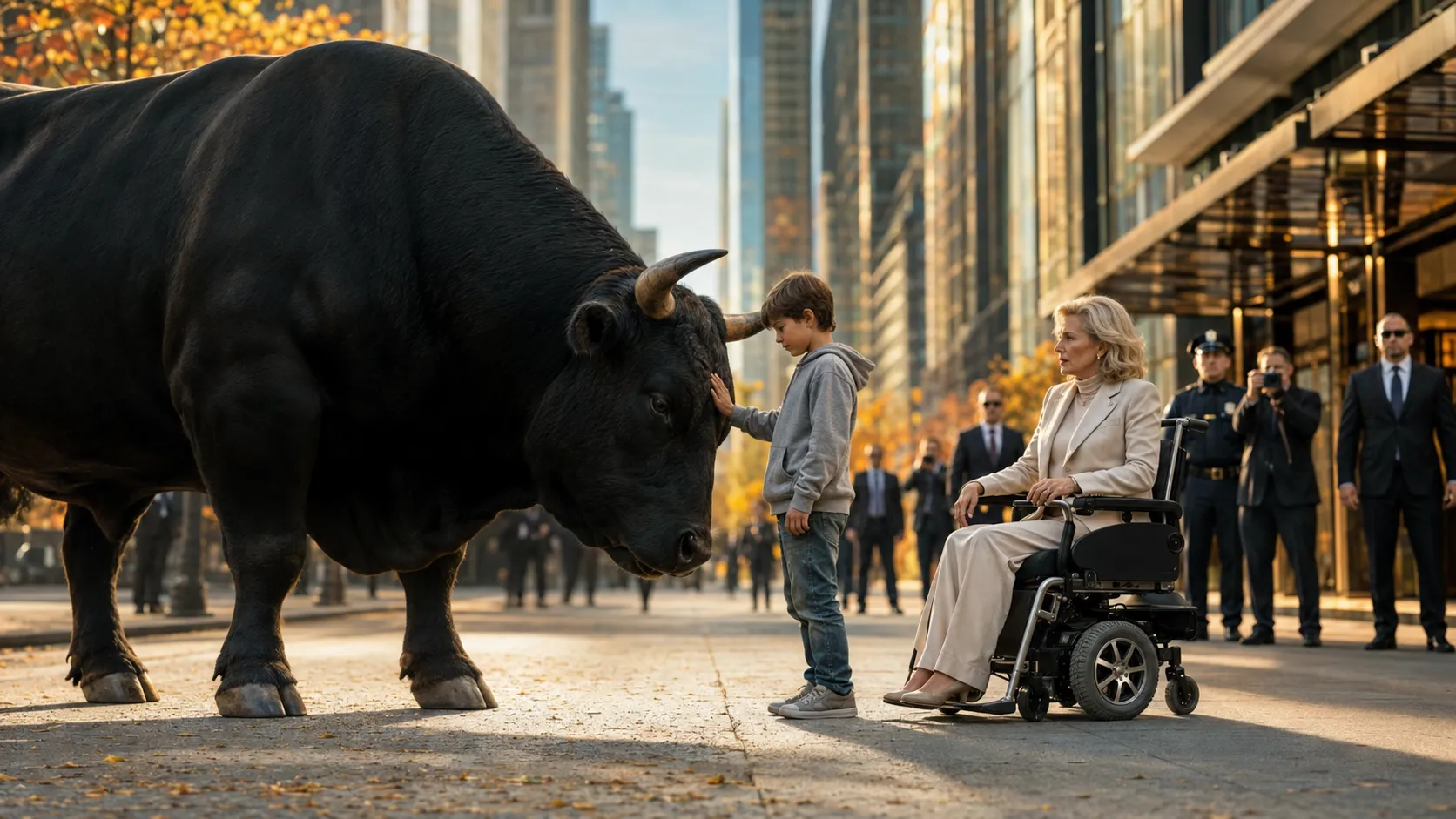
Victoria Hale thought the escaped bull was the danger charging toward her wheelchair. Then a silent eight-year-old boy stepped into the street, stopped the animal with one look, and revealed the secret her company had buried fifteen years earlier.
The bull should have destroyed everything in its path.
That was what everyone said afterward about the afternoon on Lexington Street.
A livestock truck had crashed near the intersection, and one massive black bull broke loose into the heart of downtown Chicago. Office workers screamed. Cars stopped sideways. A police officer shouted for people to clear the street.
Then the bull saw Victoria Hale.
She sat outside the Grand Bellmont Hotel in a cream designer suit, her electric wheelchair positioned near the curb while reporters waited for her statement about a billion-dollar merger.
Victoria was one of the richest women in America.
People called her the Ice Queen of Wall Street.
Her companies built medical technology, artificial intelligence systems, and private research facilities no journalist had ever been allowed to fully inspect.
For years, rumors followed her empire.
Children missing near company sites.
Animals used in secret trials.
Research projects that vanished from public records.
Nothing was ever proven.
Then the bull lowered its head and charged straight toward her.
Her bodyguards tried to move the chair, but one wheel caught against the curb. Victoria’s face went pale. For the first time in years, she looked powerless.
The bull was almost on her.
Then a child stepped into the street.
He was no more than eight. Thin, quiet, wearing faded sneakers and a gray hoodie too large for his small body.
“Move!” someone screamed.
The boy did not move.
He stood between the bull and Victoria and stared directly into the animal’s eyes.
The bull stopped.
Not slowly.
Instantly.
Dust rose around its hooves. Its breathing changed. The rage seemed to drain out of it as if someone had turned a key inside its mind.
Then the enormous animal lowered its head toward the boy.
Respectfully.
The crowd went silent.
The boy turned and walked toward Victoria’s wheelchair.
She was no longer looking at the bull.
She was looking at him.
“You can’t die yet,” the boy said. “Not before you give me my answers.”
Victoria’s lips trembled.
“Who are you?”
The boy tilted his head.
“You really don’t remember?”
Her face lost all color.
“My name is Daniel Mercer.”
A reporter repeated the name under her breath.
Daniel Mercer.
Victoria whispered, “That’s impossible.”
Daniel pointed to the bull.
“He remembers.”
Everyone turned.
Burned into a small metal tag on the bull’s harness was one mark:
D-17.
Victoria almost stopped breathing.
Fifteen years earlier, Project D-17 had been listed in Hale Industries records as a failed behavioral research program. Publicly, it had ended before real testing began.
Privately, it had been something far darker.
Children without families.
Animals trained through fear.
Experiments meant to control memory, obedience, and panic response.
Daniel Mercer had been Subject Eight.
Official status: deceased.
Victoria had signed the report herself.
“You told the world I died,” Daniel said.
Victoria’s voice broke. “I was told you did.”
“No,” Daniel answered. “You were told it was easier if I did.”
The cameras kept recording.
Victoria suddenly snapped at her aides.
“Turn them off.”
No one did.
The whole city was already watching.
Daniel reached into his hoodie and pulled out an old keycard marked with the Hale Industries logo.
“The facility wasn’t destroyed,” he said. “Only the files were.”
Victoria stared at the card as if it were a weapon.
Before she could answer, black SUVs turned onto the street. Men in dark suits stepped out and moved quickly toward Daniel.
“Get the child,” one of them ordered.
The bull moved first.
It stepped in front of Daniel, not attacking, not wild, but guarding him with its whole body.
The men hesitated.
Police sirens grew louder. Reporters backed away but kept filming. Victoria looked from Daniel to the men and finally understood something she had spent years refusing to face.
The project had not ended because it failed.
It had continued without her control.
“You said the children were terminal patients,” she whispered toward the lead man.
He looked at her coldly.
“They were assets.”
The word changed her.
For once, Victoria Hale did not calculate profit, risk, or public image.
She looked at Daniel — a child who had survived a machine built by people who spoke of human beings as property — and she made the first honest decision of her life.
“Stop,” she said.
The lead man ignored her.
Victoria reached into the side panel of her wheelchair and pulled out an emergency drive.
Every camera turned toward her.
“My private archive,” she said, her hands shaking. “Names. Transfers. Medical approvals. Lab locations. Enough to reopen every buried case.”
The men froze.
Then they ran.
Police surrounded the street within minutes.
Victoria handed the drive to a federal investigator in full view of the cameras. No lawyer could undo it. No company statement could bury it. No fortune could make the crowd forget what they had heard.
A reporter asked Daniel what he wanted.
He looked at the bull, then back at Victoria.
“The truth,” he said. “And the others.”
Victoria closed her eyes.
“There were eighty-three children.”
The crowd gasped.
Daniel did not.
He only asked the question that had kept him alive for fifteen years.
“My mother?”
Victoria’s face crumpled.
“She died looking for you.”
For the first time, Daniel looked like a child.
The bull lowered its head beside him, and he rested one small hand against the animal’s neck.
Before police escorted Victoria away, she leaned close and whispered something only Daniel heard.
“There is another facility. And some of them are still alive.”
Daniel went still.
Then he looked toward the cameras, the police lights, the frightened executives, and the city that had finally stopped looking away.
Project D-17 had created him to obey.
But it made one mistake.
It taught him how to remember.


