
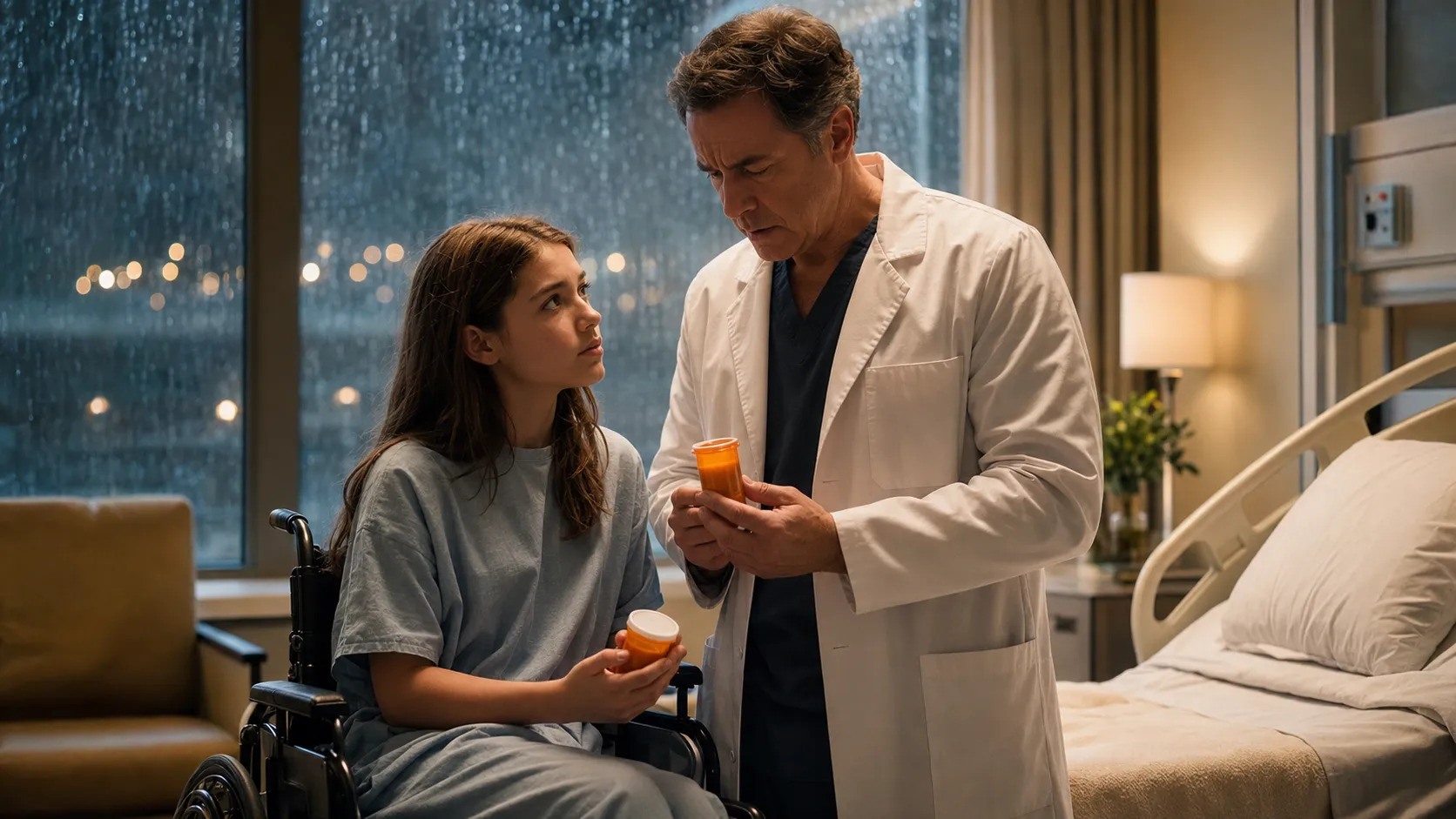
Emily trusted her mother with everything, even the strange orange bottle she was given every night. But when her legs grew weaker and a doctor finally read the label, the truth shattered the one person she thought would always protect her.
Rain hammered the windows of Saint Mercy Hospital while fourteen-year-old Emily Carter sat alone in Room 214, gripping a small orange medicine bottle in both hands.
For weeks, her legs had been getting weaker.
At first, her mother, Julia, said it was exhaustion. Then she said it was a rare nerve condition. Every night, she gave Emily the same pills and whispered, “Don’t worry, sweetheart. This will help you.”
Emily believed her.
A child wants to believe her mother.
But that night, everything changed.
Earlier, Emily had heard two nurses whispering outside her door.
“She’s too young,” one said.
“And something about this case doesn’t feel right,” the other answered.
The words stayed in Emily’s head until Dr. Michael Reeves came in for his evening check. He was kind, patient, and one of the few adults who spoke to her like she was a person, not a diagnosis.
Emily lifted the bottle with trembling hands.
“Dr. Reeves,” she whispered, “what is this medicine for?”
He took it casually.
Then he read the label.
His face went white.
For several seconds, he said nothing.
Emily’s heart began to pound.
“What is it?”
Dr. Reeves looked at her wheelchair, then back at the bottle.
“Who gave this to you?”
“My mom.”
“How long have you been taking it?”
“Almost two months.”
The doctor’s hand tightened around the bottle.
“Emily,” he said carefully, “this is not normal medication. This is an unapproved neurological compound. It can damage the nervous system. In high doses, it can cause paralysis.”
The room turned ice cold.
Emily stared at him.
“My mom gave it to me every night.”
Dr. Reeves knelt beside her.
“Listen to me. None of this is your fault.”
Within an hour, the hospital floor was quietly locked down. Blood tests confirmed what Dr. Reeves feared: Emily’s body contained dangerous levels of the compound. Another few weeks, and the damage might have become permanent.
Detectives arrived after midnight.
Emily answered their questions through tears. She told them her mother said the medicine would help her walk again. She told them Julia had changed after Emily’s father died two years earlier — colder, frightened, sometimes crying in the kitchen when she thought Emily was asleep.
“She loves me,” Emily whispered, though even she no longer sounded sure.
Then the door opened.
Julia Carter stepped inside, soaked from the rain.
The moment she saw the police, panic crossed her face.
“What’s going on?”
Detective Harris held up the bottle.
“Mrs. Carter, where did you get this?”
Julia froze.
Emily saw it.
That tiny flash of guilt.
“Mom?” she whispered.
Julia forced a smile. “Sweetheart, they’re confused.”
But Dr. Reeves stepped forward.
“This substance was harming your daughter.”
The room went silent.
Emily’s voice cracked.
“Why?”
Julia covered her face and broke down.
After her husband died, the bills had swallowed everything. The house. The savings. The little security Emily had left. Then a private pharmaceutical group contacted Julia, offering money if Emily joined what they called a neurological study.
“They said it was safe,” Julia sobbed. “They said it was temporary. Then they threatened me when I wanted to stop.”
Dr. Reeves looked furious.
“You gave your child an experimental drug without telling her what it was.”
“I was scared!” Julia cried.
Emily stared at the woman who had tucked blankets around her, kissed her forehead, and handed her the bottle that was slowly stealing her strength.
“You were supposed to protect me,” she said.
Julia reached for her.
Emily pulled back.
That hurt Julia more than any handcuffs could have.
Police took Julia away that night. She cried, begged, and called Emily’s name until the door closed.
But Emily could not answer.
Over the next weeks, treatment began. Some damage remained, but doctors believed she could recover. The company behind the illegal trial was exposed. Executives were arrested. Julia later testified against them, but that did not undo what she had done.
Months later, Emily stood during physical therapy.
One step.
Then another.
The room applauded.
Dr. Reeves smiled with tears in his eyes.
“You did it.”
Emily smiled too, but softly.
Because walking again was not the same as being whole.
Before leaving the hospital that evening, she stopped by the same window where she had once sat terrified in her wheelchair. Rain slid down the glass just like that night.
But this time, Emily was standing.
She had survived the medicine.
She had survived the lie.
And although the truth broke her heart, it also saved her life.


