
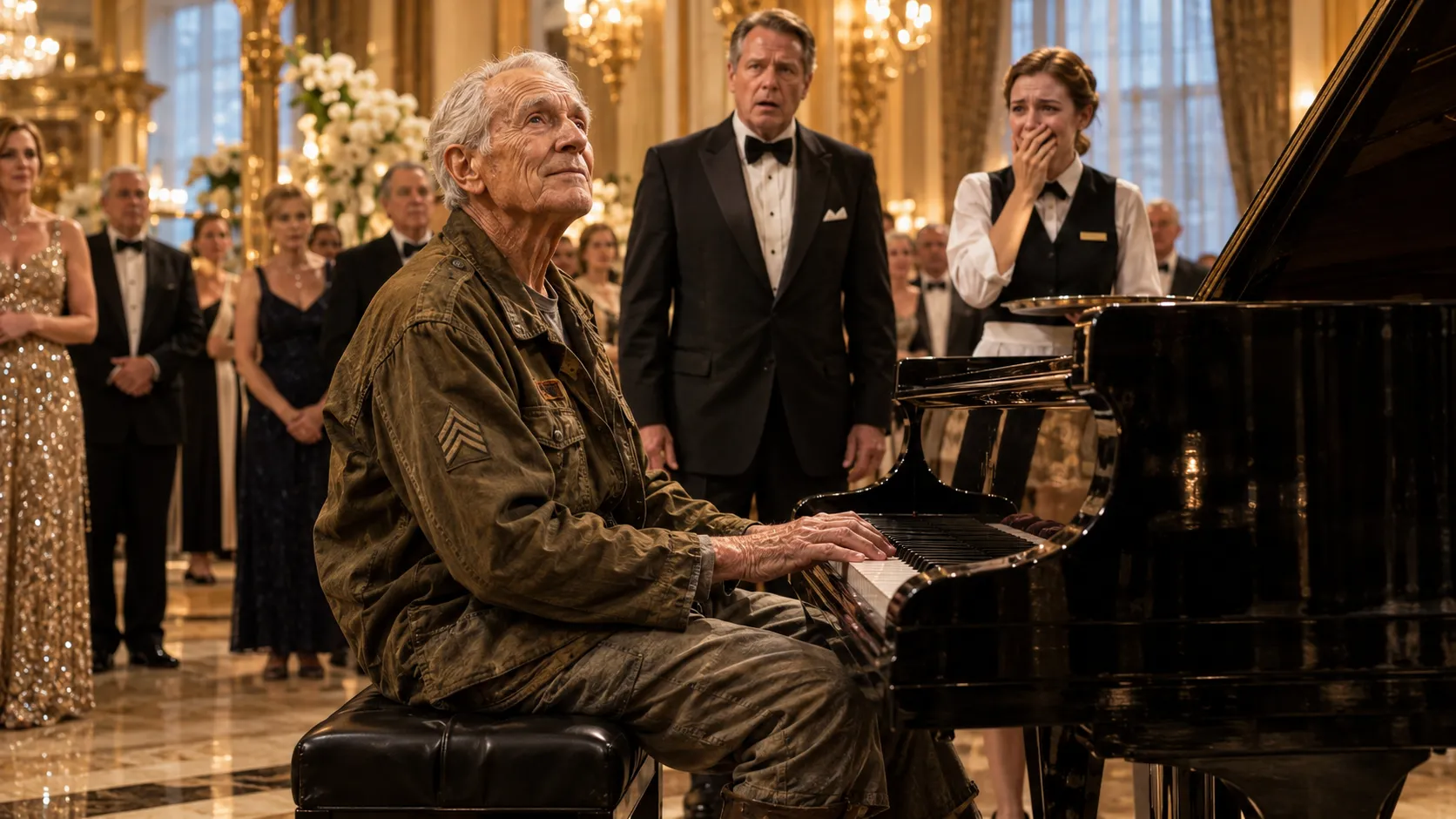
Walter Hayes walked into a luxury charity gala with a faded army jacket and asked for one plate of food. The rich guests laughed when he touched the million-dollar piano — until the first note made the entire room go silent.
The Grand Legacy Ballroom was built for people who never had to ask for anything.
Crystal chandeliers glowed above marble floors. Wealthy guests held champagne glasses, discussed donations, and smiled for cameras at a charity gala meant to raise money for veterans.
Then the doors opened.
An elderly man stepped inside wearing a faded army jacket and worn boots. His hair was gray, his hands trembled, and rainwater clung to the edge of his coat.
Security moved toward him at once.
But the old man lifted one hand.
“I don’t want trouble,” he said. “I only want a meal.”
The room went quiet.
Then he looked toward the black grand piano in the center of the ballroom.
“Could I play one song for it?”
A laugh broke from a man near the front.
Richard Thompson, the chairman of the fundraising committee, stood in a tailored suit with a smile sharp enough to wound.
“You?” he said. “You want to touch that piano?”
The guests laughed with him.
The old man lowered his eyes, but he did not leave.
“My name is Walter,” he said. “I can play.”
Richard stepped closer, enjoying the attention.
“Fine. Play. If you make even one person in this room cry, I’ll give you a thousand dollars and dinner. If not, security throws you out.”
More laughter filled the ballroom.
Near the kitchen doors, a young waitress named Emily Carter watched with pain in her eyes. She had tried to bring the old man water, but the manager warned her not to get involved.
Walter saw her.
Then he walked to the piano.
His hands looked rough and tired against the polished black wood. Several guests lifted phones, ready to record his humiliation.
Walter sat down.
For a moment, he did nothing.
Then he pressed one key.
The note was clear, perfect, and strangely powerful.
The laughter faded.
He began with a quiet melody, soft as memory. It sounded like rain on an old roof, like soldiers walking home in silence, like letters never sent. The ballroom slowly changed. Faces that had been mocking became still. Champagne glasses stopped halfway to lips.
Then Walter’s hands moved faster.
The fragile melody rose into something fierce. His fingers crossed the keys with impossible control, filling the room with sorrow, pride, and a storm of feeling no one expected from a man they had treated like trash.
Emily began to cry first.
Then an older guest near the front wiped his eyes.
Then another.
Richard’s smile disappeared.
Walter finished the piece and let the final note fade.
For several seconds, no one spoke.
Then Abram Stevens, an elderly industrialist and lifelong supporter of the arts, stood slowly.
“My God,” he whispered. “I know who you are.”
Walter looked at him calmly.
Abram turned toward the room.
“During the war, there was a young corporal from Ohio. He played broken pianos for frightened soldiers before battle. They called him the Pianist of the Ridge. He saved his platoon and was later declared missing, presumed dead.”
The room held its breath.
Abram pointed toward the old man.
“His name was Walter Hayes.”
A wave of shock passed through the ballroom.
Walter straightened his back. The helpless posture vanished. For the first time, everyone saw the soldier beneath the coat.
Richard went pale.
Minutes earlier, he had called him worthless.
Now he was staring at a national hero.
Walter turned toward him.
“You spoke tonight about opportunity,” he said quietly. “At nineteen, I had the opportunity to carry a wounded friend through enemy fire. At twenty, I had the opportunity to survive a prison camp by remembering music when everything else had been taken.”
No one moved.
Then Walter looked around the ballroom.
“This gala exists because of an anonymous donor who gave five million dollars to build the new Veteran Support Center.”
A murmur spread.
Walter’s eyes returned to Richard.
“That donor was me.”
Richard’s mouth opened, but no words came out.
Walter continued.
“I came here in disguise to learn what kind of man was leading a center meant to serve veterans who have lost their homes, their health, and sometimes their hope.”
He stepped closer.
“And now I know.”
The silence became heavier than applause.
“Effective immediately,” Walter said, “Richard Thompson is removed as chairman.”
No one defended him.
Richard walked out alone, his expensive shoes echoing across the marble floor.
Then Walter called Emily forward.
The young waitress hesitated, wiping her eyes.
“You tried to help me before you knew who I was,” Walter said. “That is character.”
Emily could barely speak.
Walter handed her the thousand dollars Richard had lost in the bet.
“You won this,” he said. “You were the first person in this room to cry because you actually heard the music.”
Then he added something that changed her life.
“Your tuition will be paid in full. And when you graduate, the Veteran Support Center will need someone with your heart.”
Emily covered her mouth and cried.
Six months later, the center opened with Abram Stevens as chairman and Emily Carter helping veterans find food, housing, counseling, and dignity.
The grand piano remained in the ballroom.
Silent most nights.
But everyone remembered the evening it spoke louder than wealth, status, and cruelty.
Because one old veteran had entered like a beggar…
and left as the man who taught an entire room what honor sounded like.


