
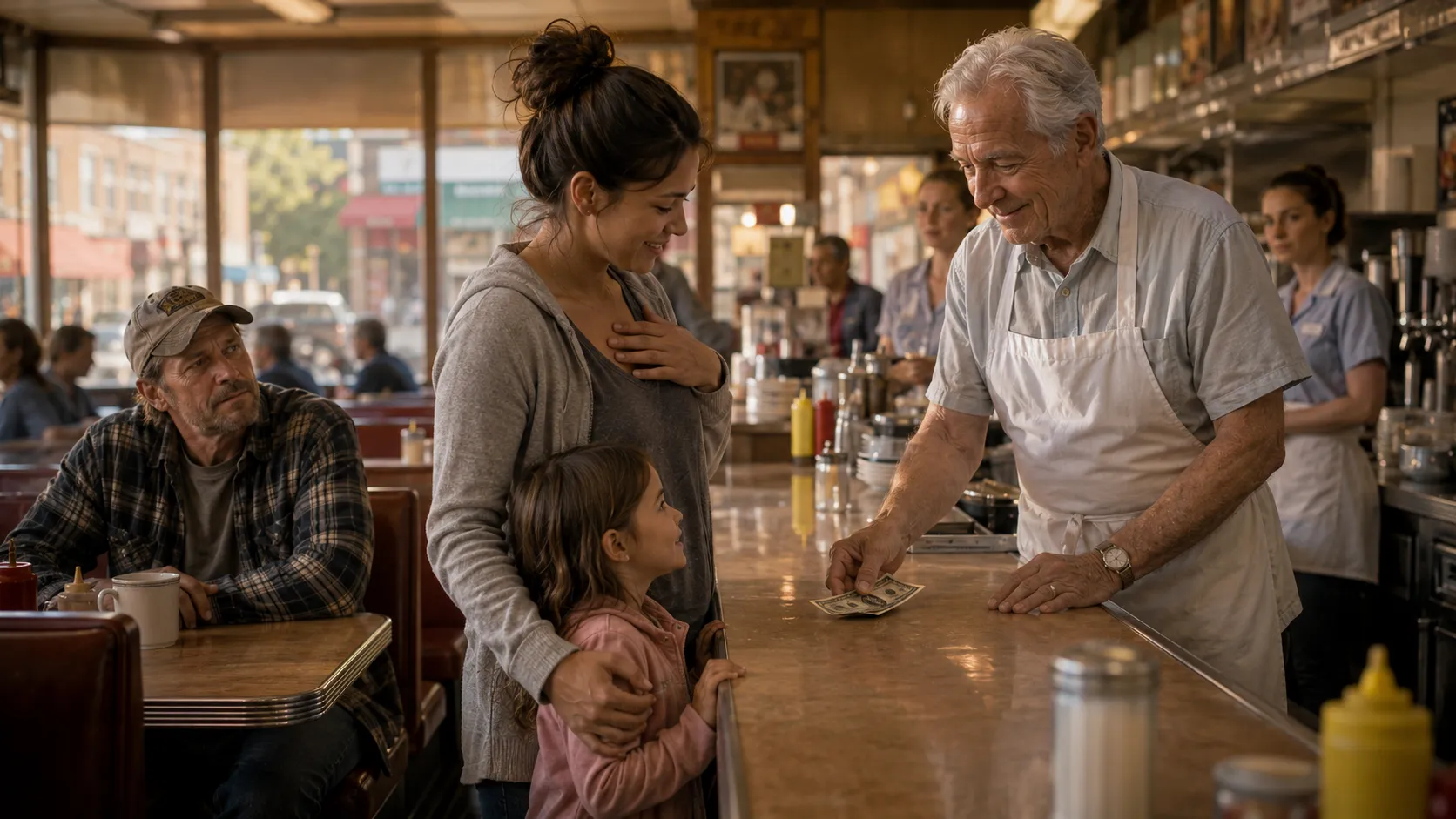
Michael Carter came to his diner dressed like an ordinary customer, hoping to understand why profits were falling. Instead, he overheard two cashiers mocking an elderly dishwasher — and planning to frame him for theft.
Michael Carter pulled his worn baseball cap low and stepped into Carter’s Diner like any tired stranger looking for lunch.
No one recognized him.
That was the point.
For fifteen years, Michael had owned the diner chain, turning one failing restaurant into four busy locations across the city. But lately, something felt wrong at the original flagship location. Customer reviews stayed strong, but employee turnover had risen, profits had dropped, and complaints kept disappearing before they reached him.
So he came in quietly, dressed in faded jeans, an old flannel shirt, and three days of stubble.
At the counter, a cashier named Megan barely looked at him.
“Turkey club and coffee,” Michael said.
He paid cash and sat where he could see everything.
At first, the diner looked normal. Waitresses hurried between booths, cooks shouted orders, and the register chimed through the lunch rush.
Then Michael noticed Henry.
The elderly dishwasher moved slowly but carefully, stacking plates with hands bent by arthritis. His white hair was damp with steam, his apron soaked, and his back stiff from hours of work. Still, every time someone passed the dish window, Henry smiled.
Customers knew him by name.
The staff did not treat him the same way.
“He should’ve retired years ago,” Megan muttered.
Later, Michael watched a young mother approach the register with two small children. She opened her wallet, counted twice, and went pale. She was short.
Before the embarrassment could grow, Henry dried his hands and walked over. He slipped a few bills onto the counter.
“No rush,” he said kindly. “The kids enjoying their summer break?”
The mother’s eyes filled with relief.
When she left, another cashier named Troy leaned toward Megan.
“That’s the third time this week,” he said. “Old fool’s going to go broke saving strays.”
Megan laughed. “As if he isn’t broke already. I bet he sleeps in that beat-up car.”
Michael tightened his grip around his coffee cup.
He stayed for hours.
He saw Henry pay for a teenager whose card was declined. He saw him help an elderly man confused by the menu prices. He saw him clean stations no one else touched and stay long after his shift should have ended.
Then Michael heard Troy and Megan whispering near the register.
They were not just cruel.
They were planning something.
“Henry slips money into the register when people can’t pay,” Troy said. “Patricia doesn’t know that. All she sees is the numbers not matching.”
Megan smiled. “So if the drawer comes up short again…”
“Exactly,” Troy said. “We make sure Patricia catches him near the register. She’ll think he’s stealing. Then I can get my cousin hired, and we split the referral bonus.”
Michael sat frozen in the booth.
They were going to frame him.
That night, Michael followed Henry from a distance and learned the truth no report had shown him.
Henry lived in a worn-down trailer behind a row of commercial buildings. Its steps looked ready to collapse. One bulb flickered inside. It was barely bigger than Michael’s closet.
The next morning, Michael met a regular customer named Ron.
Ron told him Henry had lost his wife, Martha, to cancer. They had been married for fifty-two years. To pay for her treatment, Henry had sold their house, emptied his retirement, and taken the dishwashing job at seventy years old.
“He still pays the medical bills,” Ron said. “And he still helps people at the diner because it gives him purpose.”
Michael drove back feeling sick.
He had built Carter’s Diner on family, dignity, and service.
Somewhere along the way, he had stopped checking whether those words still meant anything.
The next day, he set the trap.
A struggling single mother came in with her little girl. When she came up short at the register, Megan humiliated her loudly.
Henry came forward, as Michael knew he would.
“I’ve got it,” he said.
Troy watched with satisfaction.
Minutes later, Patricia, the manager, counted the drawer and went pale.
“Thirty-seven dollars missing.”
Troy stepped forward with false concern.
“I’ve noticed Henry around the register a lot lately.”
Megan added, “I saw him there too.”
Patricia walked to the dish room, torn but frightened.
“Henry,” she said quietly, “I have to ask. Are you stealing from the register?”
The old man’s face changed.
Not anger.
Hurt.
“I was putting money in,” he said. “Not taking it out.”
Megan scoffed. “On a dishwasher’s salary? Convenient.”
Henry looked around and understood. He did not shout. He did not accuse. He only lowered his eyes.
“I suppose you’ll want my resignation.”
Patricia swallowed. “I’m afraid I have to let you go.”
“That won’t be necessary,” Michael said.
He stood from the booth, removed his cap, and straightened to his full height.
The diner went silent.
Patricia’s face drained.
“Mr. Carter…”
Michael looked at Troy and Megan.
“I’ve been here all week,” he said. “Watching.”
Then he connected a small device to the television in the corner.
The screen came alive.
First, it showed Troy pocketing bills from the register.
Then Megan voiding legitimate transactions after customers left.
Then both of them whispering near the counter.
“If we frame Henry for stealing, Patricia will have to fire him.”
Gasps filled the diner.
The footage continued. It showed Henry slipping his own money into the register to help hungry customers. It showed him staying late, cleaning, protecting younger workers, and quietly doing the work others ignored.
Michael paused the video.
“The only theft in this diner,” he said, “was committed by the people accusing him.”
Troy tried to speak.
Michael cut him off.
“You mocked a man who has endured more hardship than you can imagine, and still shows more compassion than you ever did.”
Police entered moments later. Troy and Megan were escorted out while the customers watched in stunned silence.
Then Michael turned to Henry.
“I owe you an apology,” he said. “Not just for today, but for failing to make sure this company treated you with the respect you deserved.”
Henry shook his head.
“You didn’t know.”
“That is no excuse,” Michael said.
The next morning, Carter’s Diner opened to a crowd.
People had come not for gossip, but for Henry.
Michael called him into the office and placed two folders on the desk.
The first was a promotion.
Floor manager. Higher salary. Full benefits. Reasonable hours.
Henry stared at the papers.
“I don’t have management experience.”
“You have something better,” Michael said. “Integrity. Compassion. You understand what this diner should be.”
Then Michael pushed forward the second folder.
Inside was the deed to a small house three blocks away.
“No rent,” Michael said. “No mortgage. Seven years of overdue bonuses.”
Henry’s hands began to tremble.
Michael continued.
“And your wife’s remaining medical bills have been paid in full.”
For the first time, Henry broke.
Tears moved down his weathered face.
“Why would you do this?”
“Because you reminded me what I forgot,” Michael said. “A business is not only profit. It is people. Every day, you lived the values I only talked about.”
When they stepped back into the diner, customers and staff applauded.
Michael announced a new company-wide policy: living wages, full benefits, emergency assistance, and a community fund named after Henry Lawson to help families facing medical bills and hard times.
Henry stayed with the diner.
Not because he had to.
Because it was his family.
And every day, when he walked through the doors, people no longer saw an old dishwasher who lived in a trailer.
They saw the man whose quiet kindness had changed the heart of an entire business.


