
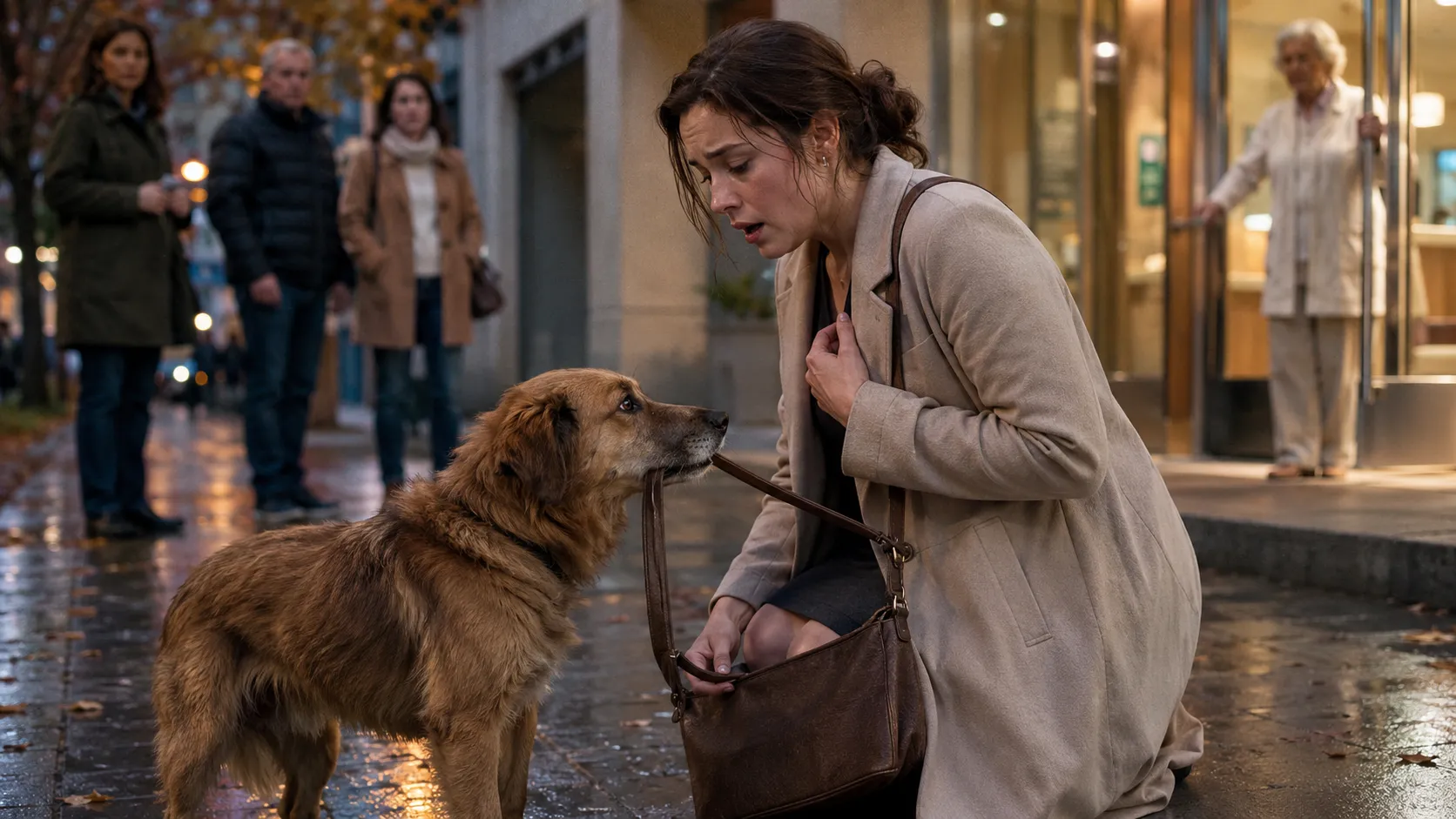
Emma thought the stray dog was only trying to steal from her. But when he tugged at her bag until she broke down in the street, the secret she had been carrying alone finally came out.
Emma had been pretending to be strong for so long that even her own reflection no longer believed her.
For weeks, her mother, Margaret, had been in the hospital. The doctors spoke gently, but every pause in their voices said the same thing: the treatment had to begin soon, and it would cost more than Emma could pay.
She worked in a small office during the day, stayed late whenever her manager allowed it, and spent her nights selling whatever she could. Her grandmother’s bracelet. A small table from the kitchen. The good winter coat she had promised herself she would keep.
Still, the number did not move enough.
Every morning, Emma visited the hospital before work. Every evening, she returned with a tired smile and lied to her mother.
“It’s going to be okay.”
Margaret always touched her hand.
“You don’t have to carry the world alone, sweetheart.”
But Emma did not know how to stop.
Then the dog appeared.
The first time she saw him, he was walking a few steps behind her on the sidewalk. Dusty fur, thin body, serious brown eyes. He did not bark. He did not beg. He simply followed.
The next day, he was there again.
And the day after that.
Emma began to notice him near the bus stop, outside the hospital, across from her office building. Always quiet. Always watching her with a strange patience, as if he knew something she had not admitted yet.
One evening, after another impossible conversation with the hospital billing office, Emma walked home with her bag pressed tightly against her side.
Inside were unpaid invoices, loan papers, and the last photograph of her mother before the illness had taken the color from her face.
Emma kept telling herself not to cry.
Then the dog stepped in front of her.
Before she could move around him, he caught the strap of her bag in his teeth and pulled.
“Hey!” Emma cried. “Let go!”
People turned.
She pulled harder. The dog refused to release it. He was not growling. He was not trying to run away. His paws stayed planted on the pavement, his eyes fixed on hers with desperate insistence.
“Please,” Emma whispered, her voice breaking. “I can’t lose anything else.”
That was when the tears came.
Not small tears.
Everything she had held inside spilled out in the middle of the street — the hospital, the bills, the fear, the shame of not having enough money to save the woman who had given her everything.
A few passersby slowed.
One woman touched Emma’s shoulder.
“Are you all right?”
Emma shook her head. “My mother is sick. She needs treatment, and I’ve tried everything. I can’t do it alone anymore.”
The street went quiet.
This time, it was not the cold silence of people looking away.
It was the silence of people finally listening.
A man in his fifties asked how much was needed. A student offered to post the story online. A bakery owner said she would put a donation box near the register. Someone called a local charity. Someone else contacted a church group.
And the dog?
He released the bag.
Then he sat beside Emma as calmly as if this was the moment he had been waiting for.
The story spread faster than Emma expected.
By morning, strangers were sending small donations. By afternoon, the bakery box was full. By the end of the week, enough money had been raised for Margaret’s treatment to begin.
Emma cried again when the hospital confirmed it.
This time, the tears did not feel like defeat.
The days that followed were hard. Margaret was weak. Some nights Emma sat beside her bed, afraid to breathe too loudly. But slowly, the doctors began to smile. The treatment was working. Her mother was stabilizing.
When Margaret was finally discharged, Emma stepped outside the hospital with her heart pounding.
There, near the entrance, sat the dog.
The same dusty fur.
The same serious eyes.
The same quiet patience.
Emma dropped to her knees and wrapped her arms around him.
“You started all of this,” she whispered.
Margaret, still pale but smiling, reached down and touched his head.
“What’s his name?”
Emma looked at the dog who had followed her when no one else saw her pain, who had pulled at her bag until her silence broke, who had somehow known that help could not arrive until the truth did.
“Hope,” she said.
From that day on, Hope was no longer a stray.
He slept near Margaret’s chair, walked beside Emma to the hospital, and became part of the small family he had helped save.
Years later, Emma would still think about that evening on the street — the bag, the tears, the strangers, and the dog who refused to let go.
And she would understand something she had not known then:
sometimes help does not arrive as a miracle.
Sometimes it arrives as a muddy dog with tired eyes…
pulling you toward the people who were waiting to care.


