
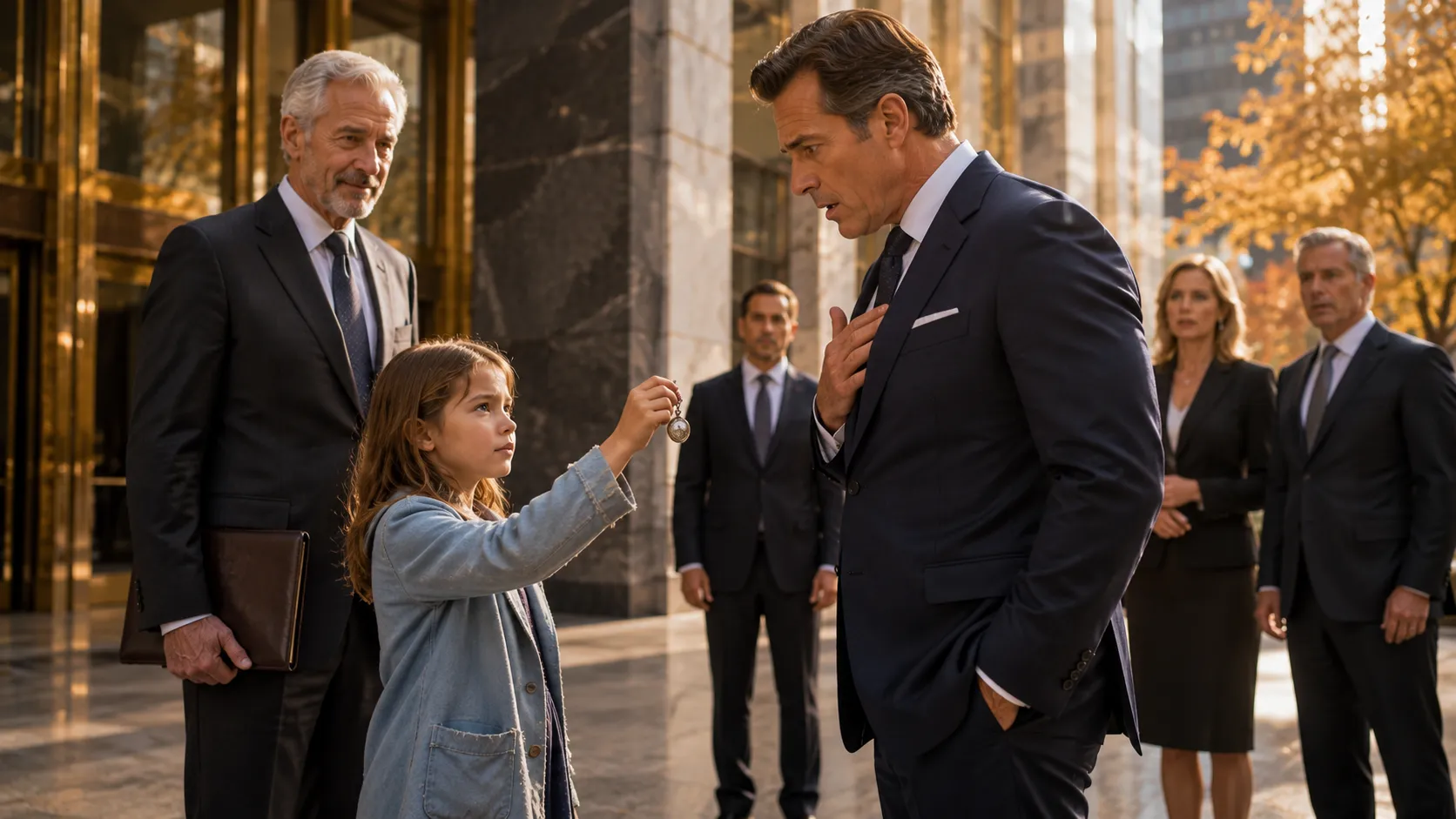
Richard Harrington laughed when an eight-year-old girl stood outside his skyscraper and said the company belonged to her. Then she lifted the pendant he had once given her mother — and the empire he built suddenly felt smaller than the child he never knew.
Richard Harrington believed he had earned everything.
The glass tower. The private elevators. The billion-dollar company with his name across the entrance. The executives who followed him like shadows.
At fifty-two, Richard had trained himself to look untouchable.
Then a little girl appeared on the marble steps of Harrington Global Holdings.
She was eight years old, wearing dusty shoes and a faded blue coat. Beside her stood a quiet man in a dark suit, watching without speaking.
Security moved toward them, but Richard raised one hand.
“What is this?” he asked coldly.
The girl looked straight at him.
“This company belongs to me.”
The executives laughed.
Richard almost laughed too.
“And what makes you believe that?”
The girl reached beneath her collar and lifted a small silver pendant into the sunlight.
Richard’s smile vanished.
He knew that pendant.
Years earlier, before the tower, before the private jets, before people called him a genius, there had been Emily Carter. She had believed in him when he had nothing but debt, ambition, and impossible plans.
On their last night together, Richard had given her that pendant.
“One day,” he told her, “everything I build will be because you believed first.”
Then success came.
Investors.
Travel.
Pressure.
Pride.
Richard told himself Emily deserved better than a man consumed by work. Then he told himself she had moved on. Then he stopped calling because silence became easier than guilt.
Now the pendant hung around a child’s neck.
“You gave this to my mother,” the girl said. “She said it was the only promise you ever kept.”
Richard’s voice changed.
“What was your mother’s name?”
“Emily Carter.”
The tower seemed to tilt beneath him.
The man beside the girl finally spoke.
“My name is David Cole. I was Emily’s attorney.”
Richard turned slowly. “Was?”
David’s expression hardened.
“She died six months ago.”
The words struck harder than any accusation.
The girl did not cry. That somehow made it worse.
“My name is Ava,” she said. “My mother told me you were my father.”
The executives went silent.
Richard stared at her face properly for the first time.
The shape of her eyes.
The stubborn lift of her chin.
The calm way she stood before powerful people and refused to shrink.
He saw Emily.
Then he saw himself.
“Why didn’t she tell me?” he whispered.
David opened a leather folder.
“She tried.”
Inside were letters. Dozens of them. Some returned unopened. Some sent to old offices. Some blocked by assistants who thought they were protecting Richard from distractions.
Then David placed one final envelope in Richard’s hand.
Emily’s handwriting.
Richard opened it with trembling fingers.
If Ava ever comes to you, do not give her money first. Give her truth. Tell her whether the man I loved still exists beneath the empire.
Richard could not finish reading.
Ava watched him carefully.
“I didn’t come to take your company,” she said. “I came because Mom said I should know who my father is at least once.”
For the first time in years, Richard had no speech prepared.
No strategy.
No command.
No clean answer.
Only shame.
He turned toward his executives.
“Cancel everything.”
One of them blinked. “Sir, the Chicago investors are already upstairs.”
Richard looked at the glass tower behind him, then back at the little girl standing on the steps.
“Let them wait.”
That afternoon, Richard sat with Ava in his private office. At first, she answered every question like a child who had learned not to expect too much. Yes, she liked drawing. No, she had never been inside a building this tall. Yes, her mother spoke about him sometimes.
“Was she angry?” Richard asked.
Ava thought for a moment.
“No. Sad.”
That answer hurt more.
Over the next weeks, Richard learned what ambition had cost him. Emily had raised Ava alone while working as a school librarian. She never used his name for attention. Never asked for money. Never allowed bitterness to become the child’s inheritance.
“She said you were not a bad man,” Ava told him one evening. “Just lost.”
Richard looked out over the city he had spent his life trying to conquer.
“I was.”
Ava touched the pendant.
“Are you still?”
He had no right to answer quickly.
So he answered with time.
He came to parent meetings. He learned how Ava liked her pancakes. He visited Emily’s grave and apologized without cameras, lawyers, or speeches. He created a trust for Ava, but more importantly, he kept showing up when there was nothing public to gain.
Months later, Ava stood again in front of Harrington Global Holdings.
This time, Richard stood beside her.
A reporter asked if she would inherit the company.
Ava looked up at him.
Richard smiled softly.
“She already gave me something more difficult to manage.”
“What’s that?” the reporter asked.
Richard placed one hand over his heart.
“A second chance.”
The tower still carried his name.
But from that day forward, it no longer felt like the largest thing he had built.
Because an eight-year-old girl with dusty shoes had walked up the marble steps and reminded him that an empire means nothing if it costs you the people who once believed in you.


