
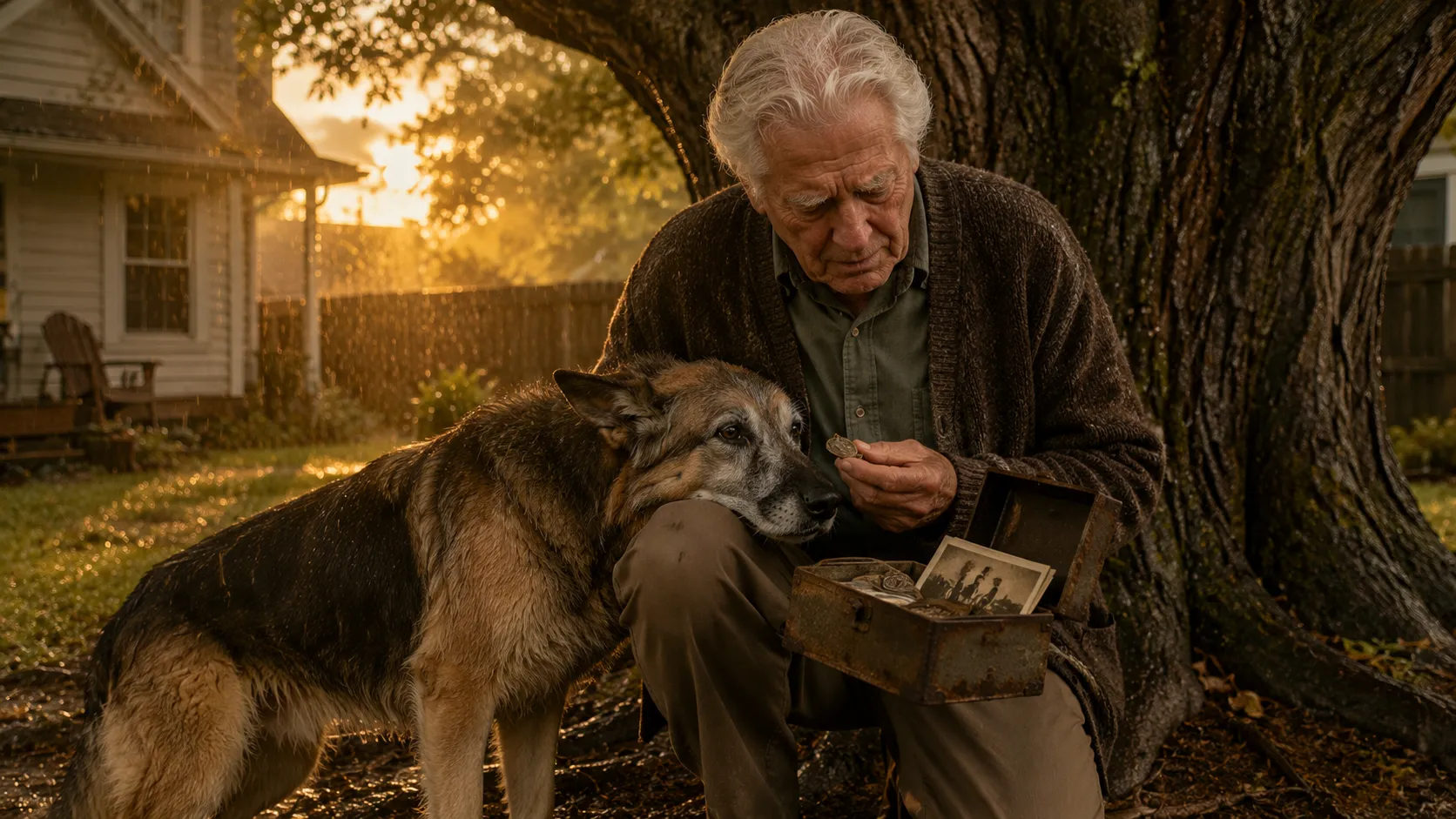
Everyone thought Henry was wasting his last dollars on a blind old dog no one wanted. But that night, Shadow began digging beneath the oak tree — and uncovered a memory Henry’s heart had been waiting years to find.
Henry Parker walked into the county animal shelter with five dollars folded in his trembling hand.
He was seventy-eight years old, thin from age, slow from grief, and alone in a way that made even polite neighbors lower their voices when they spoke about him. Since his wife, May, died five winters earlier, Henry’s little Ohio house had become too quiet.
Same porch chair.
Same empty kitchen.
Same second coffee cup he could never bring himself to throw away.
“I heard you have an old dog,” Henry told the young shelter worker. “The one nobody wants.”
The girl looked uncomfortable.
“You mean Sam. He’s a German Shepherd, but he’s very old. Nearly blind. Bad hips. He may not have much time.”
Henry nodded.
“Neither do I.”
When they opened the kennel gate, the dog did not bark. He limped forward, gray around the muzzle, ribs showing beneath tired fur, and rested his head against Henry’s knee.
The shelter worker’s eyes filled.
“He hasn’t gone to anyone like that.”
Henry placed the five-dollar bill on the counter.
“Then I suppose he already chose.”
He renamed the dog Shadow.
At first, people thought it was foolish. Why would an old man living on a pension take home a dying dog? Why spend his last years cleaning muddy paws, buying medicine, and walking slowly beside a creature that could barely see?
But Henry did not care.
Shadow gave the house a sound again.
The click of nails on the floor.
The sigh of a dog settling near the chair.
The soft breathing at night that reminded Henry he was not the only living thing beneath the roof.
They moved through life at the same pace.
Henry cooked simple meals. Shadow waited by the stove. Henry sat on the porch at sunset. Shadow lay at his feet. Sometimes Henry spoke to him as if he were speaking to May.
“You would’ve liked him,” he whispered one evening. “Stubborn. Gentle. Sleeps like an old man after church.”
Shadow lifted his head and wagged his tail once.
Then came the storm.
The sky turned black before dinner. Wind bent the trees. Thunder rolled over the fields, and rain began hitting the windows like thrown gravel.
“Come inside, Shadow,” Henry called from the porch.
But the dog stood beneath the old oak tree in the yard.
He was staring at the ground.
“Shadow,” Henry called again. “You’ll catch your death out there.”
The dog ignored him.
Then he began to dig.
His old paws tore at the wet dirt with a desperation Henry had never seen. Mud flew behind him. His breath came hard. Lightning flashed, and for one strange second, Henry saw the dog as something younger, stronger, almost guided by a purpose he could not explain.
Henry grabbed his cane and hurried into the rain.
“What are you doing, boy?”
Shadow kept digging until his claws struck metal.
Henry knelt, his knees aching, and brushed mud from a small rusted box buried beneath the oak roots. His hands shook as he opened it.
Inside was a photograph.
Henry and May.
Forty years younger, standing under that same oak tree on the day they bought the house. May was laughing, her head tipped against his shoulder, her hand pressed to his chest as if she had just told him something sweet and secret.
Beneath the photograph was a small brass tag.
To my Henry — when you forget where love went, look where it began.
Until we meet again, May.
Henry’s breath broke.
He remembered now.
May had buried that box during their first summer in the house. She had told him it was “for someday,” and he had laughed because someday felt too far away to matter.
Then life happened.
Work.
Bills.
Illness.
Funerals.
Silence.
He had forgotten.
Shadow pressed his wet head against Henry’s knee.
For the first time in years, Henry cried without trying to stop himself.
That night, he sat on the porch with the rusted box in his lap and Shadow resting beside him. Rain washed over the steps, but Henry did not feel cold.
He felt found.
The next morning, he opened the back door and called for Shadow.
No answer.
The dog’s bed was empty.
Panic tightened Henry’s chest. He followed faint paw prints through the wet yard, down the lane, and up the hill toward the cemetery.
There, beside May’s headstone, Shadow lay still.
Between his paws was a single yellow wildflower.
Henry lowered himself to the ground and gathered the old dog into his arms.
“Oh, Shadow,” he whispered. “You brought me back to her.”
The town heard what happened before noon.
By evening, neighbors came quietly to Henry’s house. No one knew what to say, so they brought soup, coffee, blankets, and silence. The shelter worker came too, crying when Henry told her where Shadow had been found.
“You gave him a home,” she said.
Henry looked at the rusted box on the table.
“No,” he answered softly. “He gave me one back.”
After that, Henry changed.
Not loudly. Not all at once.
But he opened the curtains again. He sat on the porch and waved at children passing by. He visited May’s grave every Sunday, placing one flower for her and one for Shadow.
Months later, Henry passed away peacefully in his chair by the window.
Neighbors found the rusted box in his lap.
Beside it were two collars.
One read Shadow.
The other was May’s old bracelet, tied carefully through the ring.
Some people said Henry saved a dying dog.
But the town knew better.
Shadow had come into that quiet house with cloudy eyes, weak legs, and almost no time left.
And somehow, before he left, he gave an old man the one thing grief had stolen from him.
A way home.


