
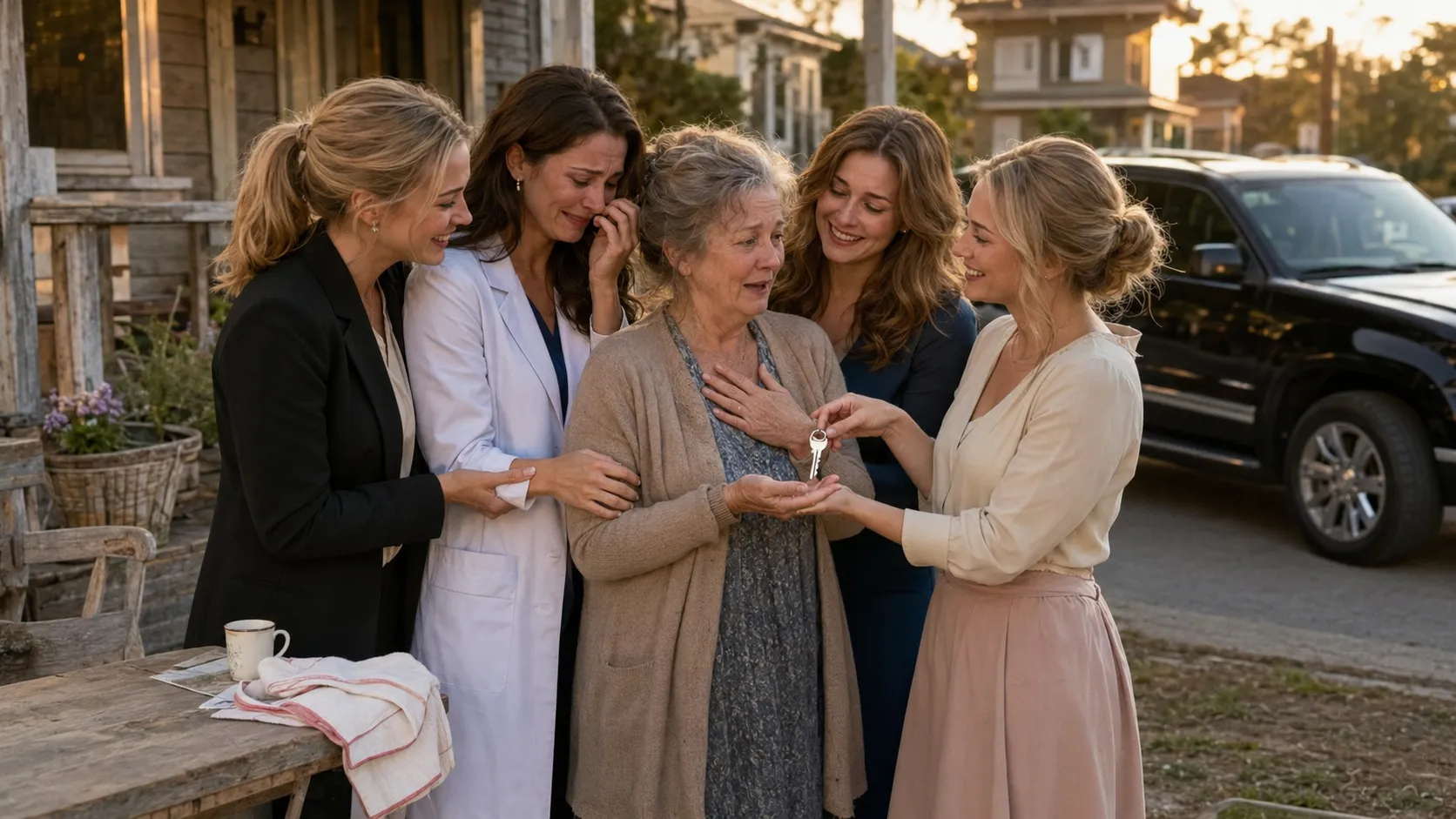
Emily had almost nothing, but she still fed four little girls standing hungry in the rain. Years later, the same girls returned in a black SUV to repay the woman who had become their mother when the world looked away.
The first time Emily Parker saw the four girls, they were standing outside the diner window in the rain.
It was almost closing time. The booths were empty, the floor was sticky from a long shift, and Emily’s feet hurt so badly she could barely stand. She had thirty-seven dollars in tips in her apron pocket and an overdue rent notice waiting at home.
Then she looked through the glass.
Four little girls stood beneath the broken awning, soaked to the bone. Their clothes were thin, their shoes were worn, and their faces carried the quiet exhaustion of children who had already learned not to expect help.
Emily stepped outside.
“Sweethearts,” she said gently, “where are your parents?”
The oldest girl held the youngest one’s hand tighter.
“We don’t have any,” she whispered. “We were told to leave the shelter.”
Emily felt something inside her break.
The youngest girl looked past Emily at the warm lights inside the diner.
“We don’t have money,” she said quickly. “We were just looking.”
Emily opened the door wider.
“Then tonight you don’t need money.”
The girls hesitated until Emily smiled.
“Come inside. You’re safe here.”
She sat them in the corner booth and brought four plates of hot food: soup, bread, mashed potatoes, and chicken from the kitchen leftovers. The girls ate slowly at first, then desperately, as if afraid someone might take the plates away.
Her manager, Carl, saw them and frowned.
“Emily,” he snapped, “who’s paying for that?”
“I am.”
“You barely pay your own bills.”
She placed her tips on the counter.
“Then I’ll be poor with a clean conscience.”
Carl shook his head. “You can’t save every stray child who comes to the window.”
Emily looked at the four girls huddled over their plates.
“No,” she said. “But I can save dinner for these four.”
That night changed her life.
Their names were Anna, Lily, Grace, and Sophie. They had lost their mother, then their aunt, then the last adult who had promised to keep them together. Emily reported everything properly, spoke to social workers, churches, and neighbors, and did the only thing she knew how to do: she kept showing up.
After long shifts, she brought food. On Sundays, she washed their clothes. When school started, she bought notebooks from the discount bin and taught them multiplication at her tiny kitchen table.
The girls began calling her Mama Emily.
People talked.
Some said she was foolish. Some said she was wasting her life on children who were not hers. Carl said she would never get ahead if she kept giving away everything she earned.
Maybe he was right.
Emily skipped meals so the girls could eat. She stitched their torn coats by lamplight. She spent birthday nights baking small cakes in a kitchen where the oven only worked when it wanted to.
But every time one of the girls fell asleep with a full stomach, Emily felt rich in a way no bank could measure.
Years passed.
The girls grew taller. They studied hard. They won scholarships, found part-time jobs, moved away one by one, and promised they would come back. Emily smiled each time, but after the last one left, her little house felt painfully quiet.
She was older now. Her hands ached. The diner had closed. The landlord had raised rent twice. Some evenings, Emily sat on her porch with tea and wondered if love was supposed to leave such a silence behind.
Then one afternoon, a black SUV turned onto her street.
Emily stiffened.
Cars like that never stopped in front of her weathered house.
The driver opened the doors, and four elegant young women stepped out.
For a moment, Emily did not understand.
Then the tallest one smiled through tears.
“Mama Emily.”
The teacup slipped from Emily’s hand.
Anna, Lily, Grace, and Sophie ran up the porch steps and wrapped their arms around her. Emily sobbed so hard she could not speak.
“Look at you,” she whispered. “My girls… look at you.”
Anna was a lawyer. Lily was a doctor. Grace had built a food program for homeless children. Sophie owned a small chain of bakeries that hired women starting over.
“We became this because of you,” Grace said.
Emily shook her head. “No, no. I only gave you dinner.”
Lily took her hand.
“You gave us a place in the world.”
Then Sophie placed a small silver key in Emily’s palm.
Emily stared at it.
“What is this?”
Anna pointed to the SUV. “First, that car is yours.”
Emily gasped.
“And second,” Lily said softly, “we bought you a home.”
Emily covered her mouth.
“No. I can’t accept that.”
Grace knelt in front of her, the way Emily had once knelt in the rain.
“You went hungry so we could eat. You worked until your hands shook. You loved us when nobody was watching. Please let us love you back.”
They drove her to a small house with a garden, sunlight in the windows, and a kitchen big enough for a family table.
Emily stood in the doorway, crying.
That evening, the four women cooked dinner while Emily sat at the table for once, not serving, not rushing, not worrying.
Before they ate, Sophie raised a glass of water.
“To the woman who taught us that kindness is never wasted.”
Emily looked at the faces around her and finally understood.
All those years, she thought she had been giving away pieces of her life.
But love had been growing quietly in four hearts.
And now it had come home.


