
When I found my little daughter standing outside in the dark with a suitcase, I thought something terrible had happened inside our home. But the truth she finally told me became the parenting lesson I will never forget.
When I pulled into the driveway that evening, the house was too quiet.
After ten hours at the plant, I expected cartoons from the living room, toys on the floor, and my four-year-old daughter running to the door with some urgent story only she understood.
Instead, Lily was standing alone on the porch.
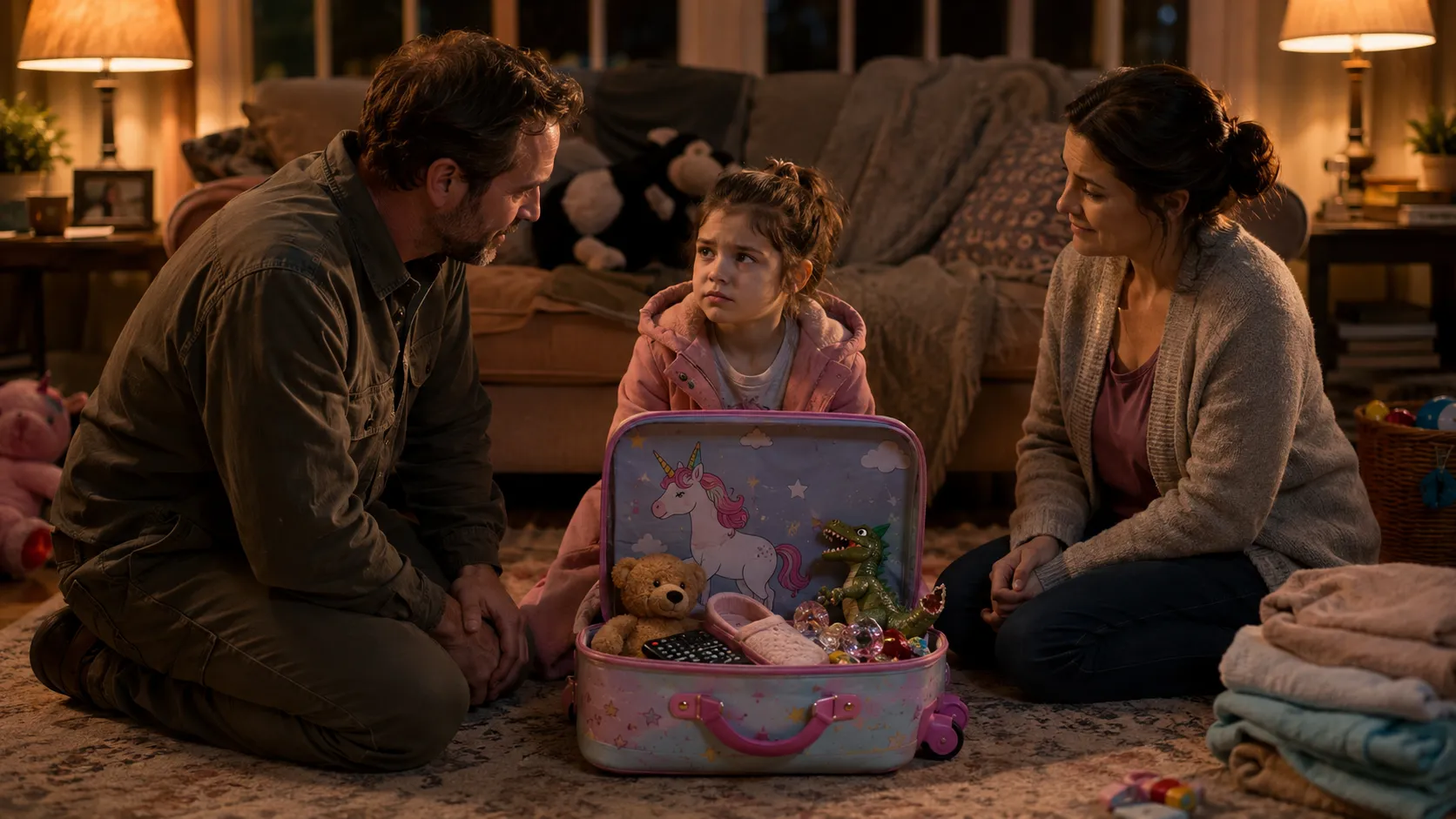
She wore her pink coat zipped to her chin, her little backpack stuffed full, and beside her was the unicorn suitcase we only used for vacations. Her cheeks were wet. Her eyes were red. But she was not crying anymore.
She looked decided.
I jumped out of the truck.
“Lily? Sweetheart, what are you doing?”
She gripped the suitcase handle with both hands.
“Daddy,” she whispered, “I’m leaving.”
The words hit me so hard I forgot how to breathe.
“What do you mean you’re leaving?”
“I can’t live here anymore.”
I looked toward the closed front door. My wife, Sarah, was inside. The woman I trusted more than anyone. The woman I had left our daughter with every day while I worked long shifts.
“What happened?” I asked, trying to keep my voice steady.
Lily leaned close, as if the house itself might hear her.
“I can’t live with your wife anymore.”
Your wife.
Not Mommy.
Not Mom.
My blood turned cold.
“What did she do?”
Lily’s face crumpled.
“She’s a monster,” she cried. “She won’t let me live.”
I picked her up, suitcase and all, and carried her to the truck. My mind filled with terrible thoughts. Had I missed something? Had stress broken Sarah in some way I had refused to see? Had my daughter been trying to tell me something for weeks?
I drove two blocks before I realized I had not asked the most important question calmly enough.
So I pulled into the empty church parking lot, turned off the engine, and faced my little girl.
“Lily,” I said softly, “Daddy is listening now. Tell me exactly what happened.”
She sniffed, opened her backpack, and began unloading evidence.
Her teddy bear.
Three shiny rocks.
A half-eaten bag of candy.
The TV remote.
One slipper.
And a plastic dinosaur with no tail.
I stared at the pile.
“Baby… where are your clothes?”
She looked offended.
“I don’t need clothes. I need important things.”
That was the first crack in my fear.
Then she told me the crime.
Sarah had made her pick up her toys before dinner. She had thrown away a candy wrapper Lily wanted to keep. She had said no more cartoons until the blocks were back in the basket.
And worst of all, she had asked Lily to fold two tiny towels.
“To live like that,” Lily said with trembling dignity, “is not fair.”
For a long moment, I sat in silence.
Then I covered my face with one hand.
Nothing terrible had happened.
Nothing cruel.
No hidden danger. No monster.
Only a tired four-year-old who had been asked to do chores and had translated frustration into escape.
But my relief did not turn into laughter right away.
Because I realized something that made me ashamed.
I had believed the panic before I listened to the child.
Not because I was foolish. Because I loved her. Because every parent carries one secret fear: that something could happen while we are not there.
So I drove home slower than I had left.
Sarah opened the door before we reached the porch. Her face was pale.
“I turned around and she was gone,” she said. “I was about to call you.”
Lily hid behind my leg with the seriousness of a woman returning from exile.
Sarah knelt.
“Lily, you scared me.”
“You made me clean.”
Sarah blinked.
I cleared my throat. “Apparently, this was a human rights issue.”
For one second, Sarah looked like she might cry.
Then she laughed.
Not because it was funny.
Because the fear had finally loosened its grip.
We sat on the living room floor and unpacked the suitcase together. Lily explained why every item mattered. The rocks were treasure. The teddy was family. The remote was “for freedom.” The dinosaur, apparently, was brave enough to come with her.
Then Sarah explained something too.
“Cleaning your toys doesn’t mean Mommy doesn’t love you,” she said. “It means we take care of our home together.”
Lily thought about that.
“Can I be mad and still live here?”
I nearly broke at the question.
I pulled her into my arms.
“Yes,” I whispered. “You can be mad. You can be sad. You can tell us anything. But you don’t have to leave.”
That night, Lily fell asleep between us on the couch, one hand still holding the suitcase handle.
The next morning, we made a new rule in our house.
No one runs away with a suitcase before talking.
And the adults have a rule too.
No one panics before listening.
Years later, the little unicorn suitcase still sits in the top of Lily’s closet. Sometimes we joke about the night she tried to leave home over folded towels and a candy wrapper.
But I never laugh too hard.
Because that night taught me something I needed to learn.
Children do not always tell the truth in adult words.
Sometimes fear sounds like drama.
Sometimes frustration sounds like danger.
Sometimes a child says “monster” when she means “I feel small, angry, and misunderstood.”
And sometimes the best thing a parent can do is not rush toward the worst story.
It is kneel down, breathe, and ask gently:
“Tell me what you mean.”


